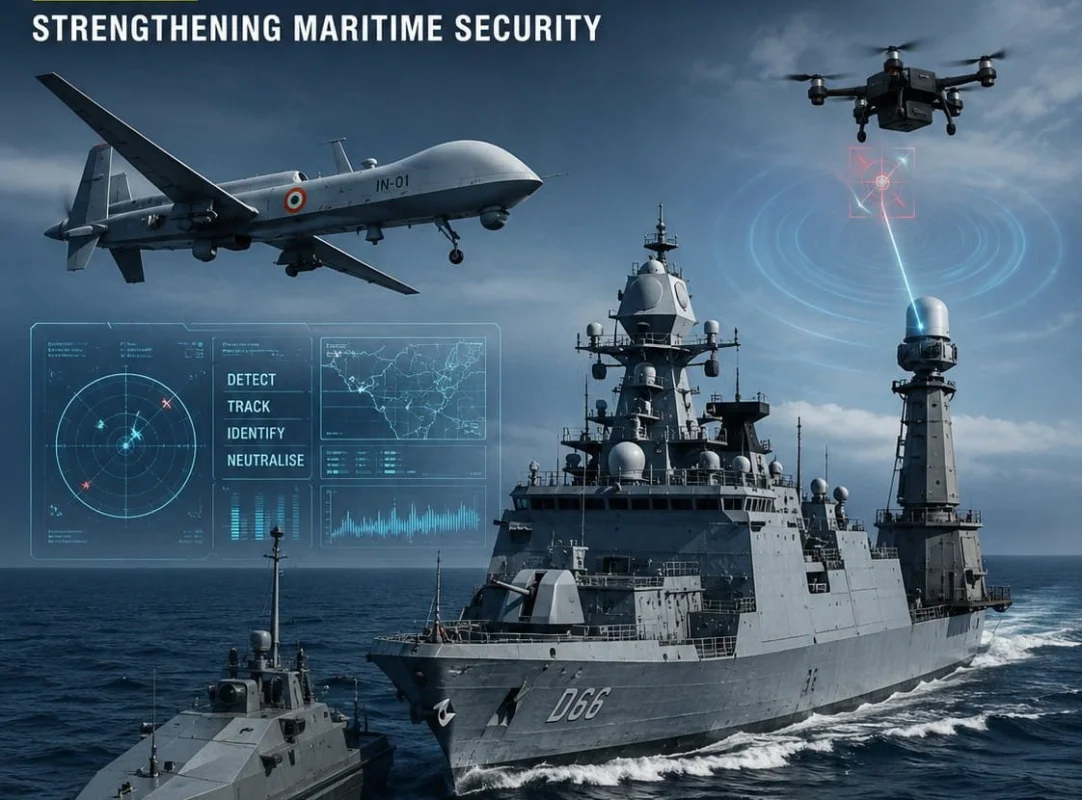
The Indian Navy is actively accelerating the comprehensive upgrade of its unmanned systems and counter-drone networks to maintain firm maritime dominance across the strategically vital Indian Ocean Region (IOR). By integrating a multi-layered security grid composed of compact tactical drones, shipborne aerial vehicles, long-range aircraft, and cutting-edge anti-drone weaponry, the maritime force is seamlessly fusing wide-area ocean surveillance with rapid-reaction and hard-kill destruction capabilities.
For close-quarter operations and high-stakes ship boarding tasks, naval commandos now deploy highly agile, portable spotter drones. These compact devices provide immediate, real-time visual reconnaissance during sea interceptions, allowing sailors to safely evaluate potential risks before stepping onto suspicious vessels.

To extend the tracking range of moving naval platforms, the procurement of advanced Naval Shipborne Unmanned Aerial Systems (NSUAS) is moving forward rapidly. Backed by recent major approvals from the Defence Acquisition Council, these platforms take off directly from warship decks to serve as airborne scouts, effectively pushing the fleet’s sensor range far beyond the horizon and providing crucial early warnings against incoming dangers.
On a broader scale, the Navy is expanding its wide-area surveillance capabilities through the induction of indigenous Medium Altitude Long Endurance (MALE) remotely piloted aircraft, highlighted by the Drishti 10 Starliner. Capable of flying continuously for over 36 hours with advanced radar and optronic sensor payloads, these long-range aircraft allow for marathon intelligence-gathering missions across vast oceanic expanses.

Defensively, the force is actively countering the threat of hostile, low-cost drones by deploying the DRDO-developed Naval Anti-Drone System (NADS) across mobile and ship-mounted networks. This architecture relies on a combination of soft-kill tactics, which use electronic warfare to jam or spoof a target’s navigation links, and hard-kill mechanisms, which utilize laser-based directed energy or kinetic weapons to physically destroy incoming threats.
To reinforce these technological upgrades, specialized counter-drone Rapid Response Teams have been established. These highly trained units are dedicated exclusively to spotting, tracking, and neutralizing rogue aerial threats, ensuring that vital warships, strategic coastlines, and maritime assets remain completely secured against unconventional modern warfare.







 ---------------------------------------------------------------------------------------------------