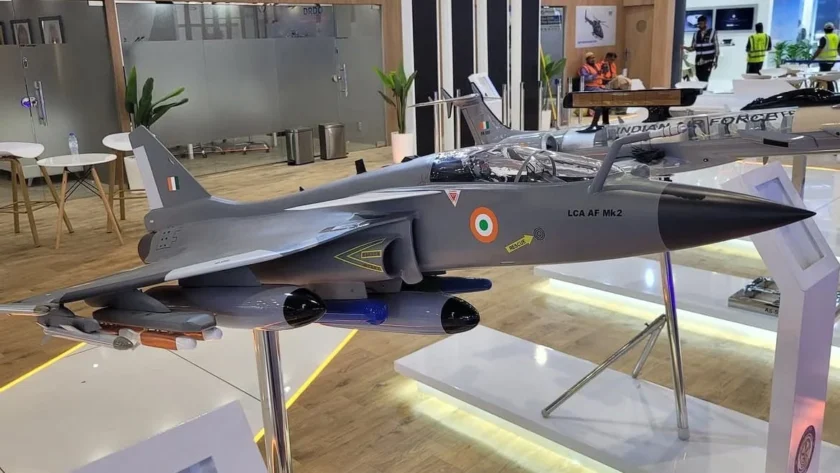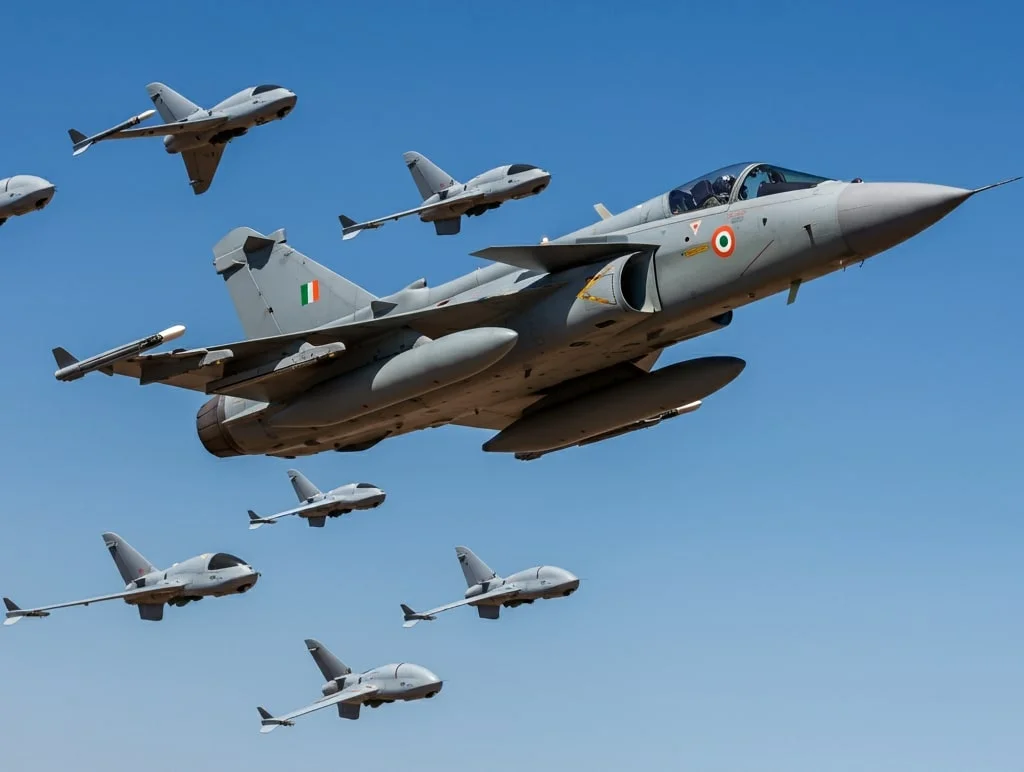
New Delhi: The HAL Tejas Mk1A is increasingly being viewed not only as an upgraded light fighter, but also as a potential early platform for India’s evolving manned–unmanned teaming (MUM-T) doctrine, where piloted aircraft operate in coordination with autonomous drones.
While attention around the Mk1A often centres on its improved radar systems, electronic warfare suite, and weapons capability, its deeper strategic value may lie in its ability to act as an airborne coordination hub for networked combat operations.

Shift Toward Networked Air Combat
Modern air warfare is steadily moving toward integrated systems in which fighter aircraft no longer operate in isolation. Instead, they function as command nodes that manage drones for surveillance, strike missions, and electronic warfare tasks.
Countries including the United States, China, Russia, and others are actively developing such concepts, where human pilots guide multiple autonomous platforms in real time.
Why Tejas Mk1A Fits Early Adoption
Although India’s future Advanced Medium Combat Aircraft is expected to serve as a more advanced drone-control platform, the Tejas Mk1A may be able to take on an early version of this role sooner due to its design flexibility.
Its open-architecture systems and full domestic control over software and communications allow greater freedom for upgrades compared to imported aircraft platforms, where integration is often restricted by external vendors.
Enabling Software-Driven Warfare
The ability to independently modify mission systems gives the Tejas Mk1A a key advantage in developing future combat capabilities. It allows integration of artificial intelligence tools, secure datalinks, and evolving mission software without external constraints.
This makes it a practical platform for testing early versions of drone coordination and network-centric warfare systems.
Developing Airborne Coordination Capability
Hindustan Aeronautics Limited (HAL) is reportedly working on interface systems designed to support manned–unmanned teaming, enabling twin-seat variants of the Tejas Mk1A to function as control hubs for drones.

In such a configuration, the aircraft could coordinate multiple unmanned platforms performing roles such as reconnaissance, electronic warfare, decoy operations, and precision strikes.
Expanding Role of Loyal Wingman Systems
India’s emerging ecosystem of loyal wingman drones is expected to include a variety of specialised unmanned systems designed to accompany fighter aircraft into contested airspace.
These could include surveillance drones for deep reconnaissance, jamming platforms for electronic warfare, decoys to confuse enemy air defences, and strike UAVs capable of engaging targets without risking pilots.
Supporting Indigenous Development Efforts
Programs such as the Combat Air Teaming System (CATS) and ongoing research by the Defence Research and Development Organisation are laying the technological foundation for autonomous flight, swarm coordination, and AI-driven targeting systems.
Together, these developments are expected to support the transition toward fully networked aerial combat systems.
Toward a Network-Centric Battlefield
Future aerial conflicts are expected to depend less on individual platforms and more on integrated networks combining fighters, drones, sensors, and ground systems.
In such scenarios, Tejas Mk1A formations could operate as distributed nodes within a larger combat network, sharing intelligence, coordinating strikes, and guiding unmanned assets while remaining at safer distances from high-threat zones.
The Tejas Mk1A represents an important step in India’s evolution toward networked and AI-assisted air combat. While not originally designed as a drone command platform, its flexibility and indigenous architecture may allow it to play a foundational role in developing manned–unmanned teaming capabilities ahead of more advanced future fighters.







 ---------------------------------------------------------------------------------------------------