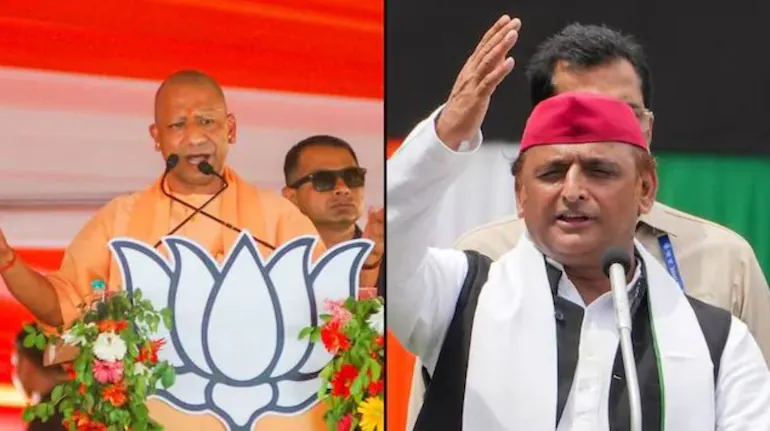
Lucknow: A fierce political battle over women’s welfare and safety is unfolding in Uttar Pradesh, with Akhilesh Yadav stepping up efforts to attract female voters, a segment long seen as a stronghold of Bharatiya Janata Party under the leadership of Chief Minister Yogi Adityanath.
The renewed push comes as the Samajwadi Party attempts to rebuild its image among women voters, many of whom were perceived to have distanced themselves during the party’s previous tenure. The BJP’s decisive victory in the 2017 Assembly elections was, in part, attributed to concerns over women’s safety during the earlier SP government—an issue that continues to shape political narratives today.
At a recent women’s felicitation event held at the SP headquarters in Lucknow, Akhilesh Yadav unveiled a major electoral promise: the proposed Nari Samriddhi Samman Yojana. Under this scheme, if voted to power in 2027, the party plans to provide ₹40,000 annually to women from economically weaker families through direct bank transfers. He also announced the revival of the Samajwadi pension scheme in an updated form, positioning these initiatives as central to the party’s new election strategy.
Akhilesh has expanded his earlier PDA (Backward, Dalit, Minority) formula by adding “A” for Aadhi Aabadi (women), signaling a deliberate shift toward a broader social coalition. Highlighting past initiatives such as the 1090 women’s helpline and schemes for girls’ education, he asserted that the SP has always been committed to women’s empowerment, dignity, and rights.
However, critics argue that the party faces an uphill task in overcoming its past image. The BJP has been quick to counter Akhilesh’s claims, with senior leaders accusing the SP of presiding over an era marked by insecurity for women. Deputy Chief Minister Keshav Prasad Maurya stated that women voters have consistently rejected the SP in successive elections, while Brajesh Pathak launched a sharp attack, recalling law-and-order concerns from the previous SP regime.
The BJP, on its part, continues to highlight measures such as stricter policing, initiatives like anti-Romeo squads, and its broader law-and-order narrative, claiming these have contributed to a greater sense of security among women in the state.

Akhilesh, however, has pushed back, alleging that incidents of crimes against women are rising under the current administration and accusing authorities of political misuse of law enforcement. He stressed that financial assistance must go hand-in-hand with a secure environment, arguing that his proposed scheme aims to address both economic and social vulnerabilities.
The political significance of women voters in Uttar Pradesh cannot be overstated. Often described as a निर्णायक (decisive) voting bloc, their preferences have shaped electoral outcomes across multiple elections. Drawing parallels with states like Bihar, where direct financial assistance schemes for women influenced voter behavior, the SP hopes its cash-transfer model will resonate with voters in UP as well.
Yet, questions remain over the feasibility of such promises. With millions of potential beneficiaries, the financial burden on the state exchequer could be substantial. At the same time, analysts note that economic incentives alone may not suffice—issues of safety, dignity, education, and long-term empowerment are equally critical for women voters.
The evolving contest between the SP and BJP underscores a larger shift in Uttar Pradesh politics, where women are no longer just participants but central to electoral strategy. While the SP seeks to reinvent itself through welfare promises and outreach, the BJP is banking on its governance record and law-and-order credentials.