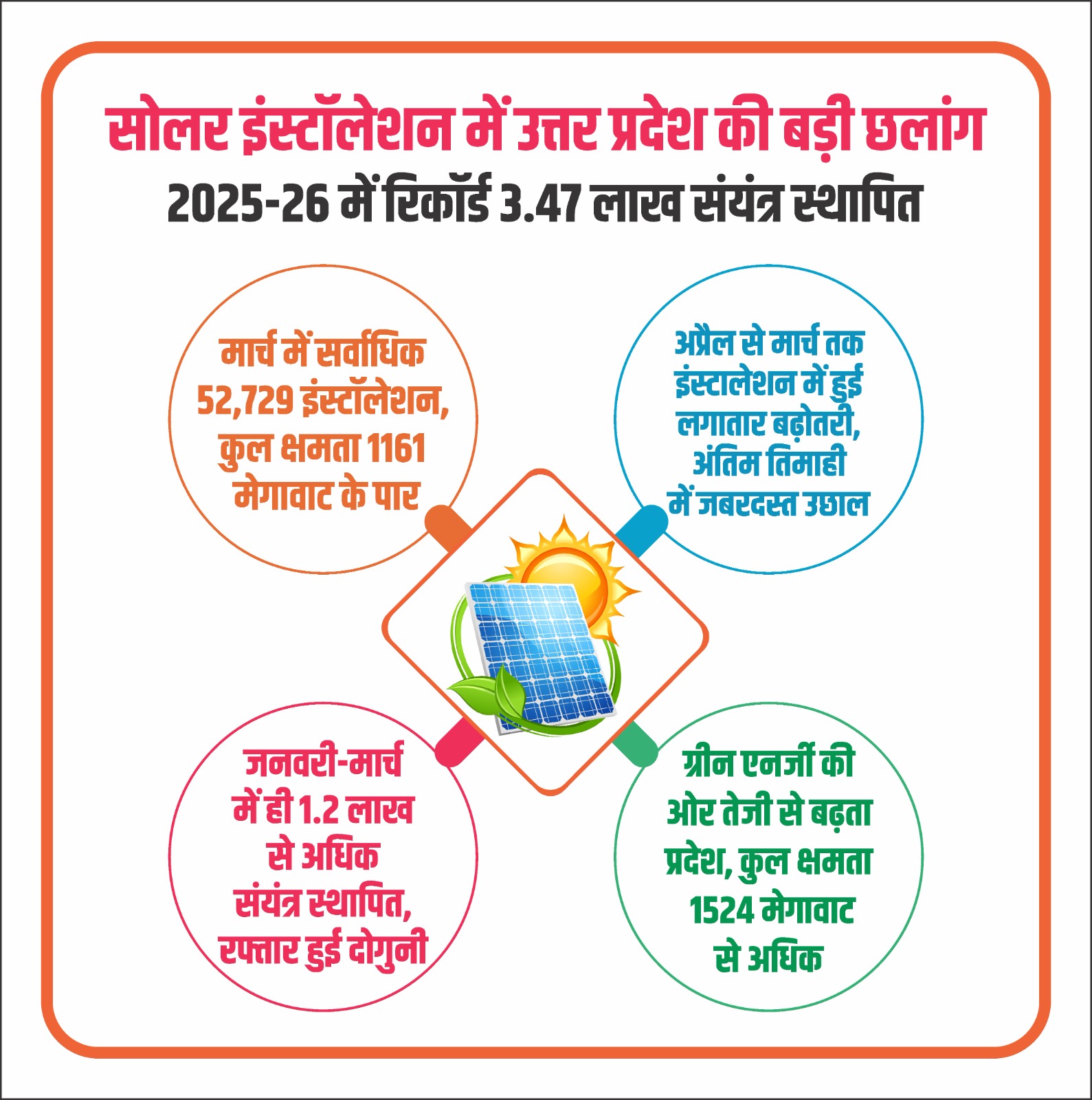
- Highest monthly installations of 52,729 recorded in March, total capacity crosses 1,161 MW
- Steady rise in installations from April to March, sharp surge in the final quarter
- State rapidly moving toward green energy, total capacity now exceeds 1,524 MW
Lucknow: Uttar Pradesh has achieved a significant milestone in the solar energy sector during the financial year 2025-26, installing a record 3,47,729 rooftop solar plants. During this period, the state’s total installed capacity reached 1,161.756 megawatts, reflecting the rapid progress toward green energy.
Looking at the monthly figures, installations began with 15,836 units in April 2025, which increased to 18,509 in May and 18,494 in June. From July, a sharp rise was observed with 29,850 installations, pushing the capacity beyond 100 MW. This momentum continued in August and September, while a slight dip was seen in October before the pace picked up again in November and December. Installations stood at 30,894 in November and 31,164 in December.

The real surge was witnessed in the last three months of the financial year. In January 2026, 33,314 installations were recorded, followed by 35,804 in February, and a record 52,729 installations in March, the highest monthly figure of the year. In March alone, 173.84 MW of capacity was added, marking the largest increase ever in a single month.
UPNEDA Director Inderjeet Singh said, “The strong growth in the final quarter is the result of the government’s effective policies, subsidy schemes, and robust implementation at the grassroots level. This has not only increased energy generation but also ensured affordable and clean electricity for consumers.”

With this achievement, Uttar Pradesh is rapidly emerging as one of the leading states in the solar energy sector in India. The state has also become No. 1 in the PM Surya Ghar: Muft Bijli Yojana.
Overall, 4,48,233 rooftop solar installations have been set up in Uttar Pradesh so far, generating around 1,524 MW of electricity daily. The continuously rising installation rate indicates that the state is likely to achieve its goals of green energy expansion and energy self-reliance even faster in the coming years.