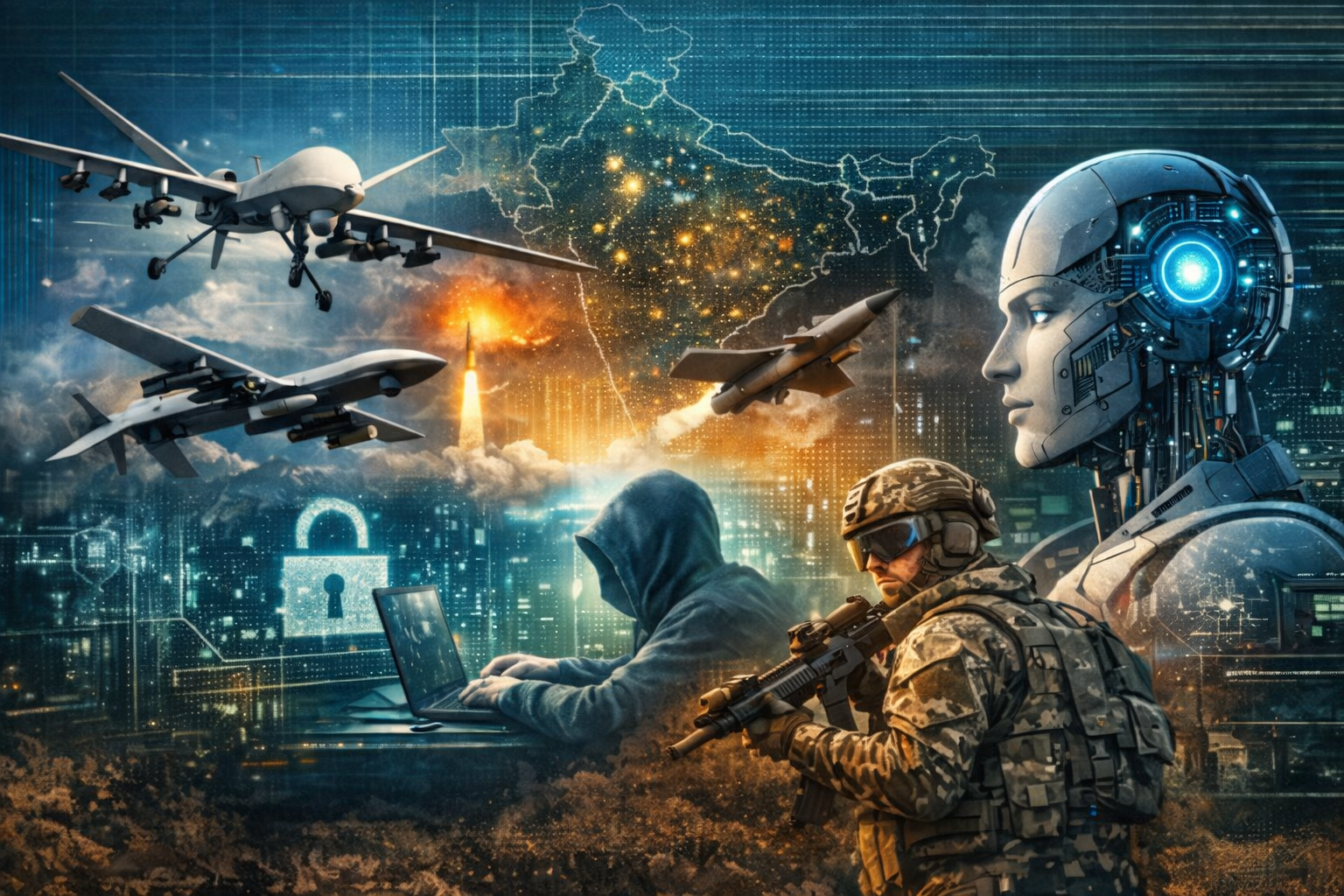
New Delhi: South Asia, particularly India, is undergoing a profound transformation in military doctrine driven by rapid advances in defence technology. Unmanned aerial systems, cyber defence infrastructure and artificial intelligence are fundamentally altering how regional powers approach surveillance, deterrence, escalation management and force modernisation.
The shift represents more than technological adoption. It reflects a strategic transition from traditional platform-centric warfare toward network-centric military ecosystems built around data integration, automation and digital resilience. In a region defined by contested borders, nuclear deterrence frameworks and persistent grey-zone activities, emerging technologies are becoming central to military planning.

South Asia’s evolving security environment—marked by tensions between India and Pakistan, maritime competition in the Arabian Sea and the Bay of Bengal, and complex hybrid threats—has accelerated investment in next-generation capabilities. Rather than merely expanding troop numbers, militaries are prioritising systems that enhance situational awareness, compress decision-making timelines and enable precision engagement across land, air, cyber and maritime domains.
Drone Warfare: The Expanding Aerial Battlefield
Unmanned aerial vehicles (UAVs) have become a defining feature of modern military operations in South Asia. Both India and Pakistan are expanding fleets that range from short-range reconnaissance drones to long-endurance strategic surveillance platforms.
India operates indigenous systems such as the Netra and the Rustom series, developed by the Defence Research and Development Organisation (DRDO). These platforms provide tactical reconnaissance, border monitoring and intelligence gathering across challenging terrains including the Himalayas.
India also employs advanced systems such as the MQ‑9 Reaper for long-endurance strategic surveillance and loitering munitions like IAI Harop and IAI Harpy, which combine reconnaissance with strike capability.
Pakistan, meanwhile, has integrated imported armed drones including the Bayraktar TB2 and CAIG Wing Loong II. Tactical systems such as the Warmate further strengthen its strike and surveillance capabilities.
These systems support multiple operational roles including:
- Border reconnaissance
- Maritime surveillance
- Precision strikes
- Suppression of enemy air defences
- Monitoring troop mobilisation
However, despite the growing visibility of armed drones, surveillance remains their primary function in regional doctrine. Persistent intelligence, surveillance and reconnaissance (ISR) coverage enables militaries to track infiltration routes, observe ceasefire lines and maintain awareness across contested zones.
Loitering munitions represent a significant technological evolution. These drones can remain airborne while searching for targets before striking with precision, effectively combining surveillance with attack capability.
Indigenous Innovation and Strategic Procurement
Both India and Pakistan are combining domestic innovation with foreign procurement to expand their UAV capabilities.
India has accelerated indigenous development programmes through the Defence Research and Development Organisation as part of its broader defence self-reliance initiative. Domestic drone production allows systems to be customised for local terrain, operational requirements and security needs.
Pakistan, while developing some indigenous systems, continues to rely more heavily on imports from countries such as China and Turkey to quickly enhance its operational capabilities.
Beyond military utility, drone development has also become part of national industrial strategy. Investments in UAV technologies are closely linked to broader goals of defence autonomy, supply-chain security and technological innovation.
Cyber Defence: The Digital Battlefield
Cyber warfare is emerging as another critical domain of conflict in South Asia. Both India and Pakistan are expanding military cyber units responsible for protecting networks, monitoring threats and developing offensive cyber capabilities.
India has created specialised units known as Command Cyber Operations and Support Wings within the Army. These units focus on safeguarding military communication systems, defending digital infrastructure and responding to cyber threats.
Pakistan’s cyber posture is shaped by institutions linked to its security establishment, including the Inter‑Services Intelligence (ISI) and the Strategic Plans Division, which oversee both defensive and offensive cyber operations.
Cyber capabilities now include:
- Intrusion detection systems
- Cyber forensic infrastructure
- Segmented military networks
- Digital threat monitoring
- Offensive cyber tools
Cyber probing activities during the 2025 India–Pakistan confrontation demonstrated how digital operations are becoming integrated into broader crisis scenarios. Attempts to interfere with communication systems or digital infrastructure highlight the increasing importance of cyber resilience for military readiness.
Artificial Intelligence on the Battlefield
Artificial intelligence is increasingly being integrated into military operations across South Asia, particularly in surveillance, command systems and logistics.
AI-driven surveillance systems can analyse vast amounts of data from drones, satellites and sensors at speeds far beyond human capability. These systems detect behavioural anomalies, classify movement patterns and identify emerging threats across large geographic areas.
Such technologies are particularly valuable in difficult environments like the Himalayan border regions, where terrain and weather complicate traditional surveillance methods.
AI is also being incorporated into command-and-control systems. These platforms integrate information from multiple sources—including satellite imagery, drone feeds and electronic warfare signals—into a unified operational picture. Commanders can then use scenario-modelling tools to simulate possible adversary responses before making strategic decisions.

India has been leading regional adoption of AI-enabled command systems, integrating machine-learning tools to improve situational awareness and accelerate decision cycles. Pakistan is also exploring similar technologies, though at a more limited scale.
AI and Military Logistics
Beyond combat operations, artificial intelligence is transforming military logistics and sustainment.
AI-driven analytics can predict equipment failures, optimise supply routes and anticipate logistical demands. Predictive maintenance systems allow military units to detect mechanical problems before equipment breaks down, improving operational readiness.
In regions with difficult infrastructure or harsh terrain, algorithm-based planning helps ensure that supplies reach frontline units efficiently. These capabilities proved valuable during military deployments in recent regional crises, where AI-assisted logistics helped maintain operational continuity.
Modernisation Challenges and Procurement Pressures
Despite technological momentum, military modernisation in South Asia faces significant financial and institutional challenges.
Advanced defence systems require long-term investments rather than one-time purchases. Costs include software upgrades, cybersecurity improvements, sensor recalibration and specialised training.
India, with a larger defence budget, must still balance spending between traditional platforms and emerging technologies such as cyber infrastructure, AI systems and space-based surveillance.
Pakistan faces sharper trade-offs due to more limited financial resources. Investment in advanced technologies often competes with the need to upgrade existing platforms.
Interoperability also presents challenges. India operates equipment sourced from multiple partners including the United States, Israel and France, requiring complex integration into domestic command networks. Pakistan similarly manages systems acquired from China and Turkey.
Training remains equally critical. Operating AI-enabled systems, cyber platforms and autonomous drones requires highly specialised personnel and continuous skill development.
Strategic Balance and Escalation Risks
Emerging technologies are reshaping the strategic balance between India and Pakistan.
Advanced surveillance systems can reduce uncertainty along contested borders by providing clearer real-time visibility. Improved intelligence and early-warning systems may help prevent miscalculations during crises.
However, these same technologies can also accelerate escalation. AI-enabled targeting, automated decision systems and precision-strike drones shorten response timelines and may increase pressure on commanders to act quickly.
For states operating with technological disadvantages, such pressures may create incentives for pre-emptive responses.
The Next Phase: Autonomous Swarms and AI Warfare
The future of warfare in South Asia may increasingly involve autonomous drone swarms capable of coordinated operations. These systems could overwhelm air defences and dramatically expand reconnaissance coverage.
AI-driven logistics and predictive maintenance systems are also expected to strengthen military readiness without necessarily expanding force size.
Ultimately, the defining measure of military strength may shift from the number of platforms a country possesses to how effectively it integrates digital technologies into operational networks.
A New Strategic Paradigm
South Asia’s defence modernisation reflects a clear strategic understanding: the conflicts of the future will be shaped by data dominance, cyber resilience and autonomous systems.
Drone warfare, cyber defence and artificial intelligence are no longer experimental tools but essential components of modern military doctrine.
For regional powers such as India and Pakistan, the challenge now lies not only in acquiring advanced technologies but in integrating them into doctrine, training and command structures.
In the evolving strategic landscape of South Asia, the depth of technological integration—not just the size of military forces—will increasingly define national power and deterrence credibility.