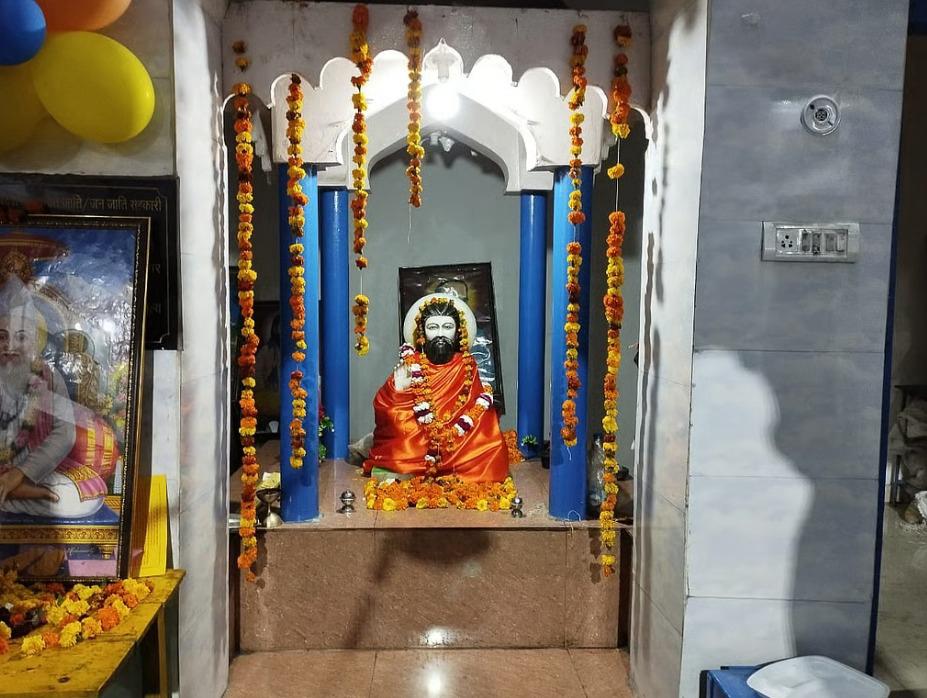
Lucknow: The 87-year-old Ravidas Temple Bara Birwa, located on Kanpur Road in the state capital, is undergoing extensive beautification and tourism development, giving it a grand and modern facelift. The initiative, led by the Uttar Pradesh Tourism Department, aims to enhance facilities for devotees while strengthening Lucknow’s religious tourism profile.
The ambitious project has been sanctioned at a cost of ₹80.27 lakh, out of which the first instalment of ₹60 lakh has already been released to expedite development works. Officials said the project is designed to preserve the temple’s spiritual essence while equipping it with modern amenities for a better visitor experience.

Uttar Pradesh Tourism and Culture Minister Jaiveer Singh stated that the temple premises will be upgraded with state-of-the-art facilities to provide a clean, safe and well-organised environment for pilgrims and tourists.
“As part of the project, modern public toilets equipped with civil, plumbing and fire safety systems will be constructed within the complex,” the minister said. “Additionally, a well-furnished tourist rest room along with a dormitory facility will be developed to accommodate visitors. This initiative will not only improve pilgrim amenities but also give a new dimension to Lucknow’s religious tourism identity.”
Modern Facilities to Enhance Devotee Experience
To ensure a smooth and organised darshan experience, directional signboards will be installed at various points within the temple complex, enabling devotees—especially those visiting from outside the city—to navigate the premises conveniently.
In a step towards energy sustainability, a 10-kilowatt solar power plant will be installed at the temple. The move is expected to strengthen electricity arrangements while promoting environmental conservation. Adequate seating arrangements, including benches, and a sufficient number of dustbins will also be placed across the complex to maintain cleanliness and comfort for visitors.
Officials said the redevelopment plan focuses not only on beautification but also on long-term sustainability, accessibility and improved infrastructure, aligning with the state government’s broader vision of integrated tourism development.
Symbol of Harmony and Social Consciousness
Minister Jaiveer Singh emphasised that the Bara Birwa Ravidas Temple is not only a site of deep religious faith but also a symbol of social harmony and collective consciousness.

“The state government is committed to preserving sacred sites associated with the saint tradition and promoting them as key religious tourism destinations,” he said. “Our efforts are aimed at giving Uttar Pradesh’s rich cultural heritage a distinct national and international identity. The project will be completed in a time-bound and systematic manner.”
He added that along with iconic religious centres, places symbolising social unity and inclusivity are also being prioritised under the state’s tourism development strategy.
The temple is closely associated with the sacred memories of Guru Ravidas, revered as a spiritual reformer and poet-saint of the Bhakti movement. Over the years, the shrine has evolved into a focal point of devotion, equality and social awareness.
Managed by the Sant Ravidas Seva Samiti, the temple witnesses steady footfall throughout the year. During Ravidas Jayanti, the complex comes alive with grand celebrations, drawing devotees from across the region. With the number of pilgrims steadily increasing, the comprehensive tourism development initiative is expected to significantly improve infrastructure and visitor management.
Boost to Religious Tourism
The facelift of the Ravidas Temple is expected to enhance Lucknow’s religious tourism circuit, complementing other major spiritual and heritage destinations in the city. By integrating modern amenities with traditional sanctity, the project seeks to make the temple more accessible and attractive to both domestic and out-of-state visitors.
Officials believe that improved facilities such as dormitories and rest rooms will encourage longer stays by pilgrims, indirectly boosting local businesses and employment opportunities. The installation of solar energy infrastructure also reflects the government’s commitment to environmentally responsible development.
As renovation and beautification work progresses, the 87-year-old shrine is poised to emerge as a revitalised centre of faith and harmony, reinforcing Lucknow’s image as a city where heritage, spirituality and modern development converge seamlessly.







 ---------------------------------------------------------------------------------------------------