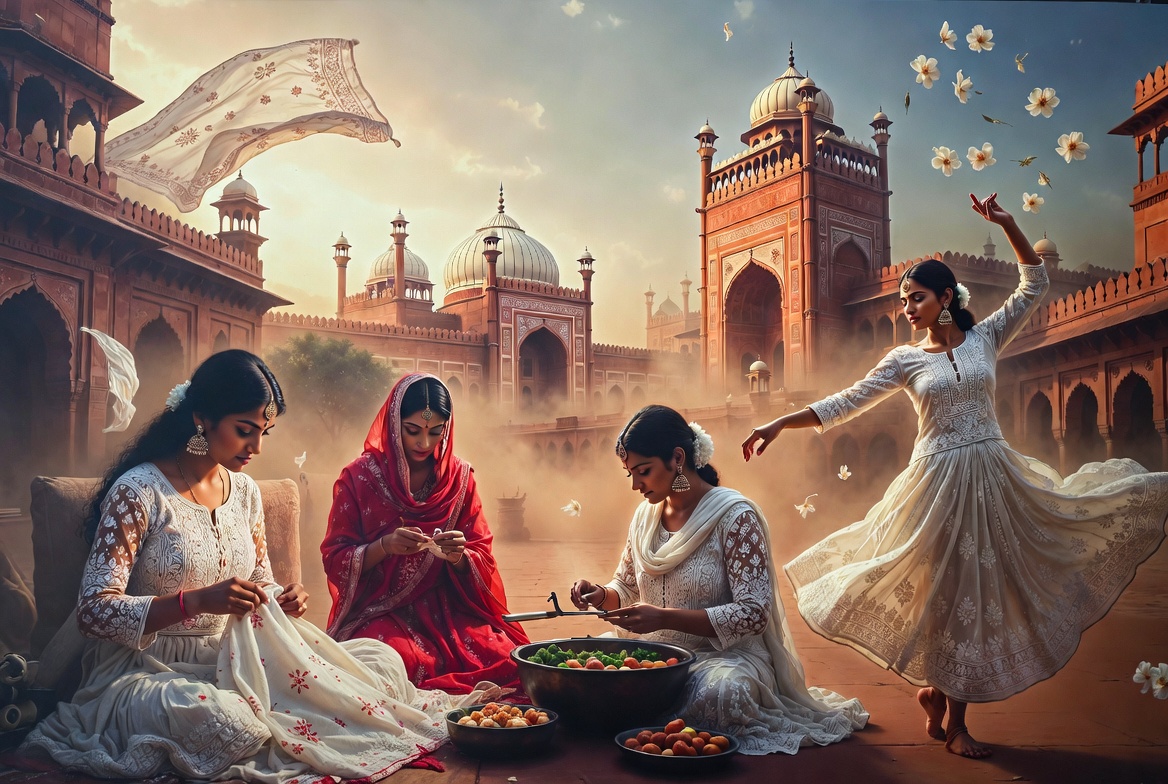
Lucknow | In the grand tapestry of Lucknow’s history, women have long been the quiet weavers—sustaining the city’s famed tehzeeb (refined culture and etiquette), intricate crafts, culinary legacies, and intergenerational knowledge systems. Often working within the private spaces of the zenana, kitchens, and modest workshops, they shaped the essence of Awadhi heritage without occupying center stage in mainstream narratives, which have traditionally celebrated nawabs, poets, and male patrons.
This historical revisit—now being explored through contemporary exhibitions and research—seeks to illuminate the indispensable yet underrepresented role of women in preserving Lucknow’s cultural soul. Far from passive participants, these women were active custodians who transmitted skills, manners, and memory across generations, sustaining what is widely known as the Ganga-Jamuni tehzeeb, a syncretic cultural ethos blending Hindu and Muslim traditions into a uniquely harmonious social fabric.

Women in the Nawabi Era: Power Behind the Veil
Lucknow rose to prominence in the 18th century as the capital of Awadh under Nawabi rule, where refinement, hospitality (mehman-nawazi), and artistic expression flourished. While rulers such as Asaf-ud-Daula and Wajid Ali Shah are often credited with patronizing architecture, music, and cuisine, women played a parallel, and often overlooked, role in sustaining these traditions.
Elite women in the zenana wielded considerable influence. Bahu Begum, for instance, managed vast financial resources and resisted colonial encroachment, while Begum Hazrat Mahal emerged as a formidable political leader during the Indian Rebellion of 1857. These figures were not merely consorts but decision-makers and protectors of cultural continuity.
Beyond royal households, courtesans or tawaifs played a critical role in shaping the city’s cultural refinement. Trained in music, dance, poetry, and etiquette, they were custodians of sophisticated art forms like Kathak and thumri, influencing the broader cultural milieu of Hindustani classical traditions.
Chikankari: Threads of Resilience and Feminine Skill
No craft embodies women’s centrality in Lucknow’s heritage more profoundly than chikankari embroidery. Believed to have been popularized during the Mughal era by Noor Jahan, this delicate art form evolved into the city’s signature textile identity.
Characterized by intricate hand embroidery on fine fabrics like muslin, chiffon, and silk, chikankari features motifs such as phool, buti, and jaali, executed through over 30 distinct stitches including bakhiya, phanda, and kauri. While its origins lie in royal patronage, the craft gradually transitioned into a vital source of livelihood for thousands of women.
Today, the chikankari industry employs hundreds of thousands, with women comprising the overwhelming majority of artisans. Much of this work is home-based, enabling women—particularly from traditional Muslim households—to balance domestic responsibilities with income generation. Organizations like Self Employed Women’s Association have played a pivotal role in empowering artisans through fair wages, skill development, and market access.
Despite this, historical narratives have often credited anonymous “artisans” or male patrons, overlooking the skilled hands of women who preserved the craft through economic upheavals, especially after the decline of Awadh following 1857 and into the modern global economy.
Culinary Traditions: The Alchemy of the Kitchen
Awadhi cuisine, renowned for its sophistication and depth of flavor, owes as much to women’s kitchens as it does to professional male chefs (bawarchis). The famed dum pukht technique—slow cooking in sealed vessels—reflects patience, precision, and an intuitive understanding of flavors, all of which were refined within domestic spaces.
Dishes such as galouti kebabs, nihari, korma, and zarda were often perfected through family traditions. Behind the celebrated recipes of establishments like Tunday Kababi lay the unseen labor of women who prepared spice blends, preserved culinary secrets, and ensured continuity of taste across generations.
In joint family systems, grandmothers and mothers served as repositories of culinary knowledge, passing down recipes not through written texts but through observation and practice—measuring ingredients by instinct, controlling heat by experience, and balancing flavors through sensory memory. Festivals, weddings, and religious observances became occasions for culinary expression, reinforcing cultural identity.
Even during periods of displacement—such as the exile of Awadhi elites to Kolkata—women recreated miniature Lucknows through food, ensuring that traditions endured despite geographic separation.
Household Knowledge Systems and Cultural Transmission
Beyond visible crafts and cuisine, women sustained what may be termed “household knowledge systems”—the subtle yet powerful practices that defined Lucknow’s social etiquette. Within the zenana, they cultivated begamati zabaan, a refined form of Urdu marked by politeness, metaphor, and grace. This linguistic tradition shaped the famed Lucknowi etiquette—where indirect speech, courtesy, and social harmony were paramount.
Women also played a central role in nurturing the Ganga-Jamuni tehzeeb. Through shared festivals, storytelling, and daily rituals, they fostered interfaith harmony. Celebrations of Holi, Diwali, and Muharram often overlapped within households, creating a lived experience of syncretism.

Storytelling emerged as another vital medium of transmission. Grandmothers narrated tales that blended moral instruction with cultural memory, while mothers maintained ritual calendars and household traditions. These practices ensured that values of respect, empathy, and coexistence were internalized from an early age.
Performing Arts and the Cultural Legacy of Tawaifs
The cultural landscape of Lucknow cannot be understood without acknowledging the contributions of tawaifs. Far from being marginalized figures, they were highly trained artists who preserved and propagated classical music and dance traditions.
Figures such as Begum Akhtar carried forward the legacy of ghazal and thumri, bridging the gap between courtly traditions and modern performance spaces. Tawaifs were also arbiters of etiquette and aesthetics, influencing fashion, language, and artistic expression.
Their salons served as informal cultural institutions where poetry, music, and discourse thrived, especially during periods when formal patronage declined. Despite their contributions, their role has often been misunderstood or undervalued in mainstream narratives.
From Background to Foreground: Reclaiming Women’s Narratives
Mainstream histories of Lucknow have largely foregrounded the opulence of nawabs and the literary brilliance of male poets, relegating women’s contributions to the margins. Yet, it is increasingly evident that without the labor, creativity, and resilience of women, the city’s identity as the “City of Adab” would not have endured.
Women embroidered garments for royal courts, prepared elaborate feasts, nurtured cultural values in households, and adapted traditions in times of crisis. Their contributions were not peripheral but foundational—forming the very fabric of Lucknow’s cultural continuity.
Contemporary exhibitions and research initiatives are now attempting to correct this imbalance. Through artifacts, oral histories, photographs, and interactive displays, they bring to light the stories of women artisans, homemakers, performers, and cultural custodians. Demonstrations of chikankari stitches, recreations of traditional recipes, and documentation of family histories offer a tangible connection to this living heritage.
Heritage in the Modern Era: Continuity and Change
In an age marked by rapid urbanization, fast fashion, and cultural homogenization, the preservation of intangible heritage has become increasingly challenging. Yet, women continue to adapt and innovate.
New organizations and grassroots initiatives are addressing contemporary issues such as digital literacy, financial independence, and mental health, while simultaneously preserving traditional knowledge. Women are emerging as entrepreneurs, educators, and cultural advocates, bridging the gap between heritage and modernity.
At the same time, traditional institutions face the challenge of remaining relevant in a changing world. The need to support artisans, document oral histories, and integrate heritage into contemporary education systems has never been more urgent.
Honouring a More Complete History
Lucknow’s enduring charm lies not only in its grand monuments or celebrated figures but in the everyday practices that have sustained its culture for centuries. These practices—embroidered in fabric, simmered in kitchens, spoken in refined language, and performed in intimate spaces—bear the imprint of women’s labor and love.
By bringing these underrepresented custodians to the forefront, we move toward a more inclusive understanding of history. Their stories remind us that heritage is not merely inherited—it is actively preserved, often quietly, through resilience and care.
This is not just a historical revisit but a reclamation. It is an acknowledgment that the needle, the ladle, the lullaby, and the lyric were instruments of cultural continuity. And in honoring these women, we honor the very essence of Lucknow—its grace, its resilience, and its timeless tehzeeb.