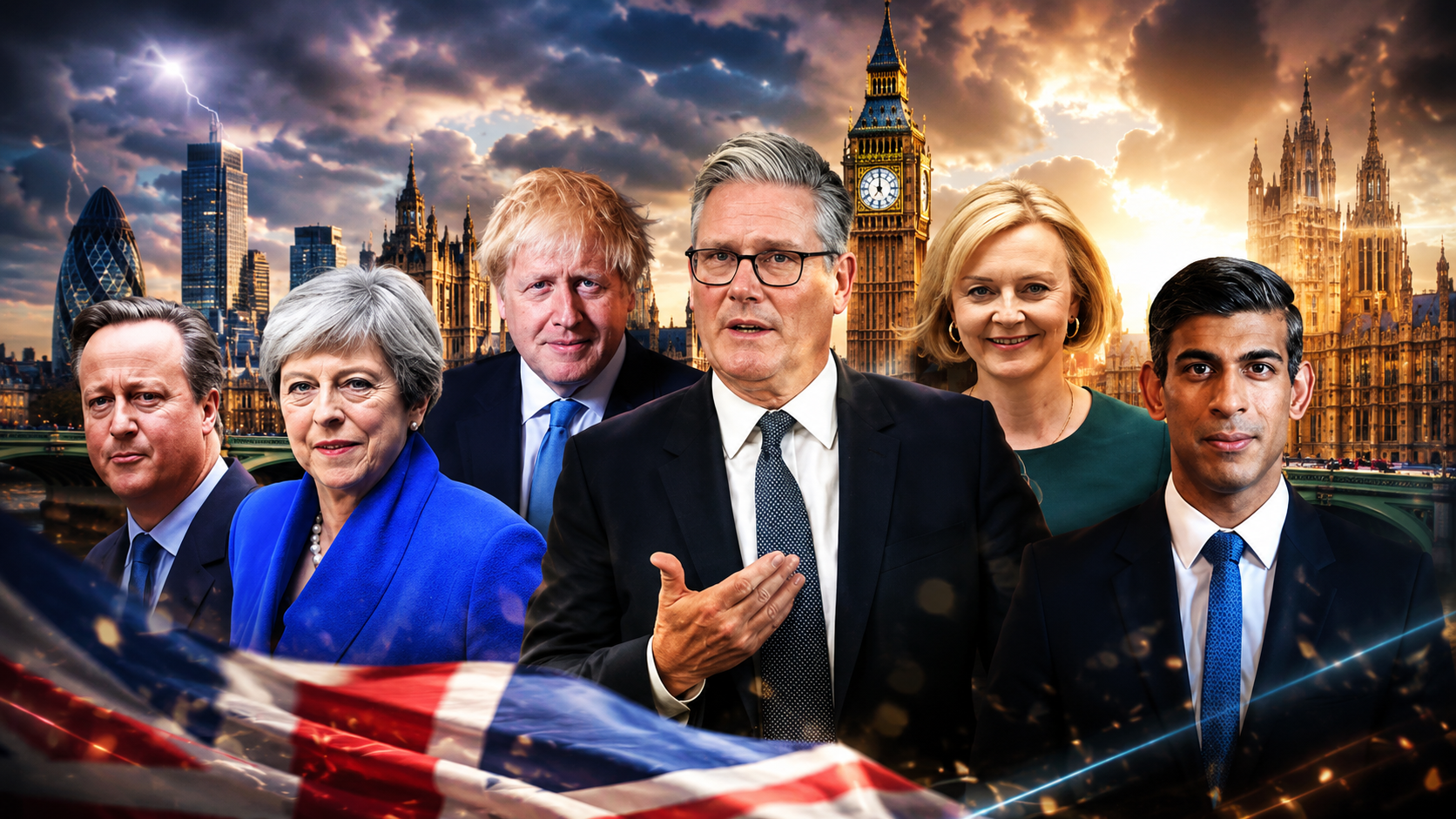
London: Britain’s political landscape has entered yet another period of uncertainty after Prime Minister Sir Keir Starmer announced that he would step down as both Prime Minister and Leader of the Labour Party, less than two years after leading Labour to a landslide general election victory in July 2024. Starmer said he would remain as caretaker prime minister until the Labour Party elects a new leader, setting the stage for Britain’s seventh prime minister in roughly a decade.
The announcement has revived debate over what many commentators jokingly describe as the “curse” of 10 Downing Street—the official residence and workplace of British prime ministers. While there is, of course, no supernatural force behind the rapid turnover of leaders, the remarkable succession of resignations since the Brexit referendum has highlighted deep structural and political challenges confronting modern Britain.

Another Prime Minister Leaves Before Completing a Full Term
Starmer’s resignation follows months of mounting pressure from within the Labour Party after disappointing electoral performances, declining public approval and growing internal dissatisfaction over his leadership. In his emotional statement outside No. 10 Downing Street, Starmer acknowledged that many Labour MPs no longer believed he was the right person to lead the party into the next general election. He pledged to ensure an orderly transition and promised his full support to his successor.
His departure means that yet another British prime minister has failed to complete a full parliamentary term—a pattern that has become increasingly common since 2016.
A Decade of Political Musical Chairs
Britain was once admired for its stable parliamentary traditions, where prime ministers often governed for many years. However, the period following the Brexit referendum has been marked by extraordinary political instability.
David Cameron (2010–2016)
David Cameron served for six years and secured a majority government in 2015. However, his decision to hold the 2016 Brexit referendum ultimately ended his premiership. After campaigning for Britain to remain in the European Union, Cameron resigned immediately following the Leave victory, accepting responsibility for the outcome.
Theresa May (2016–2019)
Theresa May inherited one of the most difficult political challenges in modern British history—implementing Brexit. Despite months of negotiations with the European Union, she repeatedly failed to secure parliamentary approval for her withdrawal agreement. Combined with a disappointing snap election in 2017 that cost the Conservatives their majority, party opposition eventually forced her resignation.
Boris Johnson (2019–2022)
Boris Johnson achieved the long-promised completion of Brexit and led Britain through the COVID-19 pandemic. However, his government became engulfed in a series of ethical controversies, most notably the “Partygate” scandal involving lockdown-breaking gatherings in Downing Street. A wave of ministerial resignations eventually left his position untenable, leading him to step down in 2022.
Liz Truss (2022)
Liz Truss became Britain’s shortest-serving prime minister after lasting only around seven weeks in office. Her government’s controversial “mini-budget,” featuring large unfunded tax cuts, triggered severe financial market turmoil. The pound weakened sharply, borrowing costs surged and investor confidence evaporated, forcing her resignation after just 49 days.
Rishi Sunak (2022–2024)
Rishi Sunak restored a measure of financial stability following the Truss crisis but struggled against stubborn inflation, slow economic growth and continuing public dissatisfaction. His decision to call the 2024 general election resulted in a crushing Conservative defeat, ending his premiership after less than two years.
Keir Starmer (2024–2026)
Starmer’s landslide election victory initially appeared to signal a return to political stability. Instead, growing tensions within Labour, declining popularity and disappointing local election performances weakened his authority. Facing increasing pressure from Labour MPs, he announced his resignation after fewer than two years in office.
Is There Really a “Curse” at 10 Downing Street?
The idea of a curse has become popular in political commentary, but historians point out that No. 10 has long been associated with difficulties—though mostly architectural rather than mystical.
Originally built during the late 17th and early 18th centuries on relatively unstable ground with shallow foundations, the famous black-brick residence has experienced structural problems for centuries. Cracked walls, uneven floors and subsidence have required repeated repairs. Extensive renovations carried out during the 1950s and 1960s were necessary to prevent serious structural failure.
Former Prime Minister Winston Churchill famously described the building as “shaky and lightly built,” a remark that has often been used metaphorically to describe the fragile nature of British politics itself.
Brexit Continues to Shape British Politics
Political analysts argue that the real explanation for Britain’s revolving-door leadership lies in the long shadow cast by Brexit.
The 2016 referendum fundamentally reshaped British politics, exposing deep divisions both within political parties and across society. Questions surrounding trade, immigration, relations with the European Union and Northern Ireland have continued to generate political conflict long after Britain formally left the EU.
Every prime minister since David Cameron has had to navigate these unresolved issues while attempting to rebuild public confidence and stimulate economic growth.
Internal Party Revolts Have Become Easier
Britain’s parliamentary system allows governing parties to replace their leaders without holding a national election. This means prime ministers remain heavily dependent on maintaining the confidence of their own Members of Parliament.
Once internal support begins to weaken, leadership challenges can gather momentum rapidly. Theresa May, Boris Johnson, Liz Truss and Keir Starmer all ultimately lost the confidence of significant sections of their parliamentary parties before leaving office.

Unlike presidential systems with fixed terms, British prime ministers can find their authority evaporating almost overnight if party unity breaks down.
Economic Pressures Leave Little Room for Error
Recent prime ministers have also governed during an exceptionally turbulent economic period.
The combined impact of Brexit, the COVID-19 pandemic, the global energy crisis, inflation, rising living costs and international geopolitical tensions has placed extraordinary pressure on successive governments.
Financial markets have become increasingly sensitive to government policy decisions. Liz Truss’s brief premiership demonstrated how rapidly investor confidence can collapse when fiscal credibility is questioned.
Meanwhile, voters have demanded faster improvements in healthcare, housing, wages, immigration control and public services, leaving governments with limited political breathing space.
Media Scrutiny Has Intensified
The digital age has transformed political leadership.
Twenty-four-hour news coverage, constant social media commentary and instant public reaction mean prime ministers operate under unprecedented levels of scrutiny. Political mistakes that might once have taken weeks to dominate headlines now spread globally within minutes.
Leadership approval ratings can deteriorate rapidly, while opposition parties and dissatisfied MPs can organise pressure campaigns far more effectively than in previous decades.
Policy Continuity Suffers
Frequent leadership changes inevitably affect long-term governance.
Each incoming prime minister brings new priorities, cabinet reshuffles and policy adjustments. Infrastructure projects, economic reforms and public sector initiatives often lose momentum as governments change direction.
Britain’s international partners have also watched the rapid turnover with growing concern, raising questions about the country’s long-term strategic consistency on issues ranging from trade to defence and climate policy.
Who Could Replace Starmer?
Attention has already shifted to Labour’s leadership contest.
Former Greater Manchester Mayor Andy Burnham, who recently returned to Parliament, has emerged as the leading contender to succeed Starmer. Burnham has received backing from several prominent Labour figures and is widely viewed as a politician capable of reconnecting with different wings of the party. Party members are expected to choose a new leader during the summer, with the winner becoming Britain’s next prime minister.
Can Britain Break the Cycle?
The rapid succession of prime ministers since 2016 represents one of the most politically volatile periods in modern British history.
While earlier decades saw leaders such as Tony Blair and Margaret Thatcher remain in office for many years, recent governments have struggled to survive prolonged political and economic turbulence.
Whether Britain’s next prime minister can restore stability remains uncertain. Success will likely depend not only on leadership skills but also on addressing the deeper structural challenges that have destabilised British politics—including economic uncertainty, party fragmentation, Brexit’s lasting consequences and declining public trust in government.
For now, the so-called “curse” of 10 Downing Street appears far less about the famous black front door itself and far more about the immense political pressures awaiting whoever walks through it.












 https://www.youtube.com/watch?si=RtToJsBhYBatUrym&v=mOuYNSdhjHA&feature=youtu.be