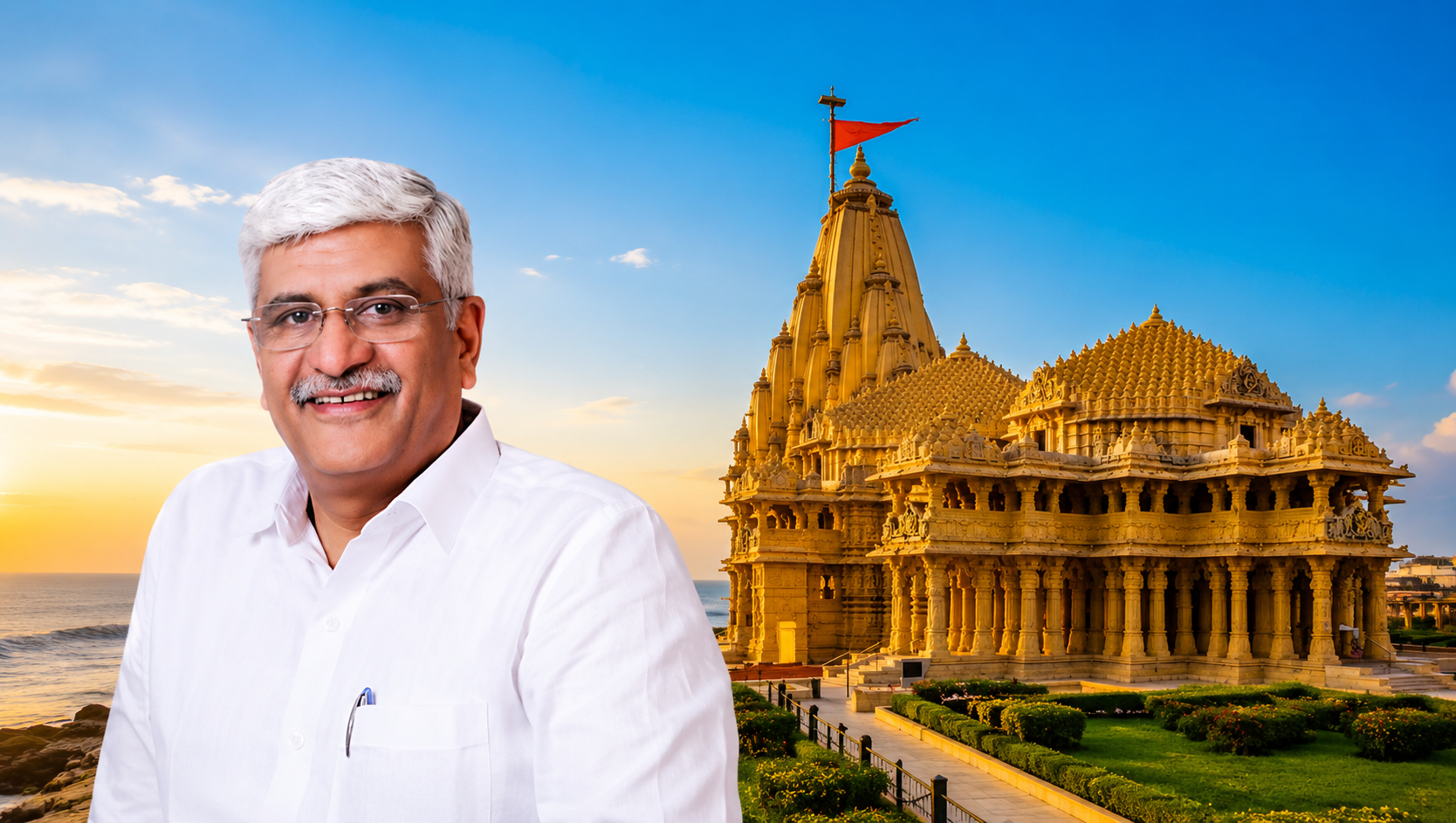
1000 Years of Somnath
By Gajendra Singh Shekhawat
“Na hanyate hanyamāne śarīre”
The soul is never destroyed even when the body perishes.
— Bhagavad Gita 2.20

Few places embody the timeless spirit of Indian civilisation as profoundly as Somnath Temple. Situated on the southern coast of Kathiawar in Gujarat and revered as the first among the twelve Jyotirlingas, Somnath has withstood centuries of invasions, destruction and political upheaval. Yet every time it was razed, it rose again. Its aarti never ceased. Its bells never fell silent. Its faith never faded.
That is the essence of India’s civilisational consciousness.
Across thousands of years of history, Sanatan Dharma has faced repeated political and military challenges. Temples, monasteries and centres of learning were targeted during invasions and changing regimes. Their structures were damaged, patronage systems disrupted and traditions challenged. Yet India’s spiritual heritage not only survived but continuously regenerated itself. The greatest strength of Indian civilisation has been that even when institutions weakened, its soul endured.
In ancient and medieval India, temples were not merely places of worship. They were centres of economic activity, social organisation, artistic excellence and intellectual discourse. Because of their connection with power and society, they often became the first targets during conflicts. The attack on Somnath by Mahmud of Ghazni remains among the most discussed episodes in Indian history. Persian chronicles celebrated it as conquest, while Indian memory preserved it as a story of pain, resistance and reconstruction.
But the deeper historical truth is this: Somnath was never erased from public faith.
Successive rulers, including the Chaulukya kings, rebuilt the shrine repeatedly. Pilgrims continued to arrive. Rituals continued uninterrupted. The temple endured because society refused to let its spiritual centre disappear. Similar examples can be found across India, where sacred traditions survived despite political instability and destruction.
The story of Somnath is therefore not merely the story of an invasion. It is the story of continuity.
From ancient times, Prabhas Patan has been regarded as one of India’s most sacred pilgrimage sites. Referred to in scriptures and traditions as Prabhas-Pattan, Shiv-Pattan and Prabhas-Tirtha, the region is associated with the confluence of three sacred rivers. It is also believed to be the place where Lord Krishna’s mortal remains were cremated after his departure from the earthly realm. Nearby sites such as Vairagya Kshetra and Gopi Talab, from where Gopi Chandan is obtained, remain integral to India’s sacred geography.
Historical records and archaeological studies on Kathiawar and Gujarat repeatedly mention the significance of this region.
Somnath is equally a symbol of India’s inclusive and pluralistic ethos. It represents the confluence of Shaiva and Vaishnava traditions and reminds us that Indian civilisation has always drawn strength from coexistence and synthesis rather than uniformity. India’s cultural continuity has been sustained not by exclusion, but by accommodation and harmony.
The modern chapter of Somnath’s renaissance began after Independence.
On November 12, 1947, during the days following Partition, Sardar Vallabhbhai Patel visited Somnath and resolved to rebuild the temple. This was not merely a religious project; it was an act of national healing and civilisational recovery. At a moment when India was grappling with trauma and uncertainty, the reconstruction of Somnath became a powerful assertion of cultural confidence.

That vision culminated on May 11, 1951, when Rajendra Prasad attended the consecration ceremony of the rebuilt temple. His presence symbolised the restoration not only of a sacred structure, but of a wounded national psyche. It reaffirmed that modern India could embrace secular democracy without disconnecting itself from its civilisational roots.
Today, as India moves toward the vision of India@2047, the lessons of Somnath have become even more relevant.
The world is passing through an age of technological disruption, geopolitical uncertainty and social fragmentation. In such times, India offers an alternative civilisational message — that development does not require abandoning compassion, and strength does not demand the rejection of restraint and wisdom.
Somnath teaches that true leadership is built not merely on power, but on memory, balance and moral conviction.
It is with this spirit that the “Somnath Swabhiman Parv 2026-27” has been envisioned. This year-long national initiative is dedicated to the spiritual energy, cultural continuity and civilisational consciousness represented by Somnath Jyotirlinga. It commemorates two major historical milestones — one thousand years since the first recorded attack on Somnath in 1026, and 75 years since the reopening of the reconstructed temple in 1951.
Beginning between January 8 and 11, 2026, the programme aims to establish Somnath as a symbol of national unity, collective memory and cultural consciousness. Until the major national event scheduled for May 11, 2026, a series of yatras, cultural programmes, educational activities and public dialogues will be organised across Jyotirlingas, states, Union Territories, districts and Shiva temples throughout India.
Under the leadership of Narendra Modi, who also serves as Chairman of the Somnath Trust, the temple has witnessed a new phase of rejuvenation. Administrative reforms, heritage conservation, infrastructure development and cultural initiatives have strengthened Somnath’s position as a vibrant spiritual and cultural centre. Efforts focused on environmental sustainability and women-led service initiatives demonstrate how ancient Indian values can coexist with modern responsibilities and inclusivity.
The “Somnath Swabhiman Parv” is ultimately an attempt to reconnect modern society with its cultural roots. It reminds us that Somnath is not merely a reconstructed temple of stone. Its true power lies in the values, traditions and responsibilities that generations have carried forward.
That is why Somnath today stands not only as a restored monument, but as a living pilgrimage of national consciousness.
For a rising India in the twenty-first century, Somnath offers a timeless lesson: a civilisation remains strong when it remains rooted, adapts with time and carries everyone along in its journey.
The legacy of Somnath must continue to inspire India — to build with purpose, to act with balance and to move forward without losing sight of its identity.
Jai Somnath!
Vande Mataram!