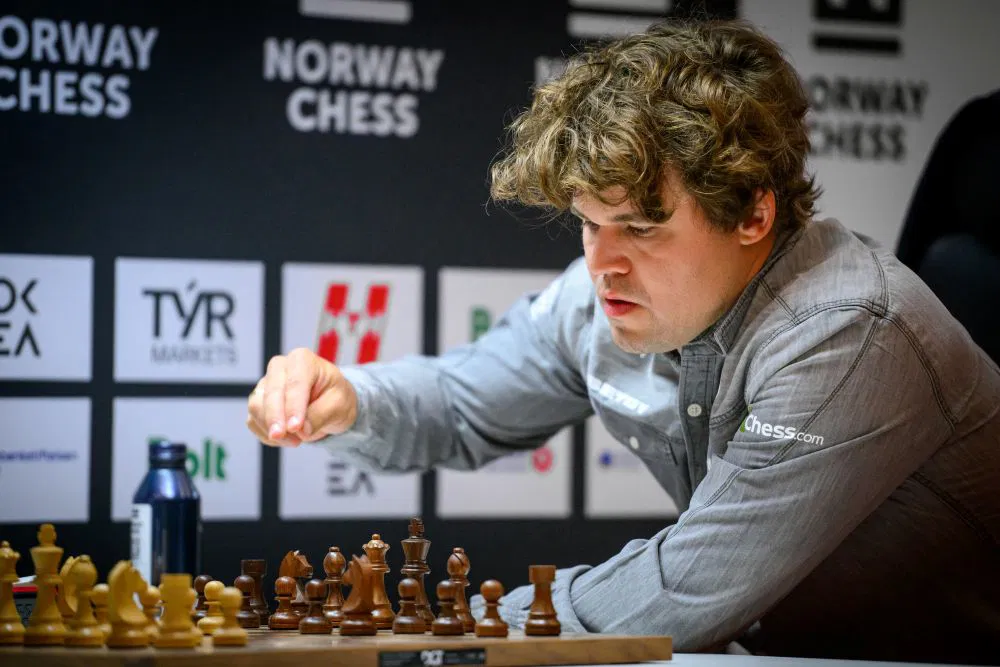
Malmö, Sweden: In a result that has sent ripples through the global chess community, former World Champion Magnus Carlsen saw his long-standing unbeaten streak in classical chess come to an unexpected end after a hard-fought defeat against Dutch grandmaster Jorden van Foreest at the TePe Sigeman & Co chess tournament.
The loss marked the conclusion of a remarkable run in classical formats that had stretched for nearly a year, underlining both Carlsen’s dominance and the increasingly competitive nature of elite chess.

A High-Stakes Battle from the Opening Moves
The encounter began with both players demonstrating deep preparation and cautious ambition. Carlsen, known for his positional mastery and endgame precision, adopted a controlled approach, steering the game into familiar territory.
The middlegame evolved into a complex positional struggle, with neither player managing to secure a decisive advantage. As the pieces exchanged and the board simplified, the game transitioned into an endgame that demanded near-perfect calculation from both sides.
Early computer evaluations suggested near-equal balance, reinforcing the expectation that the game might ultimately end in a draw.
Time Pressure Changes the Dynamic
As the clock became increasingly significant, the psychological pressure intensified. Van Foreest began to test Carlsen with practical complications, gradually increasing the tension in the position.
While Carlsen has historically thrived in such scenarios—often outplaying opponents in equal or slightly inferior positions—the time scramble introduced a rare vulnerability.
In the final phase, a critical miscalculation altered the course of the game. Carlsen’s knight became trapped in a tactical sequence, leaving no recovery path. Faced with an unavoidable material disadvantage, he eventually resigned.
It was a rare moment of visible collapse in an otherwise exceptionally stable performance record.
Van Foreest’s Surprise Victory
After the match, Jorden van Foreest admitted that even he had not anticipated a win in the position. He acknowledged that earlier in the game, a draw appeared to be the most likely outcome.
However, as the position evolved, subtle inaccuracies from Carlsen opened unexpected tactical possibilities. Once momentum shifted, Van Foreest capitalized efficiently, converting the advantage with composure.
He described the game as both intense and unpredictable, highlighting how quickly the balance can change at the highest level of chess.
Significance of the Defeat
The loss carries symbolic weight due to Carlsen’s selective participation in classical chess events in recent years. Since stepping away from the world championship cycle, Carlsen has focused more on rapid and freestyle formats, making his classical appearances comparatively rare but still highly anticipated.

This defeat, therefore, is not just a statistical end to an unbeaten streak but also a reminder of how even elite consistency can be disrupted in long-format chess, where endurance, precision, and time management are all critical.
The result also highlights the growing strength of the global chess circuit, where younger and mid-generation players are increasingly capable of challenging established legends.
Other Highlights from the Tournament
The same round featured several notable performances beyond the Carlsen upset:
- Fourteen-year-old prodigy Yagiz Kaan Erdogmus delivered a standout win against experienced grandmaster Nils Grandelius, moving into a strong position in the standings.
- Zhu Jiner secured her first victory of the event, strengthening her tournament campaign.
- India’s rising star Arjun Erigaisi held world-class opposition Nodirbek Abdusattorov to a well-fought draw in a balanced contest.
These results collectively underline the depth of talent present in modern elite chess tournaments.
What the Loss Really Means
Carlsen’s defeat is not necessarily indicative of decline but rather a reflection of the evolving competitive landscape in chess. At the highest level, even the smallest inaccuracies—especially under time pressure—can determine outcomes.
Modern chess has become increasingly analytical, with:
- Computer-assisted preparation
- Deep opening theory
- High-pressure endgame precision
In such an environment, maintaining long unbeaten runs in classical chess is exceptionally difficult, even for players of Carlsen’s caliber.
A Reminder of Chess’ Unpredictable Nature
The match between Carlsen and Van Foreest serves as a powerful reminder that chess, despite its strategic depth and preparation, remains fundamentally unpredictable.
A single misstep can overturn hours of balanced play, and even the most dominant champions are not immune to sudden shifts in momentum.
For Carlsen, the focus will now turn to how he responds in upcoming tournaments. For Van Foreest, the victory stands as a career-defining moment against one of the greatest players in chess history.
End of a Streak, Not an Era
While Magnus Carlsen’s unbeaten classical streak has come to an end, his stature in the chess world remains unquestioned. The loss instead highlights the intensity and competitiveness of modern elite chess, where every game is a test of precision under pressure.
As the tournament continues, the result will likely be remembered not as a fall from dominance, but as a rare human moment in the career of a player widely regarded as one of the greatest of all time.