Mathura: Mathura, one of India’s oldest continuously inhabited cities, stands as the spiritual heart of the Braj region and is revered worldwide as the birthplace of Lord Krishna, the eighth incarnation of Lord Vishnu. Situated on the banks of the sacred Yamuna River in Uttar Pradesh, the city seamlessly blends mythology, history and living traditions, offering visitors an immersive journey into one of Hinduism’s most cherished landscapes.
The city’s vibrant atmosphere is defined by temple bells, devotional chants of “Radhe Radhe” and “Hare Krishna,” bustling bazaars, fragrant marigold garlands and the aroma of the famous Mathura peda. Every street and shrine reflects episodes from Krishna’s life, preserving a heritage that has inspired pilgrims, saints and scholars for centuries.

The spiritual centrepiece is the Shri Krishna Janmabhoomi Temple Complex, believed to mark the prison cell where Krishna was born to Devaki and Vasudeva during the reign of King Kansa. The complex, which includes the revered Keshav Dev Temple and Bhagavata Bhavan, draws thousands of devotees daily. During Janmashtami, the temple transforms into the focal point of grand celebrations featuring devotional music, elaborate rituals and midnight prayers commemorating Krishna’s birth.
Another architectural and religious landmark is the Dwarkadhish Temple, built in 1814 by Seth Gokul Das Parikh. Dedicated to Krishna in his royal form as the King of Dwarka, the temple showcases intricate Rajasthani architecture, colourful ornamentation and richly decorated idols. The evening aarti, accompanied by soulful bhajans, remains one of Mathura’s most captivating spiritual experiences.
Just a short walk away lies Vishram Ghat, the city’s most sacred riverfront. According to tradition, Krishna rested here after defeating King Kansa. At sunset, devotees gather for the Yamuna aarti, where hundreds of floating lamps illuminate the river, creating a serene spectacle that embodies the city’s enduring devotional spirit.
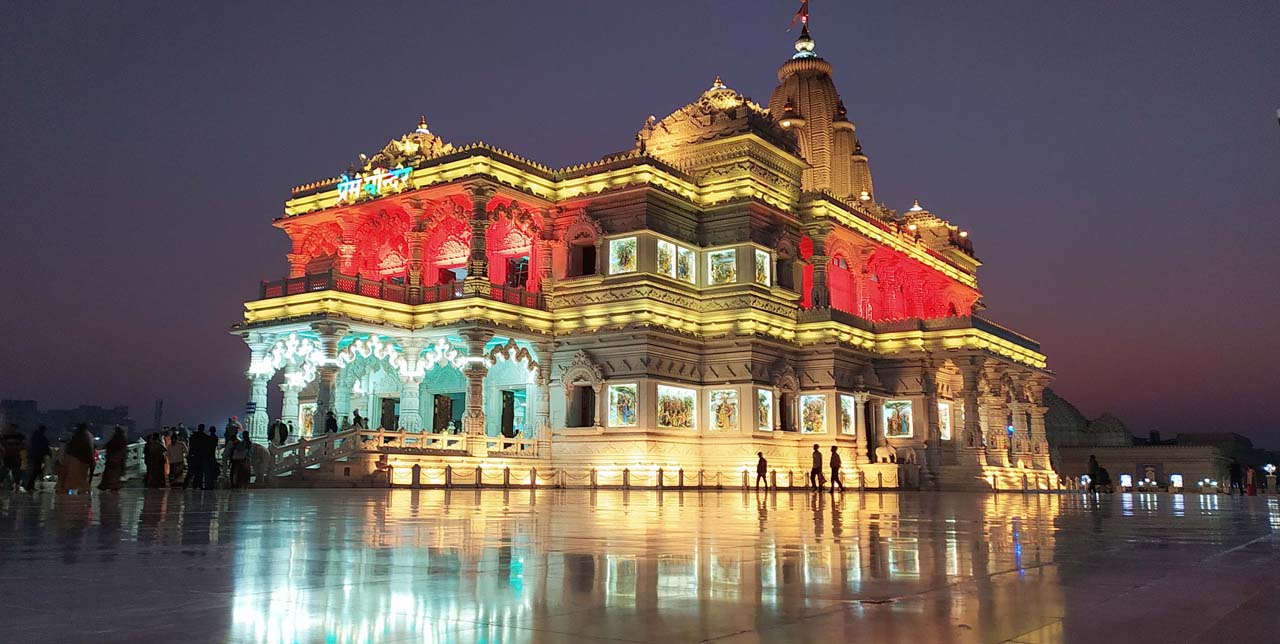
Mathura also serves as the gateway to the wider Braj Circuit, a sacred region closely associated with Krishna’s childhood and youthful exploits. Only 12 kilometres away, Vrindavan is home to iconic shrines including Banke Bihari Temple, ISKCON Temple, the magnificent marble Prem Mandir and the mystical Nidhivan, where devotees believe Krishna continues his divine raas leela every night.
Further across Braj, Govardhan Hill commemorates Krishna’s lifting of the mountain to protect villagers from torrential rains. The 21-kilometre Govardhan Parikrama remains one of Hinduism’s most significant acts of devotion. Nearby, Gokul, Nandgaon and Barsana preserve memories of Krishna’s childhood, while Barsana’s world-famous Lathmar Holi attracts visitors from across the globe with its colourful celebrations.


Beyond its religious significance, Mathura possesses remarkable historical importance. The Government Museum houses an exceptional collection of sculptures from the renowned Mathura School of Art, showcasing masterpieces from the Kushan and Gupta periods that highlight the city’s contribution to India’s artistic heritage.
Festivals define Mathura’s cultural calendar. Janmashtami, Holi, Govardhan Puja and the Kartik celebrations transform the city into a vibrant centre of devotion, attracting millions of pilgrims. During these occasions, the streets resonate with devotional music, colourful processions and traditional performances that celebrate Krishna’s timeless legacy.
The city’s culinary traditions are equally distinctive. Visitors savour the celebrated Mathura peda, alongside kachoris, rabri, traditional vegetarian thalis and temple prasadam that reflect the region’s sattvic culinary heritage.
The ideal time to visit is between October and March, when pleasant weather makes temple visits and Braj excursions comfortable. Mathura is easily accessible by road via the Yamuna Expressway from Delhi or through its well-connected railway network. Given the large number of pilgrims, visitors are advised to dress modestly, particularly while entering temples, and note that mobile phones and bags are restricted inside the inner sanctum of Krishna Janmabhoomi.
A thoughtfully planned two- or three-day itinerary allows ample time to explore Mathura’s principal temples, the sacred sites of Vrindavan and the wider Braj region, including Govardhan, Gokul and Barsana.
More than a destination, Mathura remains a living expression of Krishna’s enduring legacy. Its sacred temples, timeless rituals, artistic heritage and vibrant festivals continue to draw pilgrims, historians and travellers seeking a deeper connection with India’s spiritual and cultural traditions. Here, devotion is not confined to places of worship—it permeates every lane, every hymn and every greeting, making Mathura an eternal cradle of Krishna’s divine leela.











 https://www.youtube.com/watch?si=RtToJsBhYBatUrym&v=mOuYNSdhjHA&feature=youtu.be