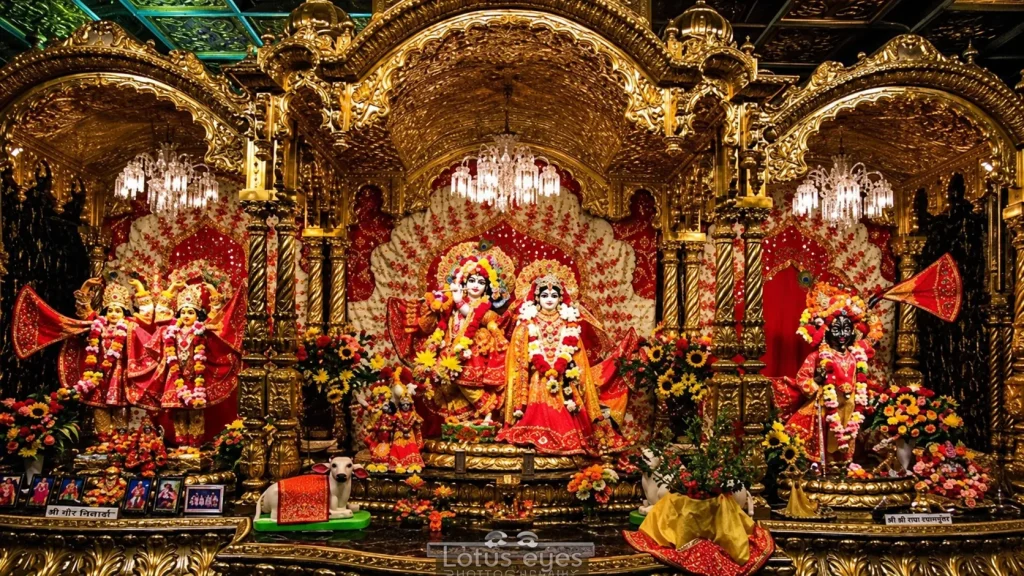
New Delhi: Temples across India witnessed large gatherings of devotees as people celebrated Janmashtami, the festival commemorating the birth of Lord Krishna. From Delhi and Mathura to Vrindavan and Mumbai, devotees assembled at prominent religious centres for early-morning prayers, special rituals and Mangla Aarti.
The festival brought a strong devotional atmosphere to several major temples, with authorities and temple administrations making arrangements to manage the movement of large crowds.

Devotees Gather at Delhi Temples
In Delhi, devotees turned up in large numbers at ISKCON temples in East of Kailash and Dwarka Sector 13 to participate in special Mangla Aarti ceremonies. Worshippers joined prayers and other traditional rituals held as part of the Janmashtami celebrations.
The Birla Mandir also observed the festival with special prayers and Mangla Aarti. The temple premises were decorated for the occasion as devotees gathered during the early hours to seek blessings.
Mathura Celebrations Draw Large Crowds
Mathura, regarded as the birthplace of Lord Krishna and one of the most important centres associated with his life, witnessed extensive religious activity throughout the festival.
At the Shri Krishna Janmabhoomi Temple, devotees participated in Mangla Aarti and special prayers. The temple complex and surrounding areas saw a steady arrival of worshippers seeking darshan and taking part in Janmashtami rituals.
Other temples across Mathura also reported significant footfall as devotees travelled from different parts of the country to mark the festival in the city closely associated with Krishna’s childhood and spiritual traditions.
Vrindavan Sees Heavy Footfall
Vrindavan also witnessed a major gathering of devotees, particularly at the Shri Banke Bihari Ji Temple. Large numbers of worshippers arrived for the special aarti, leading to long queues around the temple premises.
Barricades and crowd-control arrangements were put in place to regulate the movement of devotees and facilitate darshan. Despite the heavy turnout, worshippers continued to wait patiently to participate in the religious ceremonies.


Special Aarti at Mumbai’s ISKCON Temple
Janmashtami celebrations extended to Mumbai, where devotees gathered at the ISKCON Temple at Chowpatty for Mangala Aarti.
Worshippers participated in prayers and other festivities organised at the temple, reflecting the widespread popularity of Krishna worship and Janmashtami celebrations across the country.
Security and Crowd Management
With thousands of devotees expected at major religious centres, crowd management remained a key priority during the celebrations. Police and security personnel were deployed at several locations, including the ISKCON temple in East of Kailash.
Temple authorities and local administrations also introduced barricading and movement-control measures at crowded venues to ensure orderly entry and exit and minimise congestion.
Religious Significance of Janmashtami
Janmashtami, also known as Krishna Janmashtami or Gokulashtami, marks the birth of Lord Krishna, who is revered in Hindu tradition as the eighth avatar of Lord Vishnu.
The festival is observed on the eighth day, or Ashtami, of the Krishna Paksha, the dark fortnight of the Hindu month of Bhadrapada. Depending on the lunar calendar, Janmashtami generally falls in August or September.
Mathura and Vrindavan occupy a special place in Janmashtami celebrations because of their deep association with Krishna’s life and traditions. Every year, the two cities attract large numbers of pilgrims and visitors who participate in prayers, aarti, devotional singing and other religious ceremonies.
The gatherings this year once again highlighted the widespread observance of Janmashtami, as devotees across different regions came together at temples to celebrate the festival with faith and devotion.












 https://www.youtube.com/watch?si=RtToJsBhYBatUrym&v=mOuYNSdhjHA&feature=youtu.be