Rating: ★★½/5
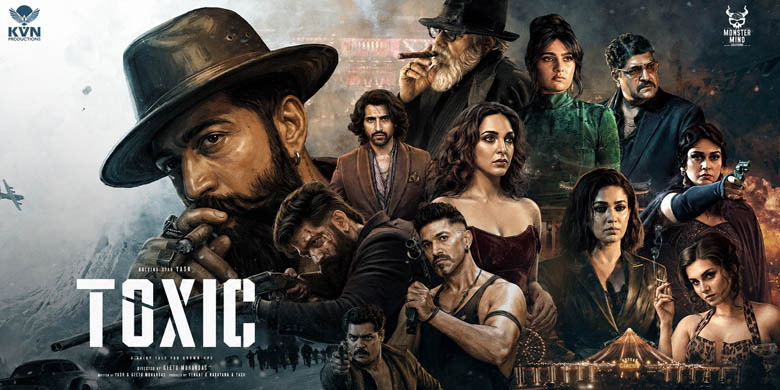
Mumbai: Toxic: A Fairy Tale for Grown-Ups is the kind of film that refuses to enter a room quietly. It arrives with guns blazing, bodies falling, characters striding through smoke and shadows, and a visual language designed to overwhelm the senses. Directed by Geetu Mohandas, the Yash-starrer is bold, expensive and unapologetically excessive. Unfortunately, beneath all that spectacle lies a story that struggles to keep pace with its own ambition.

Set largely in Portuguese-ruled Goa from the late 1940s onward, Toxic attempts to combine period gangster drama, family tragedy, action spectacle and a commentary on masculinity. The film follows Raya, a violent yet charismatic criminal played by Yash, as he builds an opium empire alongside his sister Ganga, portrayed by Nayanthara. Yash also appears as Raya’s son, Ticket/Rumi, giving the actor the opportunity to explore two generations shaped by violence and power.
On paper, it is an intriguing premise. On screen, however, the film often feels like several movies competing for attention.
Yash Owns the Screen
There is little doubt about who Toxic belongs to. Yash commands virtually every frame he occupies. Whether Raya is threatening an opponent, staring silently across a room or unleashing violence, the actor possesses the physicality and star charisma necessary for this kind of larger-than-life role.
His dual performance is most effective when the film allows him moments of vulnerability. Beneath Raya’s swagger, there are hints of trauma, emotional damage and a complicated relationship with family. These glimpses suggest a more layered character than the screenplay ultimately manages to deliver.
For audiences expecting another showcase of Yash’s mass appeal, there is plenty here. The film repeatedly plays to his strengths, turning his entrances, confrontations and action sequences into theatrical events.
A Visually Impressive Period World
The film’s greatest technical achievement is arguably its visual construction.
Cinematographer Rajeev Ravi gives Toxic a distinctive period atmosphere, while the production design creates a stylised version of Goa that feels simultaneously historical and fantastical. The camera frequently embraces darkness, elaborate compositions, smoke, colour and slow motion.
The action design is similarly ambitious. The circus sequences in particular provide some of the film’s most inventive visual moments, demonstrating that Mohandas is willing to experiment with the gangster genre rather than simply reproduce familiar templates.
At its best, Toxic looks spectacular.
The problem is that spectacle eventually becomes the film’s default mode.
When Style Takes Over the Story
The biggest weakness is the screenplay.
At nearly three hours and 15 minutes, Toxic demands considerable patience. The narrative moves through different periods, relationships and conflicts, but the transitions do not always feel organically developed. Characters enter, disappear and return without receiving enough emotional or narrative groundwork.
The result is a film that can feel less like a steadily unfolding gangster saga and more like a succession of elaborate set pieces connected by a relatively thin storyline.
The screenplay, written by Geetu Mohandas and Yash, clearly has larger ambitions. Themes of inherited violence, family trauma and toxic masculinity are visible beneath the surface. Yet these ideas are often buried beneath gunfire, sexual imagery, bloodshed, slow-motion entrances and booming music.
Instead of allowing the themes to breathe, the film frequently announces them through excess.


The Women Deserved More
The ensemble cast is impressive, but the writing does not always match the talent on screen.
Nayanthara’s Ganga has the potential to be one of the film’s most compelling characters. As Raya’s sister and partner in the criminal enterprise, she should have had a narrative arc capable of standing alongside the male protagonist. Yet her character is not given enough space to fully develop.
Kiara Advani’s Nadia, a circus performer, brings another potentially fascinating dimension to the story, while Huma Qureshi, Tara Sutaria and Rukmini Vasanth add further depth to an otherwise male-dominated world. Unfortunately, several of these characters feel more like extensions of the central narrative than fully realised individuals.
That becomes particularly frustrating because Toxic appears interested in questioning the very masculine mythology it simultaneously celebrates.
A Gangster Film That Cannot Decide What It Wants to Be
This is perhaps the film’s most interesting contradiction.
Toxic occasionally appears to critique the glorification of violent masculinity. It presents a world where power, brutality and inherited trauma destroy families and shape successive generations. But at the same time, it revels in precisely that imagery.
Every gunshot is stylised. Every confrontation is enlarged. Every violent act is accompanied by an almost operatic sense of spectacle.
The contradiction could have been fascinating if the screenplay had explored it more sharply. Instead, the film sometimes seems trapped between deconstructing the gangster hero and creating another iconic gangster hero.
The result is a strange mixture of critique and celebration.
The Final Verdict
Toxic: A Fairy Tale for Grown-Ups is ambitious enough to be admired and uneven enough to be frustrating.
Geetu Mohandas deserves credit for attempting something considerably more elaborate than a conventional gangster entertainer. The period setting, production design, cinematography and action choreography give the film an unmistakable visual identity. Yash, meanwhile, remains a formidable screen presence and carries many sequences through sheer charisma.
But ambition alone cannot compensate for an overextended screenplay.
At around 194 minutes, the film desperately needed tighter editing, stronger character development and greater narrative discipline. Too many scenes feel designed primarily to create an impression rather than advance the story. By the time the film reaches its emotional and narrative payoffs, the audience may already feel exhausted by the journey.
For Yash fans and viewers who enjoy maximalist Indian action cinema, Toxic offers enough swagger, scale and technical spectacle to justify a theatrical outing. Those looking for a tightly constructed gangster epic, however, may find themselves admiring the film more than actually enjoying it.
Toxic is a spectacular mess — visually intoxicating, thematically intriguing and narratively frustrating. It has the ambition of a classic, the confidence of a blockbuster and, unfortunately, the discipline of neither.
Rating: ★★½/5












 https://www.youtube.com/watch?si=RtToJsBhYBatUrym&v=mOuYNSdhjHA&feature=youtu.be