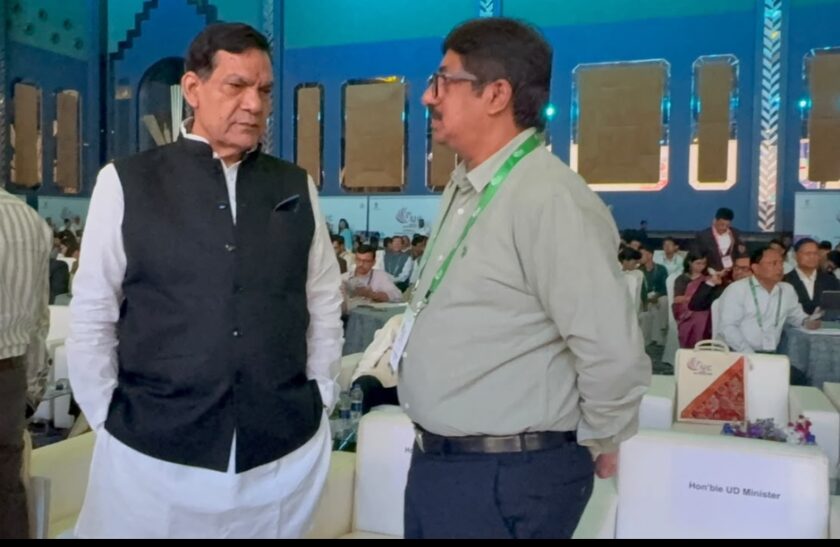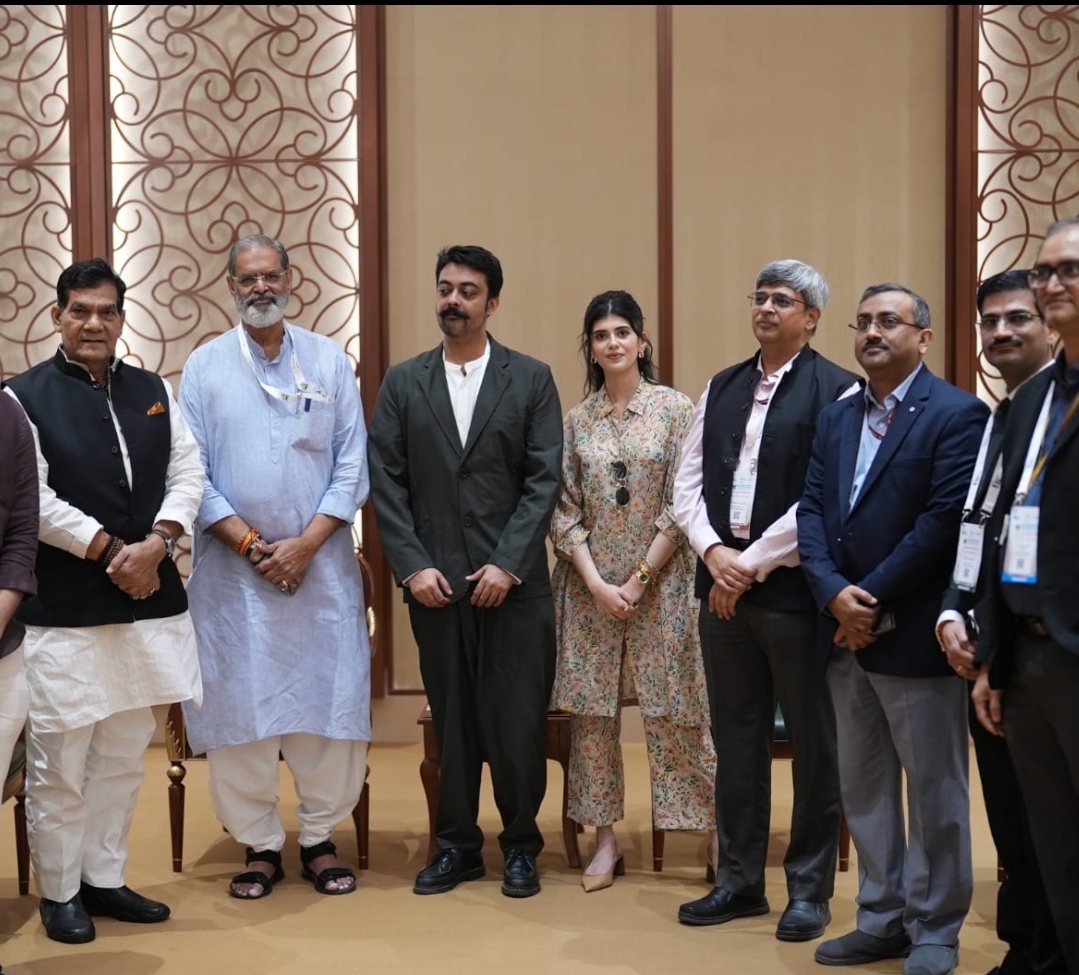
Lucknow/New Delhi: Uttar Pradesh Urban Development and Energy Minister A.K. Sharma presented the state’s renewable energy vision and agrivoltaics strategy at the seventh Agrivoltaics World Conference 2026, held at Bharat Mandapam in New Delhi, highlighting the potential to combine crop cultivation with solar power generation without taking agricultural land out of production.
Addressing the ‘State Ministerial Pitch’ session, Sharma said Uttar Pradesh, known as the country’s food bowl, was poised to emerge as a major clean energy hub. He said the state aimed to transform farmers from food providers into energy providers by enabling them to generate electricity alongside growing crops.

Sharma credited Prime Minister Narendra Modi’s leadership for accelerating India’s solar energy expansion and said initiatives such as the PM Surya Ghar Muft Bijli Yojana and PM-KUSUM were advancing energy self-reliance through public participation. He added that under Chief Minister Yogi Adityanath, Uttar Pradesh was expanding solar power generation, empowering farmers and creating fresh investment opportunities.
Agrivoltaics: One field, three benefits
The minister said nearly three crore farmers depend on agriculture in Uttar Pradesh, while more than 80 per cent of the state’s agricultural landholdings are smaller than one hectare. With the state targeting 22 GW of solar capacity, agrivoltaics—growing crops beneath elevated solar panels—could provide a strategic solution.
The approach would enable farmers to produce both food and electricity from the same land, supporting food security, energy security and rural employment. Sharma said the model could help expand clean energy generation without compromising agricultural production.
ADB support and Varanasi pilot project
Sharma said Uttar Pradesh had become the first state in India to receive technical assistance from the Asian Development Bank (ADB) for agrivoltaics. Under the pilot initiative, a 100-kW agrivoltaic plant is being developed at the ICAR-Indian Institute of Vegetable Research (ICAR-IIVR) in Varanasi.
The feasibility study has been completed, and the project is moving towards implementation. The pilot is expected to help assess the potential of integrating agriculture and solar power and provide a basis for expanding the model in the future.
Uttar Pradesh’s renewable energy progress
Highlighting the state’s achievements, Sharma said Uttar Pradesh ranked first nationally under the PM Surya Ghar rooftop solar programme, with rooftop solar installations totalling 3,018 MW across approximately nine lakh households. Around 80 per cent of the state’s allocated work under the scheme had been completed, according to the figures presented.
Under PM-KUSUM Component C1, Uttar Pradesh also ranked first, with 8,896 agricultural pumps, representing 76.2 MW, connected to solar power. Under Component C2, power purchase agreements (PPAs) had been signed for 1,708 MW across 581 substations.

In utility-scale solar power, projects with a combined capacity of 3,098 MW were operational, while projects totalling 6,295 MW, including 3,310 MW in solar parks, were under implementation.
The minister also highlighted the state’s bioenergy sector, stating that Uttar Pradesh was among the country’s leaders in compressed biogas (CBG), with 42 plants having a combined capacity of 353 tonnes per day.
In green hydrogen, pilot plants in Gorakhpur and Rampur were producing 31.5 kg per hour. Two Centres of Excellence had also been established in collaboration with IIT Kanpur, IIT (BHU) and Madan Mohan Malaviya University of Technology, according to the state’s presentation.
Investment incentives for clean energy
Sharma said Uttar Pradesh was encouraging private investment through its Solar Energy Policy 2022, Bio-Energy Policy 2022 and Green Hydrogen Policy 2024.
The incentives include land for private developers at ₹15,000 per acre annually, a 100 per cent exemption from stamp duty and electricity duty exemptions for solar projects for up to 10 years. Green hydrogen projects are eligible for capital subsidies ranging from 10 to 30 per cent, rising to 35–40 per cent for super-mega projects. CBG projects are eligible for subsidies of ₹75 lakh per tonne per day (TPD) of capacity.
Targets of 32 GW by 2030 and 150 GW by 2047
Under its ‘Viksit Uttar Pradesh @2047’ roadmap, the state has set a target of achieving 32 GW of renewable energy capacity by 2030 and 150 GW by 2047.
Sharma said Uttar Pradesh was prepared to play a leading role in the 10-GW agrivoltaics component proposed under the Centre’s PM-KUSUM 2.0 initiative. He invited global investors, developers and experts to partner with the state in its clean energy mission.
He said the expansion of renewable energy should go hand in hand with higher farmer incomes, a stronger rural economy and Uttar Pradesh’s contribution to the national goal of building a developed India.












 https://www.youtube.com/watch?si=RtToJsBhYBatUrym&v=mOuYNSdhjHA&feature=youtu.be