Spring had come to Punjab, and with it, Baisakhi — the festival that marked the harvest, the new year, the season of renewal. On the afternoon of April 13, 1919, the roads leading into Amritsar were thick with people. Villagers came in from the countryside in their best clothes, some to visit the Golden Temple, some simply to enjoy the festival, and many to gather at a modest open ground called Jallianwala Bagh, where speakers were expected to address the crowd. It was not a grand place — roughly seven acres, hemmed in on all sides by the high back walls of surrounding houses, with only one narrow lane serving as both entrance and exit. But on that day, it filled with somewhere between ten and twenty thousand men, women, and children.
Their reasons for being there were varied, and mostly peaceful. Some had come to protest the Rowlatt Act, a new law that let the British authorities imprison Indians without trial, a law that felt to many like the wartime restrictions had simply never ended. Others were angry over the arrest and deportation of two respected local leaders, Dr. Satyapal and Dr. Saifuddin Kitchlew, taken away just three days earlier. That arrest had already ignited unrest in the city — buildings burned, a few Europeans had been killed in the chaos, and a missionary named Marcella Sherwood had been attacked in the streets. Amritsar, in short, was a city on edge.

Into this tension stepped Brigadier-General Reginald Dyer, who had arrived just two days before with orders to restore order at any cost. He issued a proclamation banning public gatherings. But Amritsar was full of strangers that week — pilgrims and villagers streaming in for the festival — and the ban never reached most of the people now gathering in the Bagh. They had no idea they were breaking any law simply by being there.
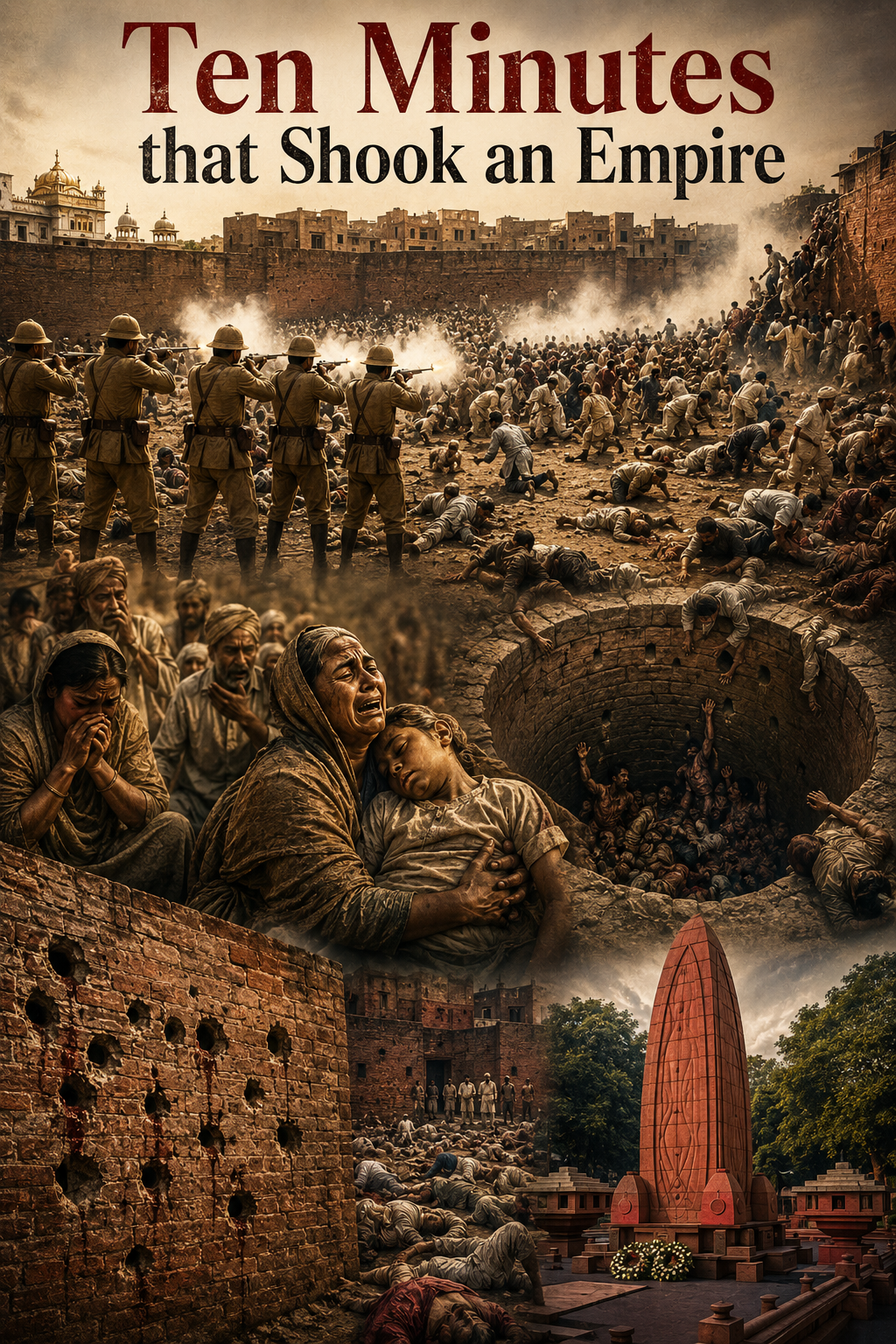
When word reached Dyer that a crowd had assembled anyway, he did not hesitate. Around five in the afternoon, he marched to Jallianwala Bagh with about fifty soldiers, Gurkha and Sikh riflemen of the British Indian Army, their Lee-Enfield rifles loaded and ready. Two armored cars trailed behind, mounted with machine guns, but the lane leading into the Bagh was too narrow for them to pass, and they were left waiting outside. Dyer led his men in on foot, climbed a small raised bank near the single exit, and positioned his riflemen in a line.
There was no warning. No order to disperse, no chance given for the crowd to leave. Dyer simply gave the command, and the soldiers opened fire directly into the packed mass of people.
For nearly ten minutes, the shooting continued. The soldiers fired roughly 1,650 rounds into a crowd that had nowhere to go. The single exit was blocked by the very men doing the shooting, so people scattered in every direction, screaming, climbing desperately at the high walls that enclosed them, trampling one another in the crush to escape an escape that didn’t exist. Some, in sheer desperation, threw themselves into a deep well inside the grounds, hoping the water might shield them from the bullets. It didn’t. When it was over, well over a hundred bodies were pulled from that well alone.


Dyer stopped only when his men were running low on ammunition. He gave the order to withdraw, and his soldiers marched out, leaving the wounded where they lay. No medical help was sent. That evening, a curfew fell over the city, so strict that families searching for missing husbands, sons, and daughters could not even go looking for them until morning came.
The official British inquiry, the Hunter Commission, would later record 379 dead and around 1,200 wounded. But Indian investigators, including a commission led by Madan Mohan Malaviya, believed the true toll was far higher — over a thousand killed, more than 1,500 wounded. Many of the dead were never identified at all. They were simply pilgrims who had come for a festival and never returned home, their names lost to families who would spend years not knowing exactly what had happened to them.
When Dyer was questioned afterward, he showed no remorse. He told the Hunter Commission plainly that he had meant to create a “moral and widespread effect” — that he would have kept firing longer if only he’d had more bullets. For this, he was relieved of his command, but he was never criminally charged. And in Britain, far from being universally condemned, he found admirers. A group of conservative supporters raised money to present him with a jewel-encrusted sword, inscribed with the words “Saviour of the Punjab.”
The massacre sent a shockwave through India and the wider world. Rabindranath Tagore, the poet and Nobel laureate, renounced the knighthood the British crown had given him, unable to hold it any longer in good conscience. Mahatma Gandhi, who had until then still held some hope for reform within the British system, saw in Jallianwala Bagh the final, undeniable proof that colonial rule had forfeited any moral claim to govern India. What had been scattered discontent across the subcontinent began, in the wake of that afternoon, to harden into something else entirely — a unified national movement that would not rest until the British left India for good, nearly three decades later, in 1947.
Today, Jallianwala Bagh stands as a national memorial. The walls still bear the pockmarks of rifle fire, preserved rather than repaired, and the well where so many died — now known as the Martyrs’ Well — remains as a quiet, permanent witness to the ten minutes that changed the direction of a nation’s history.












 https://www.youtube.com/watch?si=RtToJsBhYBatUrym&v=mOuYNSdhjHA&feature=youtu.be