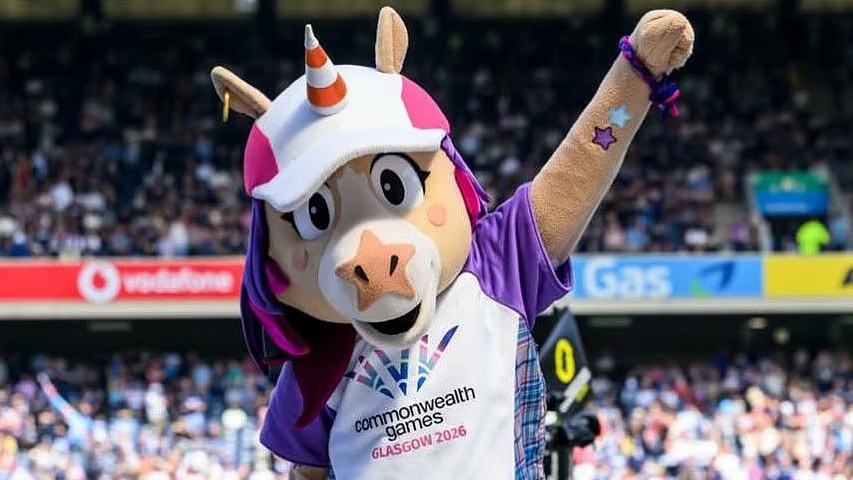
Glasgow: As the 2026 Commonwealth Games get underway in Glasgow on July 23, India enters one of its most challenging editions of the multi-sport event. Unlike previous Games, where expectations revolved around crossing the 60-medal mark and securing a top-four finish, this year’s campaign begins with significantly reduced medal prospects following a major overhaul of the competition programme.
The biggest setback for India is the exclusion of several sports that have traditionally formed the backbone of its Commonwealth Games success. Wrestling, badminton, table tennis, hockey, squash and women’s cricket—events that collectively accounted for nearly half of India’s medals at the 2022 Birmingham Games—are not part of the Glasgow schedule.

India won 61 medals in Birmingham, including 22 gold, 16 silver and 23 bronze, finishing fourth behind Australia, England and Canada. Of those, 30 medals came from sports that have now been removed from the programme. Wrestling alone contributed 12 medals, while table tennis delivered seven, badminton six, hockey and squash combined for four, and the women’s cricket team won a silver medal.
The reduction is not the result of sporting considerations but financial constraints. Australia was originally awarded hosting rights through the state of Victoria, but escalating projected costs—from around AUD 2.5 billion to nearly AUD 7 billion—forced the state government to withdraw. Glasgow stepped in to rescue the Games but opted for a scaled-down model using existing venues, hotel accommodation instead of a new athletes’ village, and a reduced list of sports to keep costs under control.
As a result, the Games now feature only 10 sports—athletics, swimming, track cycling, weightlifting, boxing, judo, artistic gymnastics, lawn bowls, netball and 3×3 basketball—with 215 gold medals on offer, compared to 19 sports at Birmingham.
India has sent a contingent of around 125 athletes, considerably smaller than the 210-member squad that competed in 2022. The country’s medal hopes now rest primarily on athletics, weightlifting, boxing and judo.
Even within these disciplines, the road will not be easy. Indian weightlifting and boxing have experienced mixed results since the Paris Olympics, with injuries affecting experienced stars such as Mirabai Chanu. At the same time, athletics has emerged as a growing source of optimism, with Indian competitors making steady progress in long jump, triple jump, race walking and several track events. A new generation of weightlifters and a blend of experienced and emerging boxers are also expected to shoulder the challenge.

Sports experts estimate India’s medal tally could range between 28 and 35 medals. While that would represent a sharp decline from Birmingham, it would still be considered a respectable outcome given the dramatically reduced number of medal opportunities.
The absence of marquee sports also means fans will miss several of India’s biggest stars. There will be no badminton featuring PV Sindhu or Lakshya Sen, no hockey led by Harmanpreet Singh, no wrestling events showcasing India’s traditional strength, and no women’s cricket team competing for medals.
India is not the only nation affected. Traditional Commonwealth powerhouses including Australia, England, Canada and New Zealand have also lost several of their strongest events. However, the impact is expected to be greatest on India because so much of its recent Commonwealth success has come in the sports omitted from this edition.
Beyond medals, Glasgow 2026 carries added significance as a crucial stepping stone ahead of the Asian Games later this year and the build-up to the Los Angeles 2028 Olympic Games. Strong performances from young athletes could accelerate their development and strengthen India’s future Olympic ambitions.
The Glasgow Games may ultimately be remembered not for the size of India’s medal haul but for testing the country’s ability to adapt. With many of its traditional medal-winning sports absent, India faces the challenge of proving it can build success across a broader range of disciplines. If the next generation rises to the occasion, Glasgow could mark the beginning of a new chapter for Indian sport rather than simply a reduced Commonwealth campaign.