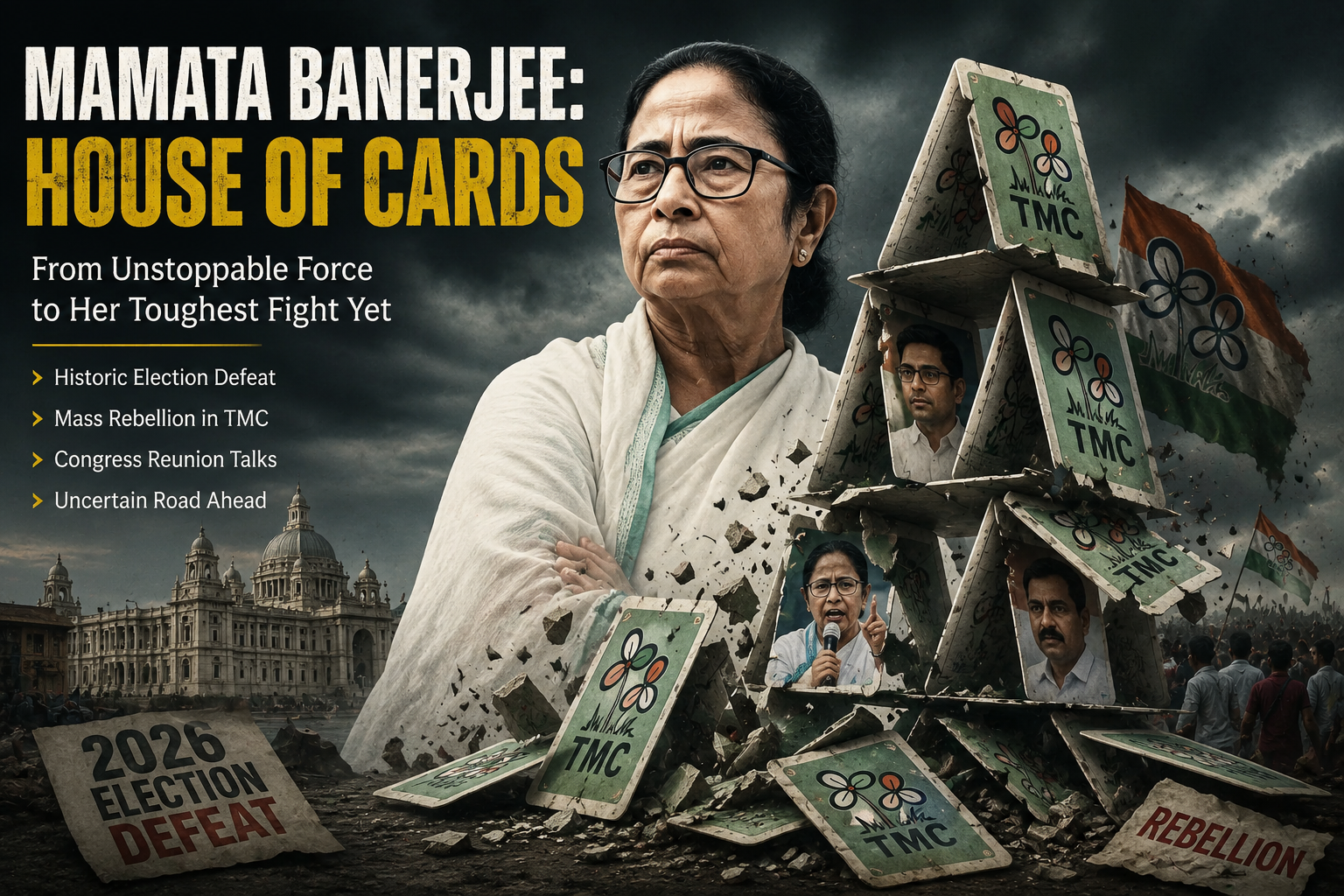
Kolkata: For more than a decade and a half, Mamata Banerjee stood as one of India’s most formidable regional leaders. She dismantled decades of Left Front dominance, built the All India Trinamool Congress into a powerful political force, and repeatedly defied predictions of her decline.
Today, however, Bengal’s most recognizable political figure finds herself confronting one of the most challenging phases of her public life.
Following the 2026 West Bengal Assembly elections, political discussions across the state and beyond have increasingly focused on the future of Banerjee, the cohesion of the Trinamool Congress, and the evolving balance of power in one of India’s most politically significant states.
Whether these developments ultimately represent a temporary setback or the beginning of a larger political transformation remains one of the biggest questions in contemporary Indian politics.
From Street Fighter to Bengal’s Most Powerful Leader
Mamata Banerjee’s political story has long been regarded as one of the most remarkable in modern India.
Born in Kolkata in 1955, she emerged from student activism and rose through the ranks of the Indian National Congress. Known for her combative style, relentless campaigning, and direct connection with ordinary voters, she quickly established herself as one of the most recognizable opposition voices in West Bengal.
Frustrated by what she viewed as the Congress party’s inability to effectively challenge the Left Front government, Banerjee broke away in 1998 and founded the Trinamool Congress.
The move transformed Bengal politics.
Over the next decade, she built a broad coalition of rural voters, minorities, women, youth, and anti-Left groups. Her grassroots campaigns against controversial land acquisition projects in Singur and Nandigram helped reshape the state’s political landscape and ultimately led to a historic breakthrough.
In 2011, Banerjee achieved what many had considered impossible: she ended 34 years of uninterrupted Left Front rule and became West Bengal’s first woman Chief Minister.
The victory was more than electoral. It symbolized a political revolution.
Years of Dominance
Once in power, Banerjee consolidated her position through a combination of welfare programmes, strong regional identity politics, and an image as Bengal’s defender against external political pressures.
Schemes aimed at women, students, and economically weaker sections earned widespread visibility. Her government promoted initiatives focused on social welfare, education, and direct benefits, helping create a loyal voter base.
Election after election, the Trinamool Congress expanded its reach.
The party successfully defeated challenges from the Left, Congress, and later the BJP, which emerged as its principal rival during the last decade.
Banerjee’s personal popularity became inseparable from the party itself.
Supporters saw her as “Didi”—an accessible leader deeply connected to ordinary citizens. Critics, meanwhile, argued that the party had become overly dependent on her leadership and lacked institutional depth beyond her personality.
That debate now appears more relevant than ever.
The Challenge of Longevity
Political history often demonstrates that long periods in power bring both achievements and vulnerabilities.
As governments age, public expectations evolve. Administrative fatigue, anti-incumbency sentiment, and internal factionalism become increasingly difficult to manage.
For the Trinamool Congress, governing for more than fifteen years inevitably created challenges.
Opposition parties repeatedly raised concerns regarding corruption allegations, organizational dominance by powerful local leaders, and governance shortcomings. The BJP, in particular, invested heavily in expanding its presence across Bengal, portraying itself as the primary alternative to Trinamool rule.
The contest gradually evolved into one of the fiercest political battles in India.
What had once been a multi-cornered contest increasingly became a bipolar struggle between the BJP and the Trinamool Congress.
Internal Strains and Questions About Succession
Beyond electoral competition, another issue has frequently surfaced within political discussions surrounding the Trinamool Congress: succession planning.
As Mamata Banerjee’s nephew, Abhishek Banerjee has emerged as one of the party’s most prominent faces, many observers have viewed him as a key figure in its future leadership structure.
Supporters argue that Abhishek represents generational renewal and organizational modernization.
Critics, however, have questioned whether the increasing prominence of family members risks creating perceptions of centralized decision-making and dynastic politics.
Such debates are not unique to Bengal. Similar questions have shaped political discourse across multiple parties in India.
Yet in moments of political stress, leadership issues often become magnified.
Whenever electoral setbacks occur, internal differences that previously remained hidden frequently become public.

The Congress Connection
Another intriguing dimension of current political speculation involves Banerjee’s historic relationship with the Congress.
Although she spent nearly three decades building an independent political identity after leaving the Congress, her roots remain deeply connected to the party.
The possibility of closer cooperation between opposition parties has generated recurring discussions about future alignments.
Some political observers believe that stronger coordination among anti-BJP parties could become increasingly important ahead of future national elections.
Others argue that regional parties like the Trinamool Congress derive their strength precisely from maintaining independent political identities.
For Banerjee, any discussion involving closer ties with Congress inevitably carries symbolic significance.
It would represent a full-circle moment in a career that began within the Congress ecosystem before evolving into one of the most successful regional political movements in India.
Whether such speculation translates into reality remains uncertain.
For now, it remains part of a broader conversation about opposition politics and coalition-building in India.
The BJP Factor
Regardless of internal developments within the Trinamool Congress, the rise of the BJP in West Bengal represents one of the most significant political shifts of the past decade.
Traditionally viewed as a peripheral force in Bengal politics, the BJP gradually transformed itself into a major electoral contender.
The party’s growth reflected changing voter preferences, organizational expansion, and its ability to position itself as the principal challenger to Trinamool dominance.
For the BJP, success in Bengal carries national significance.
The state is one of India’s largest electoral battlegrounds and has historically shaped national political narratives.
Any weakening of the Trinamool Congress therefore creates opportunities not only at the state level but also within broader national political calculations.
A Defining Moment
At 71, Mamata Banerjee remains one of India’s most experienced and resilient political leaders.
Her career has been defined by adversity.
She fought powerful political establishments, survived repeated setbacks, and repeatedly reinvented herself when many believed her political journey was nearing its end.
That history explains why many observers remain cautious about writing her political obituary.
Indian politics has repeatedly demonstrated that leaders who appear weakened can stage dramatic comebacks.
Yet it is equally true that political dominance is never permanent.
The challenges facing Banerjee today—organizational cohesion, leadership transition, electoral competitiveness, and evolving voter expectations—are among the most complex she has encountered.
The Road Ahead
The coming years will likely determine how history ultimately remembers Mamata Banerjee’s political legacy.
Will she engineer another comeback and reassert her influence over Bengal politics?
Can the Trinamool Congress adapt to a changing political environment while preserving its core support base?
Will opposition realignments reshape the national political landscape?
Or will Bengal witness the emergence of a new political era dominated by different forces?
The answers remain uncertain.
What is certain is that Mamata Banerjee remains one of the defining figures of modern Indian politics. Her journey—from Congress activist to founder of a regional powerhouse, from opposition crusader to Chief Minister, and now through a period of intense political scrutiny—continues to shape the story of West Bengal.
For supporters, critics, and political observers alike, the next chapter promises to be among the most consequential of her long and eventful career.