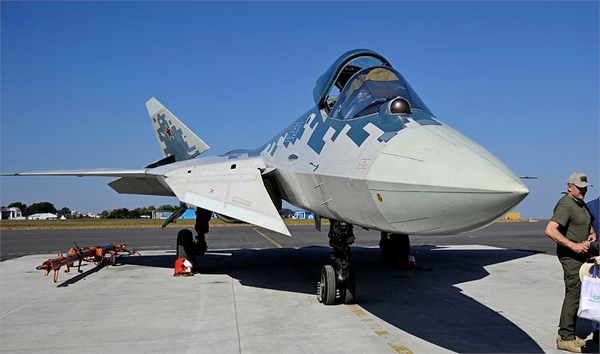
Moscow: In a significant development for India-Russia defence ties, Russian President Vladimir Putin has expressed Moscow’s willingness to deepen cooperation with India on the fifth-generation Sukhoi Su-57 fighter jet programme, including potential technology sharing and joint development opportunities.
Speaking during an interaction with heads of major global news agencies in St. Petersburg, Putin described the Su-57 as one of the world’s most advanced combat aircraft and said Russia sees no obstacles to collaborating with India on the project. His remarks have reignited discussions about future defence cooperation between the two long-standing strategic partners.

Russia Signals Openness to Joint Development
According to Putin, Russia had previously envisioned the possibility of developing the fifth-generation fighter programme in partnership with India. While Moscow ultimately pursued the aircraft’s development independently, he indicated that Russia remains open to working closely with New Delhi on the platform.
The Russian leader also suggested that cooperation could extend beyond fighter aircraft to include advanced air defence systems and other strategic military technologies. The comments underscore Russia’s continued view of India as one of its most important defence and security partners.
Renewed Interest in a Once-Abandoned Project
India had earlier withdrawn from a proposed fifth-generation fighter aircraft collaboration linked to the Su-57 programme in 2018. At the time, concerns were reportedly raised regarding the aircraft’s performance parameters, stealth capabilities, engine development, and overall suitability for the Indian Air Force’s operational requirements.
However, recent reports have indicated renewed interest in the aircraft, with speculation that India could evaluate the possibility of acquiring between 40 and 50 Su-57 fighters in the future. No official confirmation has been issued by Indian authorities regarding any such procurement plan.
Technology Transfer Could Be a Key Factor
One of the most significant aspects of the latest Russian proposal is the indication of extensive technology cooperation.
Russian officials have reportedly signalled flexibility regarding several longstanding Indian requirements, including technology transfer and greater domestic manufacturing participation. Reports suggest that Moscow may be willing to discuss sharing elements of the aircraft’s software architecture and source code while exploring production arrangements within India.
If pursued, such an arrangement could provide a substantial boost to India’s defence manufacturing ambitions under the “Make in India” initiative.

Industry observers believe that Hindustan Aeronautics Limited (HAL) could play a central role in any future production or assembly programme involving the Su-57 in India. Russian agencies are also understood to be studying potential investment frameworks for a deeper industrial partnership.
Strong Defence Ties Remain Intact
The proposal comes amid continued efforts by both nations to strengthen their longstanding defence relationship.
Sergei Chemezov, chief executive of Russian state defence conglomerate Rostec, reaffirmed the strength of India-Russia strategic cooperation. He noted that Russia has consistently supported India’s defence requirements and continued supplying military equipment even during periods marked by international sanctions and geopolitical challenges.
Chemezov emphasized that Moscow remains committed to meeting India’s future security needs and expanding defence-industrial cooperation.
Putin Comments on Oreshnik Missile
During the same interaction, Putin also made notable remarks regarding Russia’s new-generation Oreshnik missile system. He stated that the missile has not yet been deployed in combat operations, a comment that has attracted attention among international defence analysts and strategic observers.
The statement has fueled further discussion about Russia’s evolving military capabilities and future defence planning, particularly as global attention remains focused on advanced weapons systems and strategic deterrence technologies.
Strategic Implications
Defence experts believe Russia’s latest offer reflects Moscow’s intent to maintain its position as a key military partner for India at a time of increasing competition in the global defence market. For India, any decision regarding the Su-57 would likely be evaluated against broader objectives, including indigenous fighter development, operational requirements, technology access, and long-term strategic autonomy.
While no formal agreement has been announced, Putin’s remarks have injected fresh momentum into discussions surrounding next-generation military aviation cooperation between New Delhi and Moscow. If translated into concrete negotiations, the proposal could mark a significant new chapter in the decades-long defence partnership between the two countries.






 ---------------------------------------------------------------------------------------------------