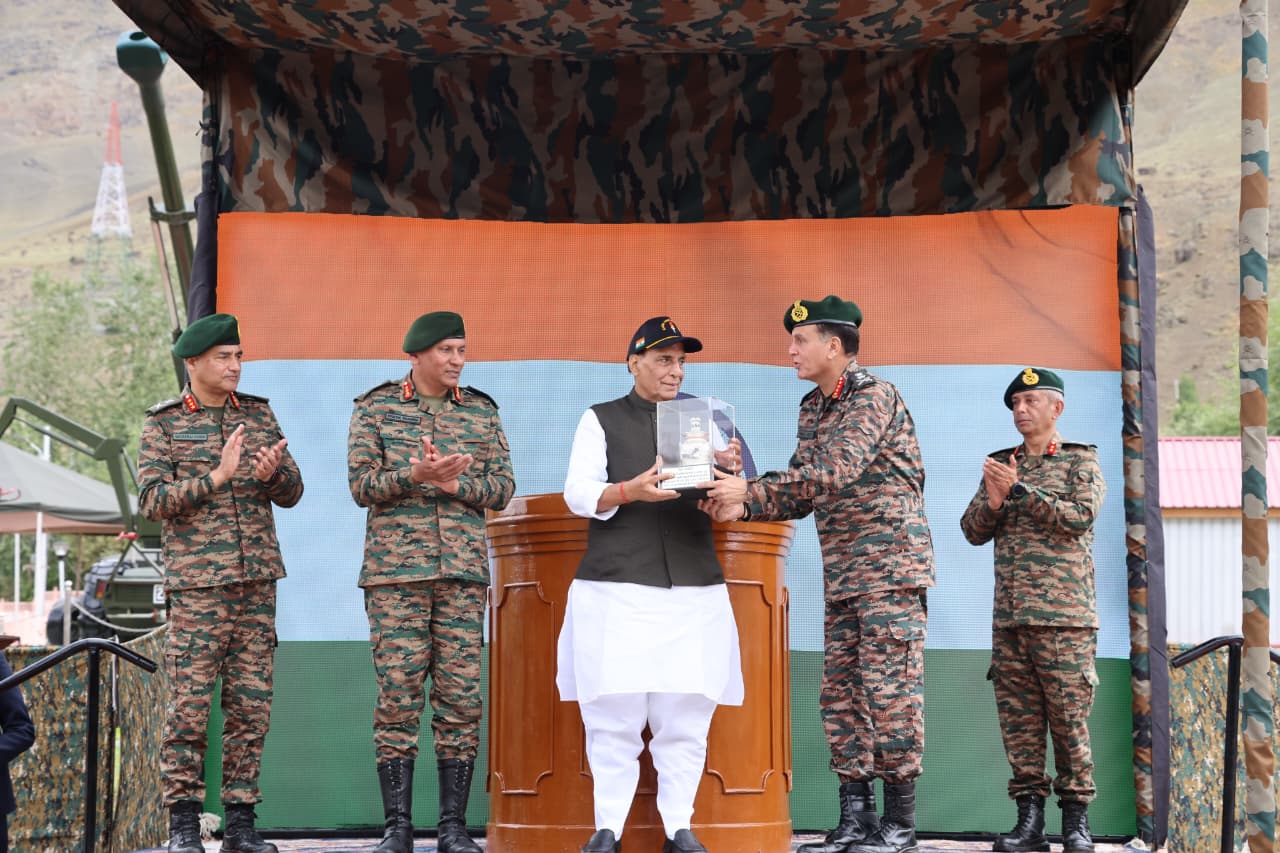
Dras: Defence Minister Rajnath Singh said Operation Sindoor has demonstrated India’s ability to respond decisively to cross-border terrorism, asserting that any future provocation from Pakistan would be met with a stronger and more determined response. Addressing the 27th Kargil Vijay Diwas commemorations at the Kargil War Memorial in Dras, he reiterated that India would hold both terrorists and those supporting them equally accountable.
Referring to the operation as a defining example of India’s military capability, Singh said Pakistan had blurred the distinction between state institutions and terrorist organisations by providing shelter and support to extremist groups. He emphasised that India’s response during Operation Sindoor reflected a shift in its counter-terrorism approach, targeting both terrorist infrastructure and its enablers.
The Defence Minister also ruled out broad bilateral dialogue with Pakistan, stating that if talks were to take place, they would focus solely on Pakistan-occupied Kashmir (PoK), which he described as an integral part of India.
Drawing a contrast between the two neighbours, Singh said India was advancing through innovation, technology, manufacturing and digital transformation, while Pakistan continued to promote terrorism, infiltration and radicalisation. He said India was investing in semiconductors, space technology, start-ups and digital payment systems, whereas Pakistan remained focused on supporting extremist networks.
Paying tribute to the soldiers who laid down their lives during the 1999 Kargil War, Singh remembered Param Vir Chakra awardees Captain Vikram Batra and Captain Manoj Kumar Pandey, saying their courage and sacrifice continue to inspire future generations. He described Kargil Vijay Diwas as a reminder that national service and sacrifice remain the foundation of a strong nation.


Highlighting the government’s commitment to national security, Singh said India has significantly strengthened border infrastructure while accelerating military modernisation. He noted that indigenous defence manufacturing has expanded substantially, with nearly 65 per cent of defence equipment now produced within the country, compared to India’s earlier dependence on imports.
He listed several homegrown platforms now serving the armed forces, including the INS Vikrant aircraft carrier, Tejas light combat aircraft, Prachand light combat helicopter, Dhruv advanced light helicopter, Arjun main battle tank, Pinaka multi-barrel rocket launcher, Astra air-to-air missile, Akash-Teer air defence control system, next-generation Akash missile, and advanced drones and counter-drone systems. Invoking Captain Vikram Batra’s famous slogan, “Yeh Dil Maange More”, Singh said India would continue pursuing self-reliance by developing next-generation fighter aircraft, submarines and missile systems.
The Defence Minister also stressed that achieving the vision of Viksit Bharat 2047 requires not only economic growth but also strategic strength, national unity and social harmony. He urged citizens to embrace a “Nation First” spirit, adding that every Indian should possess the discipline, resilience and patriotism exemplified by the country’s soldiers.
Earlier in the day, Singh laid a wreath at the Kargil War Memorial and observed silence in honour of the martyrs of Operation Vijay. He inaugurated a Virtual Walkthrough Portal showcasing the history of the Kargil War, visited the Hut of Remembrance and Veer Bhoomi, and flagged in the Shaurya Vijay Yatra motorcycle rally. The ceremony was attended by senior military leaders, including Army Chief General Dhiraj Seth, Lieutenant Governor of Ladakh Vinai Kumar Saxena, veterans, gallantry awardees, Veer Naris, families of fallen soldiers and local citizens.












 https://www.youtube.com/watch?si=RtToJsBhYBatUrym&v=mOuYNSdhjHA&feature=youtu.be