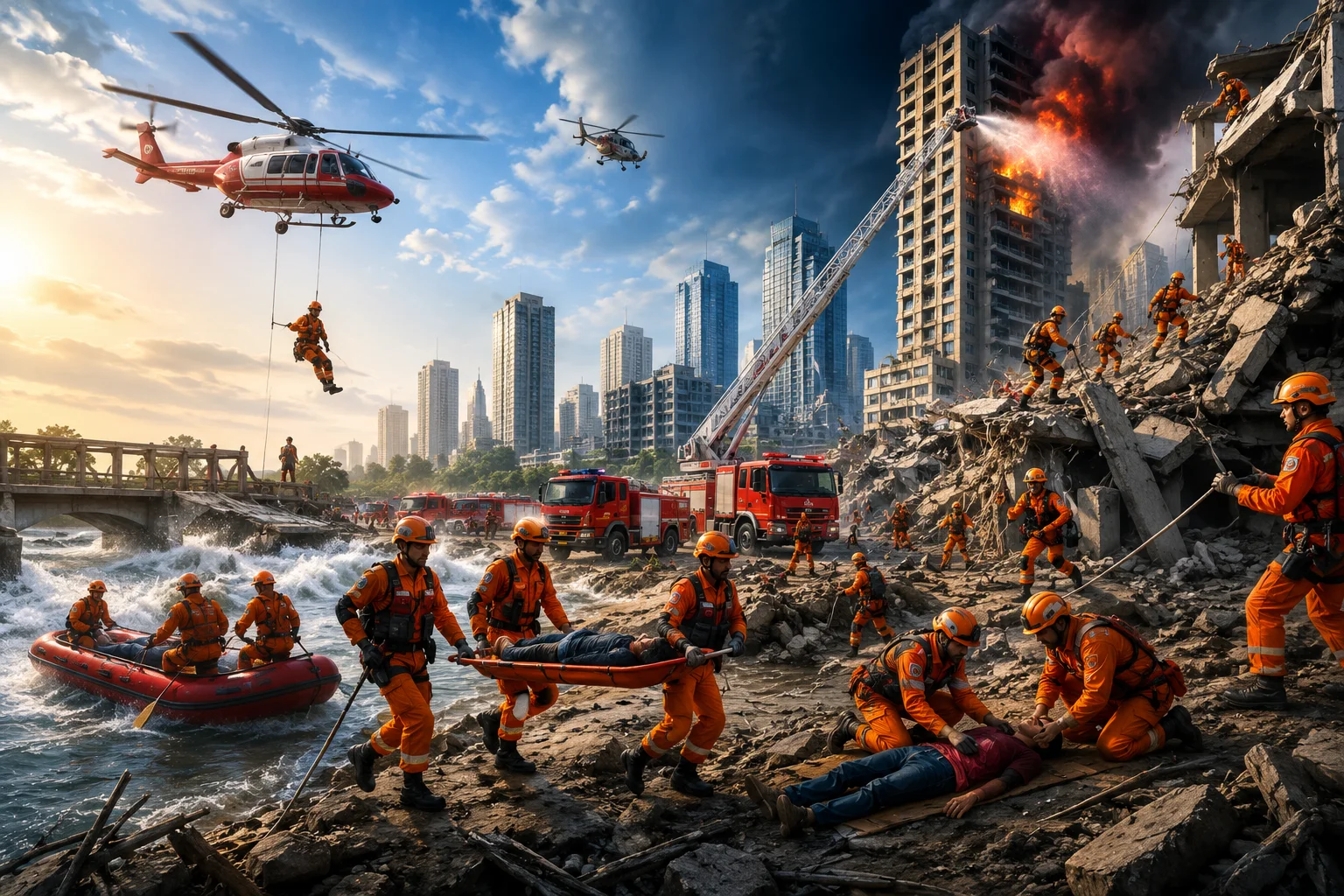
LUCKNOW — In a major move to revolutionize disaster management and emergency response, the Uttar Pradesh government is establishing a highly specialized elite force called the Specialized Rescue Group (SRG). Orchestrated under the direct instructions of Chief Minister Yogi Adityanath, this dedicated unit will drastically shift the state’s firefighting department from a traditional fire-extinguishing force into an advanced, multi-dimensional life-saving agency.
🏗️ Elite Training and Strategic Deployment
In its initial phase, the SRG will be deployed across 10 high-priority districts. The foundational cohort consists of 240 handpicked personnel who will undergo advanced tactical training.

To prepare them for complex rescue scenarios, these operatives will be trained at India’s premier elite security and defense training institutions, including:
-
National Disaster Response Force (NDRF)
-
Border Security Force (BSF)
-
Indo-Tibetan Border Police (ITBP)
-
Central Industrial Security Force (CISF)
Equipped with cutting-edge tech, the SRG will serve as a rapid-response unit specializing in complex urban operations such as structural collapses, heavy floods, chemical, biological, radiological, and nuclear (CBRN) disasters, high-rise building extractions, and confined-space rescues.
🏢 Tackling the High-Rise Challenge in Major Cities
During a comprehensive review meeting of the Firefighting and Emergency Services Department, Chief Minister Adityanath noted that rapid urban, industrial, and economic growth requires a synchronized upgrade in civil safety infrastructure.
With sky-high vertical growth transforming the skylines of major financial and cultural hubs—specifically Noida, Ghaziabad, Lucknow, Kanpur, Varanasi, and Prayagraj—the state has finalized a massive procurement blueprint for the fiscal year 2026–27 to manage vertical hazards:
-
Hydraulic Platforms: The state is acquiring ten 102-meter, three 90-meter, and seven 72-meter ultra-high hydraulic platforms.
-
Skyscraper Fire-Fighting Vehicles: Procurement is underway for 14 specialized firefighting vehicles engineered with advanced technologies capable of suppressing fires up to 100 stories high.

📈 The Post-2017 Fire Service Transformation
The upcoming infrastructure expansion builds on a steady growth trajectory maintained by the department over the last decade.
🔍 Aggressive Fire Audits and Public Safety Frameworks
To mitigate fire risks at the grassroots level, the department executed over 1.20 lakh fire audits during the 2025–26 cycle. Alongside these safety checks, authorities conducted over 31,000 mock drills and 75,000 specialized training modules, reaching out to an estimated 16.55 lakh citizens via mass awareness campaigns.
The Chief Minister has issued strict instructions to enforce zero-tolerance policy compliance and mandatory, regular fire audits across vulnerable public spaces, including:
-
Multi-specialty hospitals and healthcare facilities
-
Hotels, commercial arcades, and high-occupancy corporate hubs
-
Educational institutions and schools
-
High-rise residential apartments
💼 Streamlining Business Infrastructure: Fire NOC Reforms
To support industrial investments and enhance the ease of doing business, the state has fully integrated its Fire Service Portal with the advanced Nivesh Mitra 3.0 platform, making the Fire No-Objection Certificate (NOC) process highly transparent and time-bound.
As an investor-friendly measure, the validity of the Fire NOC has been extended from three years to five years. Demonstrating the efficiency of this digital transition, out of 14,717 online applications received between January 1 and May 31, 2026, the department successfully processed and issued clearances for 10,670 cases.
👥 Community Integration: The Rise of ‘Agnimitras’
The government has successfully met its targeted benchmark of establishing a local civil defense line by preparing dedicated Agnimitras and Agnisachetaks across every single administrative block in Uttar Pradesh.
In 2026 alone, approximately 44,000 community volunteers underwent rigorous refresher training. Moving into the next phase of community-driven emergency management, the state is developing a dedicated web portal and mobile application while formally integrating the Civil Defense, Homeguards, and the Provincial Rakshak Dal (PRD) units into this network.




 ---------------------------------------------------------------------------------------------------