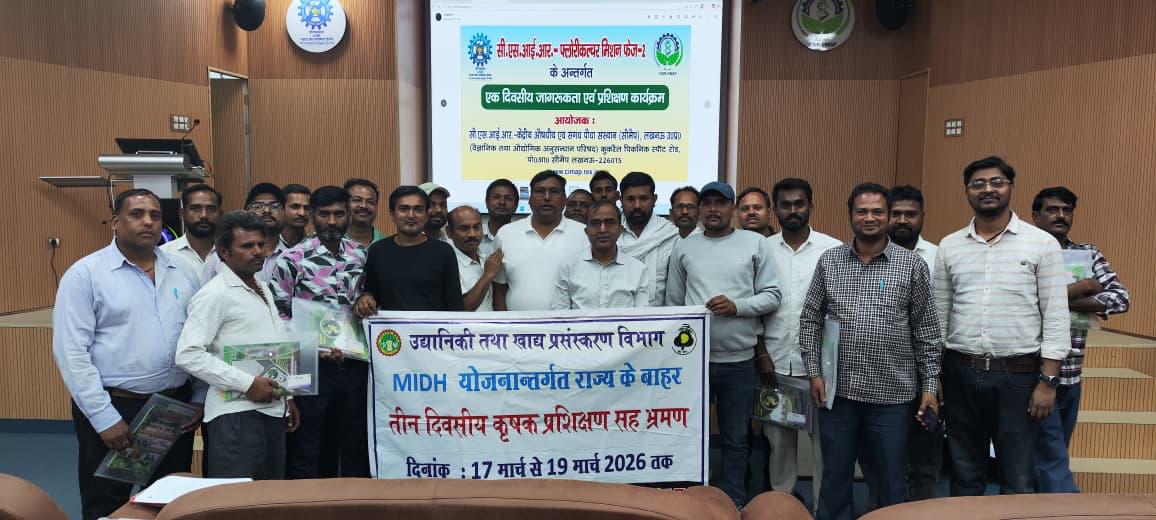
Lucknow: The CSIR-Central Institute of Medicinal and Aromatic Plants organized a one-day awareness and training programme for farmers from Satna district of Madhya Pradesh, aimed at enhancing their skills in scientific cultivation and value addition under the Aroma Mission Phase–III and Floriculture Mission Phase–II.
The programme, conducted in collaboration with the Department of Horticulture and Food Processing, Satna, brought together farmers from seven blocks of the district.
The initiative focused on promoting sustainable agricultural practices, diversification of crops, and income generation through high-value medicinal, aromatic, and floriculture crops.
A team of experts including Dr. Rakshpal Singh, Dr. Anil Kumar Singh, Dr. Rajendra Prasad Patel, and Swapnil Srivastava led the technical sessions.
They provided in-depth guidance on the scientific cultivation, crop management, and market potential of various high-demand crops.
Farmers were trained in the cultivation of floriculture crops such as marigold, rose, tuberose, and jasmine, along with medicinal plants including ashwagandha, kalmegh, and tulsi.
The sessions also covered aromatic crops like lemongrass, palmarosa, and geranium, which are increasingly gaining importance due to their essential oil value and industrial applications.
In addition to cultivation techniques, the programme strongly emphasized value addition and waste-to-wealth approaches.

Farmers received practical demonstrations on innovative income-generating activities such as producing biodegradable cutlery from agricultural residues, vermicomposting, mushroom cultivation, and preparation of value-added products like rose water and incense sticks.
The training aimed to equip farmers with scientific knowledge and entrepreneurial skills, enabling them to adopt diversified farming systems and enhance their livelihoods through sustainable practices.
Participating farmers expressed their appreciation to Dr. Zabeer Ahmed and Dr. Rajesh Kumar Verma for facilitating such a comprehensive programme.
They noted that the exposure to advanced techniques and value-addition models would significantly contribute to improving their income and farming practices.
The initiative reflects CIMAP’s continued commitment to strengthening rural economies by bridging the gap between scientific research and grassroots farming communities.