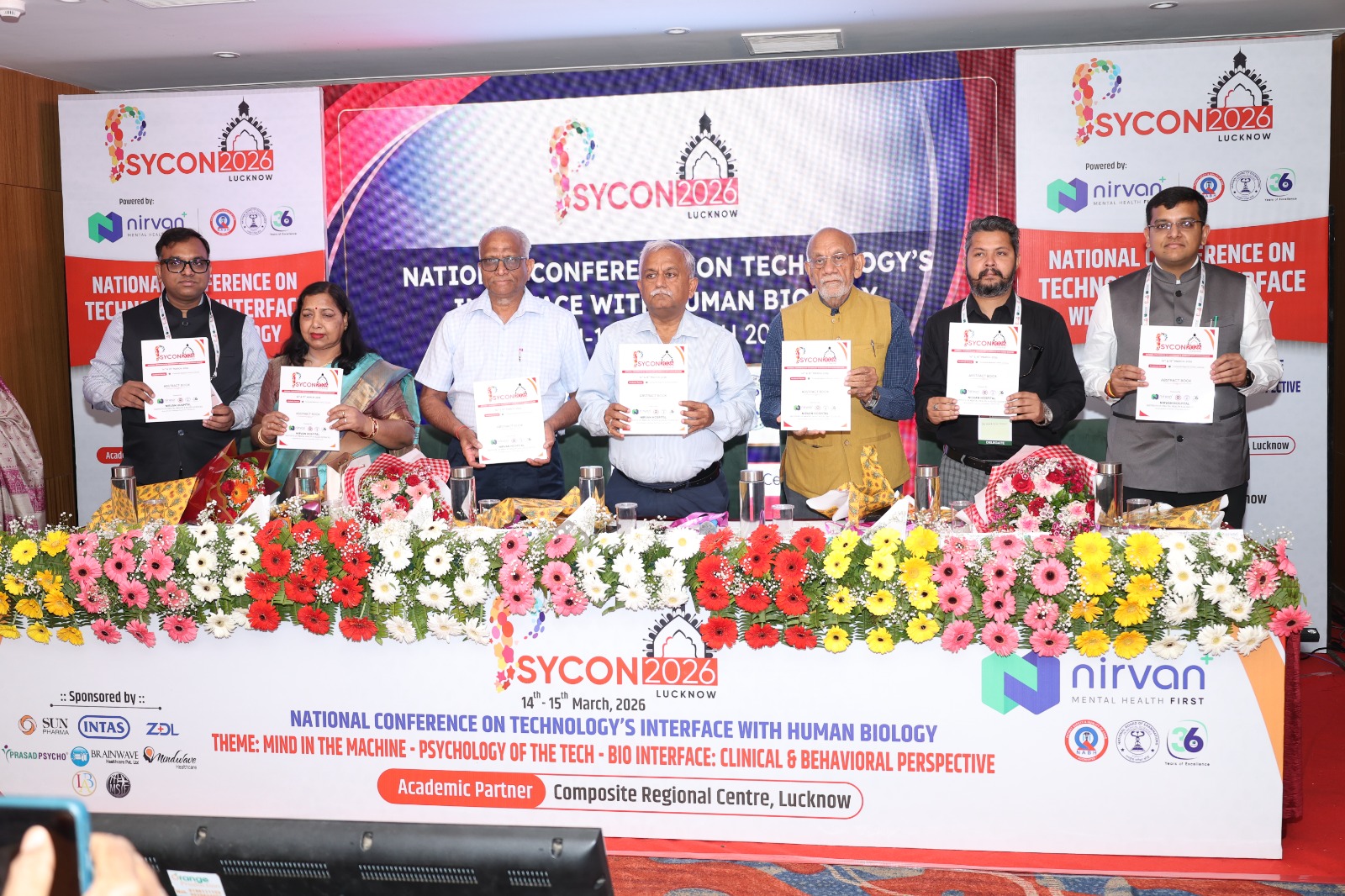
Lucknow, March 14, 2026:
Discussion on the changing relationship between mental health and technology under the theme “Mind in the Machine.” In a rapidly changing environment, caring for mental health has become essential. “What time is it?”—the answer to this question is usually the first thing people check on their phones after waking up in the morning. During college days, students often join their classes through WhatsApp groups. From that moment, many begin to fall into the grip of their mobile devices. Various topics related to digital dopamine and its effects were discussed during the two-day national conference ‘Psycon 2026.’

Experts discussed how technology is rapidly becoming an integral part of our lives and how it is influencing our thinking, emotions, behavior, and even our decision-making abilities.
The conference was organized by Nirvan Hospital, with participation from psychiatrists, psychologists, researchers, and healthcare professionals from across the country. The inaugural session was attended by the Chief Advisor to the Honorable Chief Minister of Uttar Pradesh, Mr. Awanish Kumar Awasthi, as the chief guest.
Other notable attendees included:
Dr. H. K. Agrawal, Founder Chairman and Managing Director, Nirvan Hospital, Dr. Deeptanshu Agrawal, Medical Director, Nirvan Hospital, Dr. T. B. Singh, Former Head of the Department of Psychology, IHBAS, Delhi, Dr. Pranjal Agrawal, Director, Nirvan Hospital, Mrs. Astha Sharma, Head of the Department of Clinical Psychology, Nirvan Hospital, Mr. Himanshu Singh, Director, Composite Regional Center (CRC), Lucknow and Organizing Secretary of Psycon-2026.
The theme of the conference was “Mind in the Machine: The Relationship Between Technology and Human Biology.” Through this theme, experts attempted to understand how technology is influencing the human brain, emotions, and behavior.
Specialists highlighted that in the pursuit of likes and shares, many people are losing their mental peace. Excessive phone usage among pregnant women may also negatively affect the unborn child. Meanwhile, excessive screen time among children is linked to problems such as obesity, drug abuse, insomnia, and reduced cognitive ability.

On the first day of the conference, discussions were held on several topics including the disadvantages of constantly being online, the origins of sexual aggression, the psychology of storytelling, the impact of excessive online activity on writing, the effects of a sedentary modern lifestyle and the digital world on the human body, and the evolving relationship between age, technology, and its psychological impact.
Dr. H. K. Agrawal, Founder Chairman and Managing Director of Nirvan Hospital, said that technology is giving a new direction to mental health services today. The aim of the conference is to bring experts together on a single platform to understand these changes and find solutions that are safe and effective for patients.
Chief guest Mr. Awanish Kumar Awasthi (Retd. IAS) said that mental health is one of the most important and sensitive areas in the country and deserves serious attention. During the COVID-19 pandemic, a large number of people were confined to their homes, including working professionals, women, and students, many of whom experienced significant mental stress. In response, the government collaborated with the health department and clinical psychologists to provide support.
He added that integrating artificial intelligence with clinical psychology and mental health services could lead to unprecedented results. There is also a pressing need to find solutions for issues like drug abuse and rehabilitation through clinical psychology, as both boys and girls among students are increasingly falling into its grip.
Prof. (Dr.) Tej Bahadur Singh, Former Professor of Clinical Psychology, stated that clinical psychology today stands at a point where human understanding and rapidly evolving technology are progressing together. The responsibility of mental health professionals is not limited to treatment; it also includes understanding the new challenges of a changing world.
He noted that artificial intelligence and digital technologies are opening new possibilities for the early detection of mental disorders, better assessment, and personalized treatment. However, alongside technological advancement, sensitivity and a human-centered approach must always remain at the core of mental health care.