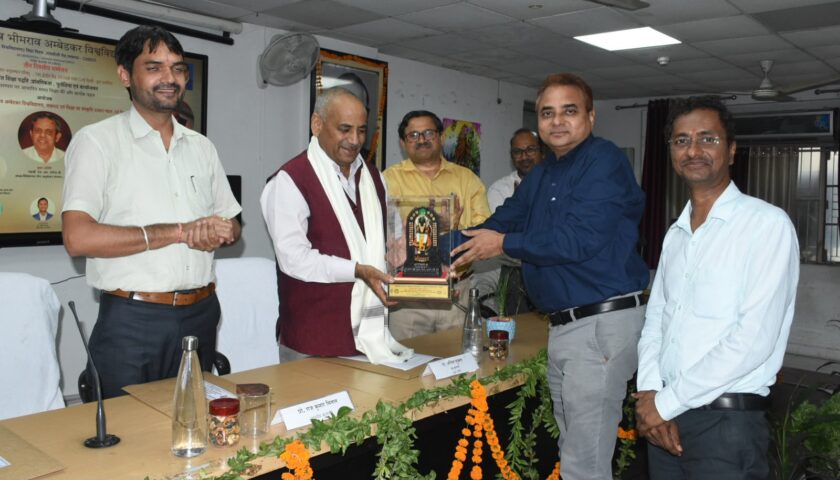
Lucknow: As artificial intelligence (AI) and rapid technological advancements continue to transform industries across the globe, higher education institutions must move beyond preparing students for their first job and instead equip them to navigate multiple career transitions throughout their lives, education leaders said during an Open House hosted by World Peace University (WPU) Goa in Lucknow.
The event brought together prospective students, parents, educators, and media representatives to discuss the future of higher education and the evolving demands of an increasingly dynamic and unpredictable job market. The discussions focused on WPU Goa’s transdisciplinary model of education, which combines disciplinary expertise with the ability to think across domains, adapt to change, and solve complex real-world challenges.
Addressing the gathering, Vice Chancellor Prof. Walter Leal said WPU Goa is being established with a transdisciplinary vision that encourages both students and faculty to think beyond conventional academic boundaries.
“WPU Goa emphasizes experiential learning, industry engagement, global exposure, and self-directed learning alongside academic excellence. Our goal is to nurture graduates who remain lifelong learners, adapt to changing circumstances, and emerge as leaders in their chosen fields,” he said.
Highlighting the changing nature of careers, Dr. Ashish Bharadwaj, Pro Vice Chancellor of WPU Goa, stressed that universities can no longer assume that preparing students for their first job is sufficient.
“The more important question is whether we are preparing students for the multiple transitions, opportunities, and disruptions they will encounter throughout their lives. The future belongs not only to specialists but to individuals who can continuously learn, connect ideas across disciplines, and tackle challenges that do not fit neatly into traditional categories,” he said.
The discussion examined how long-standing assumptions about higher education are being challenged as industries evolve faster than traditional academic cycles. New professions are emerging, established roles are being transformed, and success increasingly depends on the ability to integrate expertise from multiple fields.
During a press interaction, Associate Dean Dr. Swati Bankar and Associate Director Dr. Ravishankar Sahu elaborated on the university’s academic philosophy, admissions process, industry partnerships, and placement opportunities.
Dr. Bankar explained that admissions to programmes such as Management Studies and Psychology will be based on the university’s entrance examination, while B.Tech admissions will recognize JEE scores. Government-recognized entrance examination scores will be accepted for design programmes, and candidates without such scores can appear for the WPU entrance test.
She highlighted the institution’s strong academic legacy and industry network, noting that the WPU group has more than 45 years of educational experience and over 86,000 students enrolled across five universities. More than 1,000 companies are associated with the university network, creating extensive employment opportunities for graduates.

“Students need not worry about placements. Our long-standing relationships with industry partners ensure strong career opportunities across sectors,” she said.
Dr. Bankar further informed that the Goa campus has an intake capacity of 180 students and expressed confidence that around 125 to 130 students would come from Uttar Pradesh, particularly from Lucknow and Kanpur, reflecting the growing interest among students from the state.
Speaking on the university’s academic innovation, Dr. Ravishankar Sahu said WPU Goa aims not merely to teach students how to use AI but to prepare them to work effectively alongside it.
“Our curriculum integrates emerging fields such as Artificial Intelligence, Machine Learning, Data Science and Analytics, Cyber Security, and Intelligent Systems. We are implementing an AI-native education model where students become part of an AI-enabled learning ecosystem from their very first day on campus,” he said.
According to Dr. Sahu, students will spend four years learning how to critically evaluate AI-generated information, identify reliable sources, and apply AI tools responsibly and effectively in professional settings.
He revealed that before developing its transdisciplinary education framework, the university conducted extensive consultations with industry leaders, scientists, researchers, and academicians across 28 Indian states and 10 major global cities. Several contributors to the study are among the world’s top two percent researchers.
“The consensus from these discussions was clear: a transdisciplinary approach is the most effective way to prepare students for the future of education, innovation, and employment. WPU Goa is the outcome of that global research and dialogue,” he said.
At a time when students and parents are seeking clarity about the future of work in an AI-driven world, the discussions reinforced the need for higher education institutions to focus not only on employability but also on adaptability, resilience, critical thinking, and lifelong learning.
WPU Goa currently offers programmes including B.Tech in Computer Science and Engineering (CSE), Bachelor of Management Studies (Honours), B.Des in Integrated Product Design, B.Des in Communication Design, and B.Sc. (Honours) in Psychology, all designed around its transdisciplinary educational philosophy.











 https://www.youtube.com/watch?si=RtToJsBhYBatUrym&v=mOuYNSdhjHA&feature=youtu.be