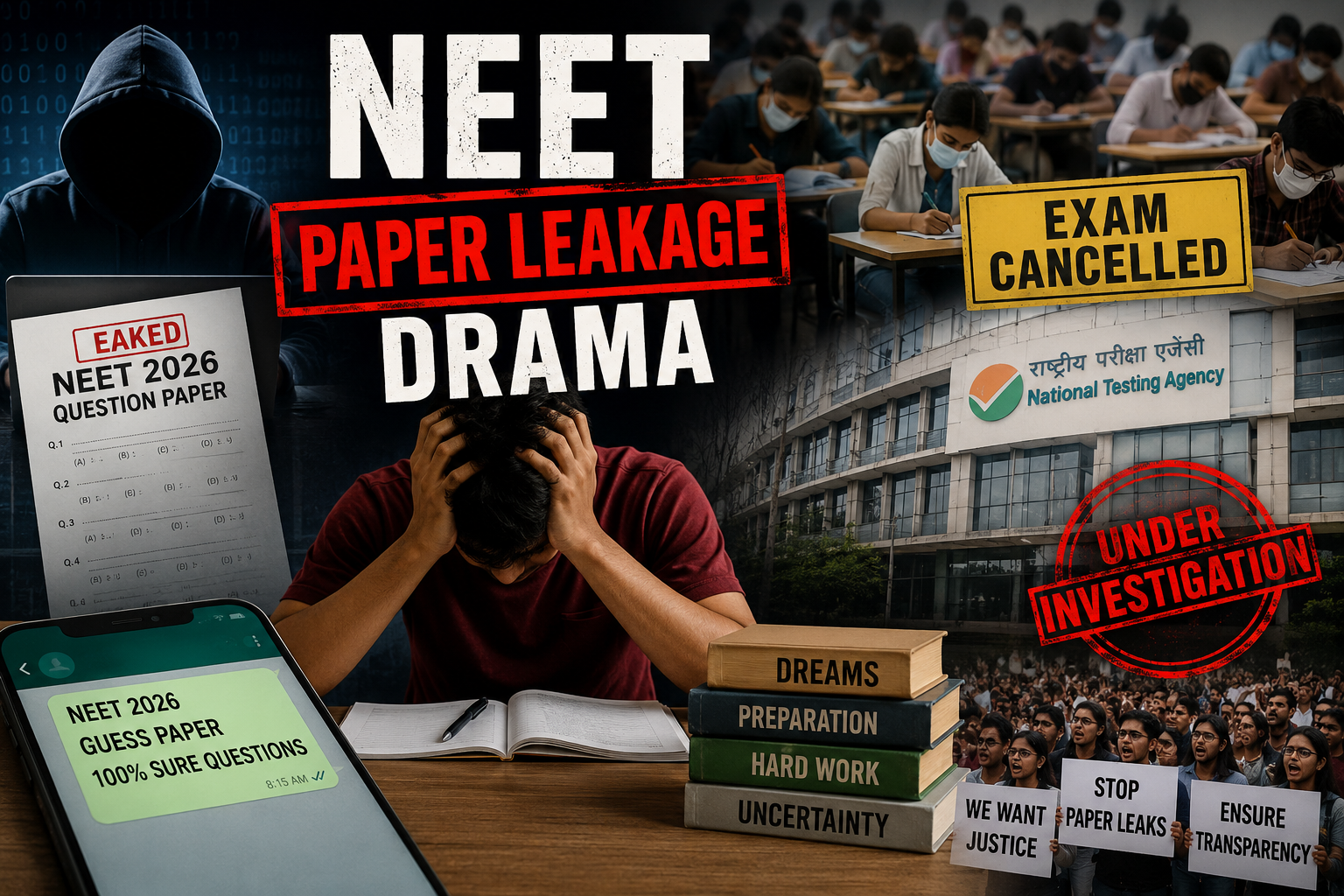
New Delhi: In India’s highly competitive medical entrance ecosystem, the credibility of the NEET-UG is once again under intense scrutiny after the 2026 examination was plunged into controversy, raising serious questions about systemic failure, accountability, and student welfare.
On May 3, 2026, more than 2.2 million aspirants appeared for the NEET-UG examination with dreams of entering India’s premier medical institutions such as AIIMS and JIPMER. However, within days, allegations of irregularities and question paper discrepancies surfaced, triggering nationwide concern. On May 12, the National Testing Agency (NTA) reportedly cancelled the examination and handed over the investigation to the Central Bureau of Investigation (CBI), sending shockwaves across the country.

Preliminary findings, including inputs from state-level investigations in Rajasthan, pointed towards suspected links between leaked “guess papers” and actual exam questions. This has deeply undermined confidence in the transparency and fairness of one of India’s most critical competitive examinations.
The impact of the controversy has been devastating for students. Many aspirants, especially from rural areas and small towns, invest years of preparation, coaching fees, hostel expenses, and emotional energy into a single attempt. For them, NEET is not just an exam but a gateway to social mobility and financial stability. The abrupt cancellation has pushed their future into uncertainty, leaving them psychologically and emotionally distressed.
Families, particularly from the middle class, who often stretch their financial limits to support coaching and preparation, are now facing not just monetary losses but emotional trauma. In many households, anxiety and frustration are rising as parents question whether their children’s future will remain perpetually uncertain under the current examination framework.
Despite multi-layer security systems, digital surveillance, flying squads, and sealed protocols, repeated allegations of paper leaks and question mismatches highlight deep structural vulnerabilities. Reports of alleged “guess paper” similarities emerging from coaching hubs such as Sikar suggest that the issue may extend beyond examination centers and into the broader question-setting and distribution chain.

Experts argue that cancelling exams after irregularities are detected unfairly shifts the burden onto students while accountability within the system remains weak. The recurring pattern raises a critical question: at which stage is the failure occurring, and who is responsible for it?
While the NTA has stated that candidates will not need to reapply and that fees will be refunded, uncertainty around new examination dates has disrupted the entire medical admission calendar. Any delay in the academic cycle of medical courses is expected to have long-term consequences for healthcare education in India.
The controversy has also cast a shadow over the integrity of India’s top medical institutions, further intensifying student demands for stronger safeguards, independent oversight, and real-time transparency in the examination process.
Although the CBI investigation offers hope for identifying those responsible, experts emphasize that investigation alone is not enough. Structural reforms—covering paper setting, storage, transport, and examination execution—are urgently needed. Without strict accountability mechanisms, such failures are likely to repeat.
As NEET continues to determine the future of millions of students, the growing crisis is no longer just an academic issue but a national concern. The repeated breakdowns in trust have triggered a larger question: can India’s premier medical entrance system be reformed before the confidence of an entire generation is permanently eroded?