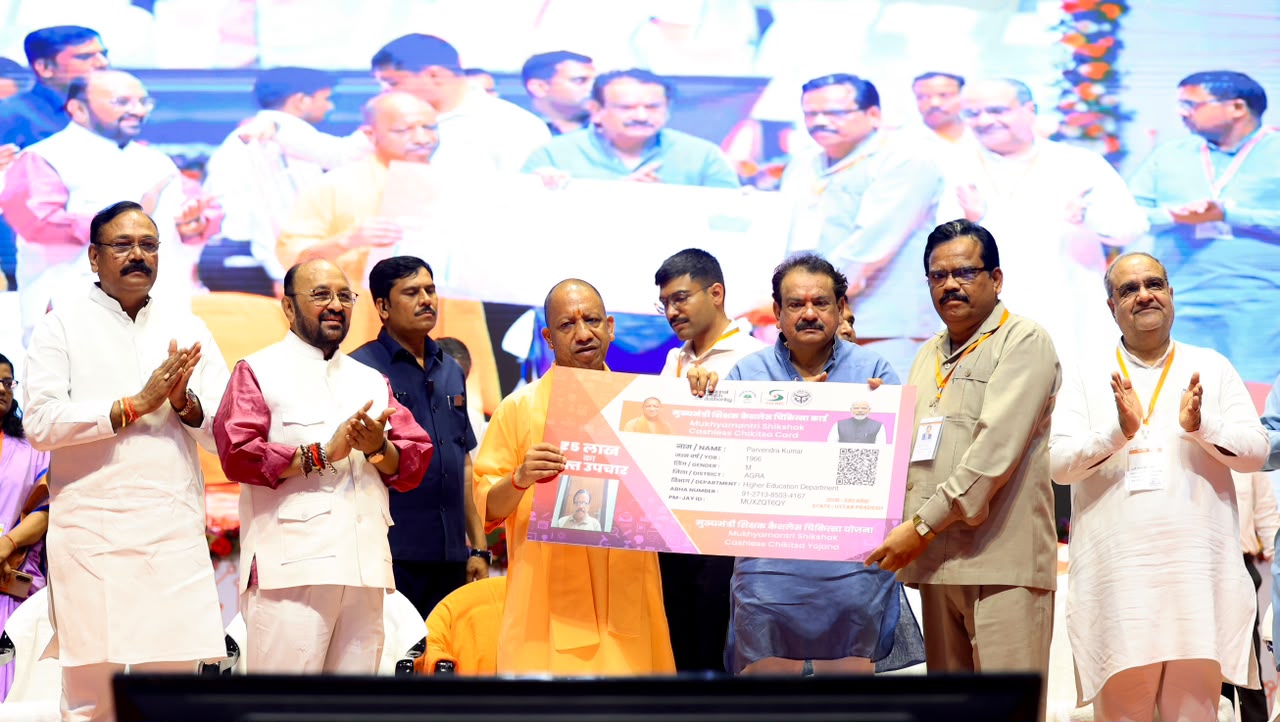
Agra: Teachers and non-teaching staff associated with Uttar Pradesh’s higher education institutions received a major boost on Sunday as Chief Minister Yogi Adityanath launched the Chief Minister Teacher Cashless Medical Facility Scheme and oversaw the signing of a Memorandum of Understanding (MoU) between the Higher Education Department and Punjab National Bank (PNB). The twin initiatives aim to strengthen healthcare access and provide comprehensive financial security to over 1.28 lakh beneficiaries and their dependent family members.
The new cashless healthcare scheme will provide eligible teachers and employees from universities, aided colleges and self-financed institutions with annual cashless treatment of up to ₹5 lakh at empanelled government and private hospitals. Beneficiaries will be able to avail of the facility from the very first day after the issuance of their health cards, with the government bearing the cost of hospitalisation, treatment, medicines and discharge.

The scheme will be administered by the State Agency for Comprehensive Health and Integrated Services (SACHIS) and will follow treatment packages similar to those under the Ayushman Bharat programme. More than 1,900 medical procedures and diseases, including cancer, heart ailments, kidney disorders and other major surgeries, will be covered. Special enrolment and card distribution drives will be organised across all districts to ensure smooth implementation.
Alongside the healthcare initiative, the Higher Education Department signed an MoU with Punjab National Bank to provide an enhanced social security package for teachers and non-teaching staff. Under the agreement, beneficiaries will receive personal accident insurance cover of up to ₹1.5 crore, air accident insurance of up to ₹3 crore, hospital cash benefits of up to ₹60,000, and term life insurance of up to ₹12 lakh. The package is designed to offer long-term financial protection to employees and their families.
The launch was welcomed by teachers attending the programme, many of whom described the initiatives as long-awaited measures that would significantly reduce financial stress during medical emergencies.

Dr Mukesh Chand said the cashless treatment facility would spare families from the burden of arranging funds for expensive healthcare. Dr Rajnath noted that the scheme fulfilled a long-pending demand of the teaching community and reflected the government’s commitment to their welfare.
Dharmendra Kumar Chaudhary highlighted the importance of the accident and life insurance benefits, saying they would provide families with greater financial security. Dr Ravi Kant Pathak said coverage for serious illnesses such as cancer and heart disease would allow teachers to focus on their academic responsibilities without worrying about treatment costs.
Dr Monica Asthana welcomed the healthcare benefits for women and dependent family members, calling the scheme a source of significant peace of mind. Anupam Saxena described both the insurance package and the cashless healthcare programme as landmark initiatives that would strengthen the welfare framework for the higher education sector.
The twin measures mark a significant expansion of health and social security benefits for the state’s higher education workforce, reinforcing efforts to improve employee welfare while ensuring access to quality healthcare and financial protection.











 https://www.youtube.com/watch?si=RtToJsBhYBatUrym&v=mOuYNSdhjHA&feature=youtu.be