New Delhi: India’s fashion story in 2026 is no longer about catching up—it’s about leading from the front. Across international runways, celebrity wardrobes, and luxury storefronts from Paris to Beverly Hills, Indian labels are asserting a new kind of influence—one rooted in heritage, powered by sustainability, and amplified by digital innovation. This is not just participation in the global fashion economy; it is a recalibration of its very rules.
Through a compelling blend of craft and contemporary design, Indian brands are proving that authenticity is the new luxury—and that tradition, when reimagined, can be a formidable global currency.
Heritage as High Fashion’s New Language
At the heart of India’s global ascent lies its most enduring strength: an unparalleled legacy of textiles and craftsmanship. Techniques once confined to regional traditions—chikankari, ikat, kalamkari, and Banarasi weaving—are now being reframed as luxury narratives for a global audience.
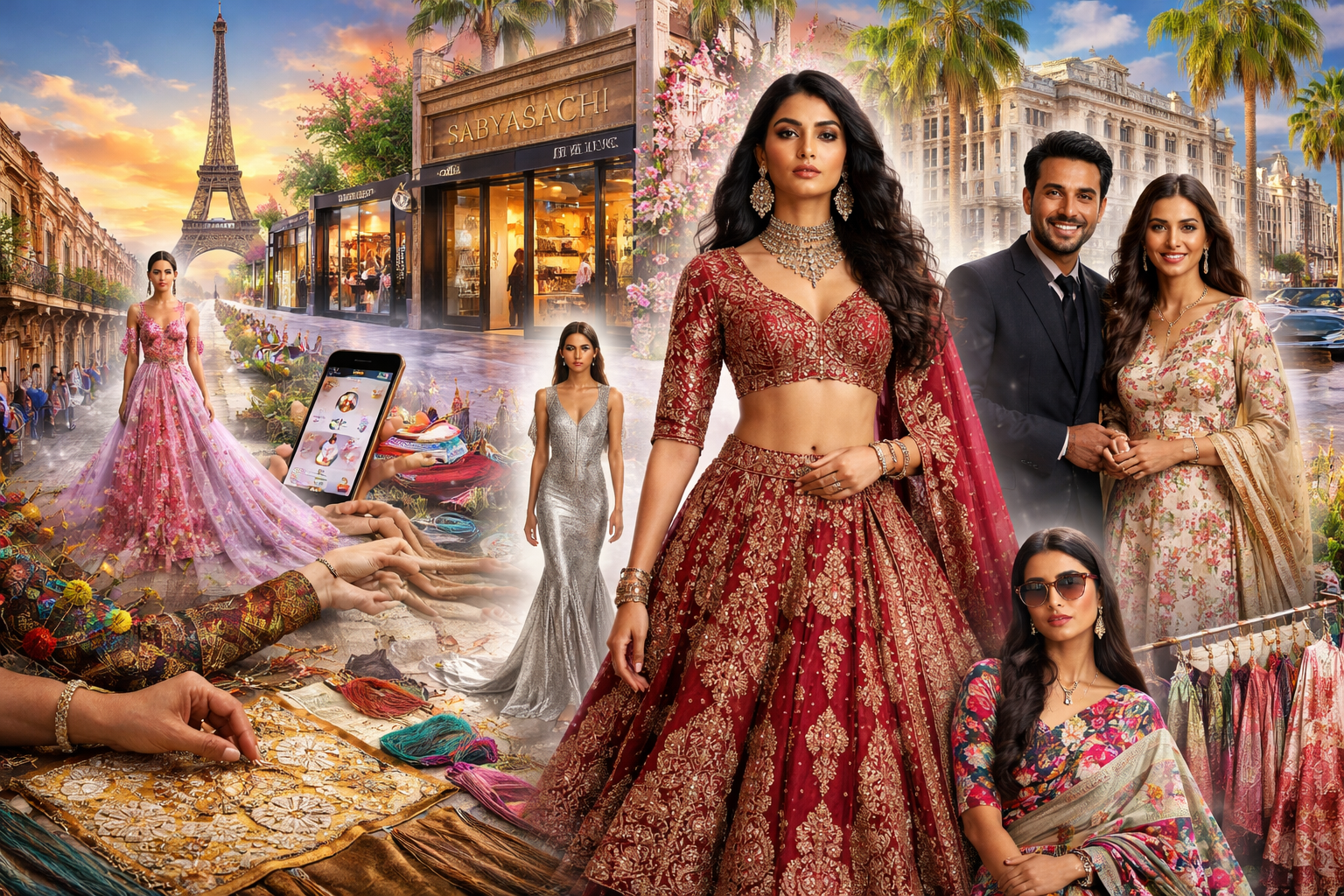
Few embody this better than Sabyasachi Mukherjee. His aesthetic—lush, romantic, and unapologetically maximalist—has transformed Indian bridal couture into an international phenomenon. With flagship stores in New York City and a strong presence in European luxury retail, Sabyasachi’s work demonstrates how storytelling rooted in heritage can translate into global desirability.
Similarly, Manish Malhotra has expanded beyond Bollywood glamour into a full-fledged lifestyle empire. His evolution—from costume designer to global entrepreneur—reflects a broader shift in Indian fashion: the move from niche cultural expression to scalable luxury. His international ventures, including stores in Dubai, merge Indian drama with global craftsmanship, creating products that resonate across markets.
Meanwhile, Rahul Mishra continues to elevate Indian couture on the world stage. As the first Indian designer to feature on the official Paris Haute Couture calendar, his intricately embroidered, nature-inspired creations blur the line between garment and art. Worn by global icons like Beyoncé and Cardi B, his work reinforces the idea that slow fashion can coexist with high glamour.
Adding another dimension is Anita Dongre, whose brand philosophy blends luxury with responsibility. Her expansion into Los Angeles—particularly her Beverly Hills store launch—signaled a turning point for ethical Indian fashion in global markets. Through her Grassroot initiative, Dongre champions artisan empowerment, proving that sustainability and profitability can go hand in hand.
New Voices, New Energy
While established designers anchor the narrative, a new generation is reshaping its edges. These creators are less bound by tradition and more inclined toward experimentation—yet remain deeply connected to their cultural roots.
Gaurav Gupta stands out with his sculptural, avant-garde silhouettes that seem almost architectural in form. His designs challenge conventional tailoring, bringing a futuristic sensibility to Indian couture.
Equally disruptive is Masaba Gupta, whose bold prints and unconventional motifs have redefined contemporary Indian wear. Her work resonates strongly with younger audiences seeking individuality and playfulness.
Designers like Dhruv Kapoor are taking everyday Indian garments and reimagining them through a streetwear lens—turning vests, kurtas, and draped silhouettes into globally relevant fashion statements. The message is clear: reinvention does not mean erasure; it means reinterpretation.
Sustainability as a Core Philosophy
In a world grappling with fashion’s environmental impact, Indian labels are emerging as leaders in conscious design. Sustainability here is not a trend—it is a cultural instinct, deeply embedded in traditional practices.
Brands like Raw Mango and Okhai emphasize handwoven textiles, ethical sourcing, and timeless design. Their approach prioritizes longevity over seasonal churn, offering an alternative to fast fashion’s disposability.
The revival of khadi exemplifies this shift. Once associated with simplicity, it is now being transformed into a modern luxury fabric by designers such as Nikasha Tawadey and labels like Ka-Sha. Softer textures, contemporary cuts, and vibrant palettes have made khadi relevant for urban and international wardrobes.
Meanwhile, digital-first brands like Virgio are pushing the boundaries of sustainable commerce. By integrating circular production models and data-driven design, they reduce waste while maintaining agility.
Behind the scenes, platforms such as Fashinza and Groyyo are transforming supply chains—bringing transparency, efficiency, and scalability to an industry traditionally defined by fragmentation.
Fusion Fashion: A Global Aesthetic
If heritage is India’s foundation, fusion is its most powerful export. Indo-Western design has evolved into a global language—one that seamlessly blends tradition with modernity.


From contemporary saree drapes to lehenga-inspired accessories and dhoti-style streetwear, Indian designers are creating garments that transcend cultural boundaries. This hybrid aesthetic appeals not only to the Indian diaspora but also to international consumers seeking fashion with meaning.
The rise of social media has accelerated this trend. Platforms like Instagram have become global runways, where designers showcase collections, engage directly with audiences, and build communities around their brand stories. A single viral moment can propel a niche craft into global consciousness.
Digital Disruption and D2C Dominance
Technology is redefining how Indian fashion reaches the world. Direct-to-consumer (D2C) models have dismantled traditional retail barriers, enabling brands to connect with customers across continents.
AI-driven styling, augmented reality try-ons, and immersive e-commerce experiences are becoming standard. These tools not only enhance customer engagement but also reduce waste—aligning with sustainability goals.
Large-scale investments are further accelerating growth. Companies like Reliance Brands and Aditya Birla Fashion and Retail are backing designers, enabling international expansion and operational scale. This fusion of creativity and corporate support is positioning Indian fashion as both innovative and commercially viable.
Looking ahead, the metaverse and digital couture present new frontiers. Virtual garments, NFT-based collections, and immersive fashion experiences are set to redefine ownership and creativity in the years to come.
From Inspiration to Authority
Perhaps the most significant shift is perceptual. Indian fashion is no longer viewed as a source of inspiration—it is now a source of authority.
Global luxury houses are increasingly drawing from Indian aesthetics, whether through embroidery techniques, silhouettes, or accessories like kolhapuri-inspired footwear. At the same time, Indian designers are dressing international celebrities, appearing on global red carpets, and opening flagship stores in fashion capitals.
This exchange signals a new balance of power. India is no longer just a manufacturing hub; it is a design powerhouse with a distinct voice.
Marching forward
Challenges remain. Scaling artisan-led production without compromising quality, navigating international trade complexities, and maintaining authenticity amid rapid growth are ongoing concerns. Yet the trajectory is unmistakable.
Driven by a new generation of consumers—particularly Gen Z—who value identity, sustainability, and storytelling, Indian fashion is evolving at an unprecedented pace. Brands are experimenting with inclusive sizing, adaptive designs, and purpose-driven collections that reflect contemporary values.
What emerges is a new blueprint for global fashion: one that balances profitability with purpose, innovation with heritage, and scale with soul.
A Distinctly Indian Future
From the looms of Kutch to couture runways in Paris and boutiques in Beverly Hills, Indian fashion is telling a story that is both deeply rooted and boldly forward-looking.
It is a story of resilience, reinvention, and rising influence.
And as 2026 unfolds, one thing is certain: the future of global fashion is no longer dictated by a handful of Western capitals. It is being co-authored by India—vibrant, sustainable, and unapologetically original.













 https://www.youtube.com/watch?si=RtToJsBhYBatUrym&v=mOuYNSdhjHA&feature=youtu.be