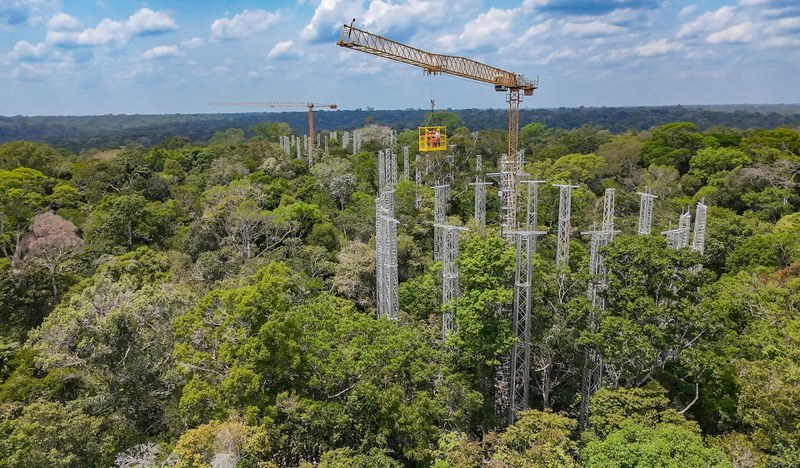
Manaus, Brazil: In the heart of the Amazon rainforest, scientists are running a unique experiment designed to glimpse the future of our planet’s climate. Using an elaborate network of steel towers, researchers have created what they call a “climate time machine” — an installation that releases carbon dioxide into the forest canopy to simulate the atmosphere of coming decades.
The initiative, known as the AmazonFACE Project, lies near Manaus, the largest city in Brazil’s Amazon region. Six circular structures, each made of towering metal frames, surround clusters of mature rainforest trees. Within half of these enclosures, scientists will infuse the air with additional carbon dioxide, replicating the elevated levels predicted for mid-century. The remaining sites will remain untouched, serving as controls for comparison.

“Our goal is to recreate the air of the future and observe how the forest reacts,” explained Carlos Quesada, a lead researcher from Brazil’s National Institute for Amazon Research (INPA). The project is being conducted jointly with Universidade Estadual de Campinas, with support from both the Brazilian and British governments.
The timing of this experiment is significant. As Brazil prepares to host the COP30 United Nations Climate Summit in Belém from November 10–21, the question of how tropical forests will withstand rising temperatures and changing atmospheric conditions will be central to global climate discussions.
FACE — short for Free-Air CO₂ Enrichment — is a pioneering method that allows researchers to test natural ecosystems under simulated future atmospheric conditions. Similar projects have been carried out in the United States and other temperate regions, but this marks the first large-scale FACE experiment in a tropical rainforest.


“This research pushes scientific boundaries,” said Gustavo Carvalho, a forestry engineer involved in the study. “It’s the first time we’re testing a natural forest of this scale in the tropics. What we learn here could change how we understand climate adaptation worldwide.”
Currently, hundreds of sensors record data from the experimental rings every 10 minutes, tracking how leaves absorb carbon dioxide, release oxygen, and manage water vapor in response to sunlight and rainfall.
Once the fumigation phase begins, scientists will gradually raise carbon dioxide concentrations to match projections for 2050 and beyond. “We’ll effectively be walking through a fragment of the future forest,” Carvalho added.
Researchers hope the findings will provide crucial insight into whether the Amazon — often called the planet’s lungs — can continue to serve as a major carbon sink or whether it will face irreversible stress in the coming decades.












 https://www.youtube.com/watch?si=RtToJsBhYBatUrym&v=mOuYNSdhjHA&feature=youtu.be