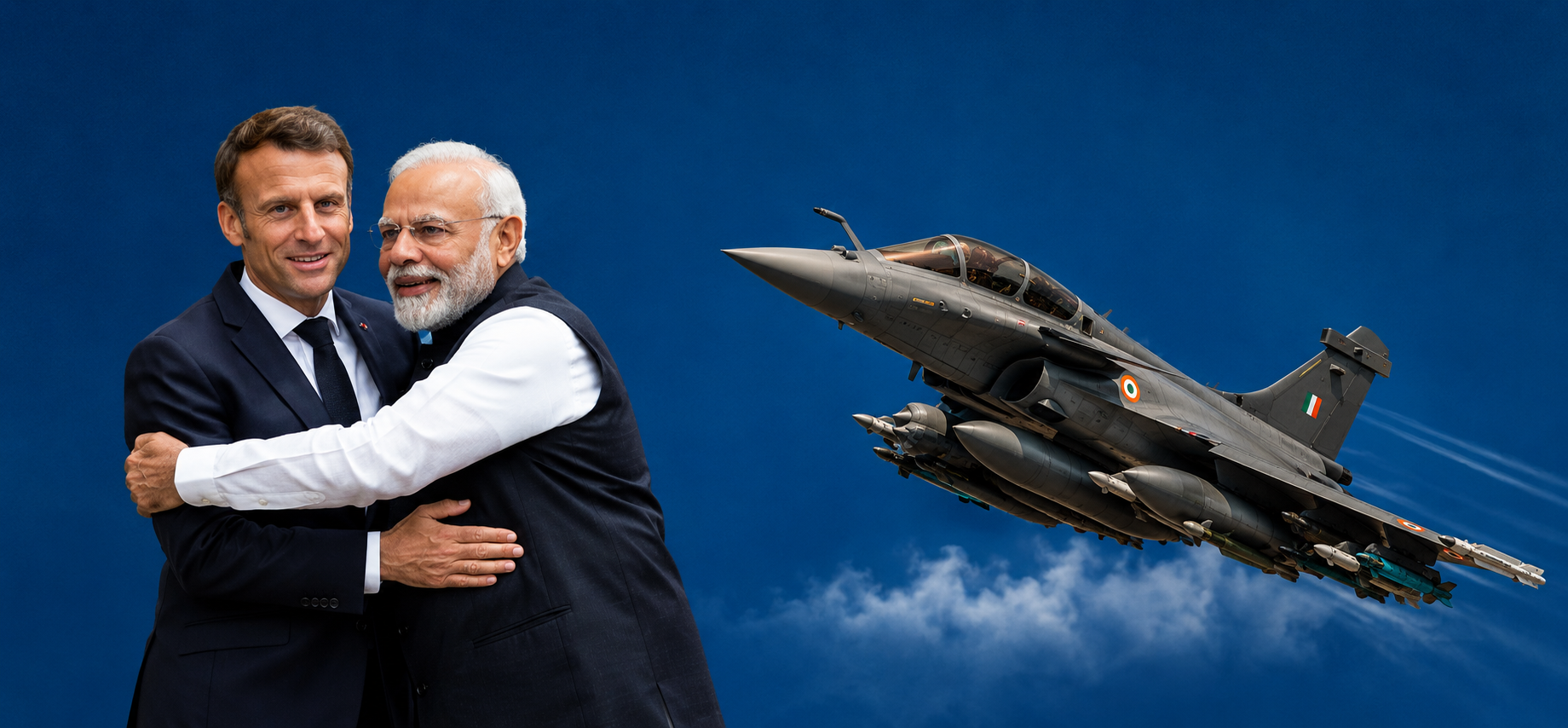
Nice, France: Prime Minister Narendra Modi has arrived in France on the first leg of a six-day European tour that is expected to focus heavily on defence cooperation, technology partnerships, and strategic ties between India and Europe. At the center of the discussions is a proposed multibillion-dollar agreement for the acquisition of 114 additional Dassault Rafale fighter jets for the Indian Air Force.
The proposed deal, one of the largest defence procurement programs in India’s history, remains under negotiation as both sides work to resolve technical and operational issues related to technology access and indigenous integration capabilities.

Technology Access Emerges as Key Issue
A major point of discussion in the negotiations involves India’s demand for greater access to Interface Control Documents (ICDs), which govern communication between an aircraft’s various mission systems and subsystems. Indian defence planners have emphasized the importance of integrating domestically developed weapons and systems into future aircraft platforms with greater operational flexibility.
The issue is viewed as critical to India’s broader objective of strengthening self-reliance in defence manufacturing and reducing dependence on external approvals for future upgrades and weapons integration.
Boost for ‘Make in India’
Under the proposed framework, a significant portion of the aircraft would be manufactured in India, marking a major step forward for the country’s defence industrial ecosystem. Industry sources indicate that production partnerships could involve extensive participation by Indian aerospace companies, creating new opportunities for technology transfer, skill development, and employment generation.
If finalized, the project would represent one of the most substantial examples of defence manufacturing localization under the government’s “Make in India” initiative. The program is also expected to strengthen India’s domestic aerospace supply chain and expand indigenous manufacturing capabilities.
Expanding India–France Strategic Partnership
Prime Minister Modi is scheduled to hold talks with French President Emmanuel Macron on a wide range of bilateral issues. Discussions are expected to cover defence cooperation, civil nuclear energy, artificial intelligence, innovation, climate initiatives, and emerging technologies.
The visit comes at a time when India and France are deepening their strategic partnership across multiple sectors. Both countries have expanded cooperation in the Indo-Pacific region, defence production, space technology, and counter-terrorism initiatives in recent years.

Existing Rafale Fleet and Future Plans
India already operates 36 Rafale fighter aircraft acquired under an earlier agreement with France. The aircraft have become a key component of the Indian Air Force’s combat capabilities. In addition, India recently moved forward with plans to induct carrier-capable Rafale-M aircraft for naval operations.
The proposed new acquisition would significantly enhance the Air Force’s operational strength and help address long-term squadron requirements while complementing indigenous platforms such as the HAL Tejas.
Wider European Engagement
Following his engagements in France, Prime Minister Modi will travel to Slovakia for high-level discussions focused on trade, investment, manufacturing, and infrastructure cooperation. The visit is expected to further diversify India’s economic and strategic partnerships across Europe.
The Prime Minister will also participate in the upcoming G7 Summit, where global leaders are scheduled to discuss issues ranging from artificial intelligence governance and economic resilience to sustainable development and international cooperation.
A Defining Moment for Defence Cooperation
Analysts view the ongoing negotiations as a defining moment in India-France defence relations. Beyond the acquisition of fighter aircraft, the discussions reflect broader questions about technology sharing, industrial collaboration, and strategic autonomy.
A successful conclusion to the negotiations could significantly strengthen India’s air combat capabilities while advancing domestic defence manufacturing goals. The outcome of the talks is therefore expected to be closely watched by policymakers, industry stakeholders, and defence experts in both countries over the coming days.







 ---------------------------------------------------------------------------------------------------