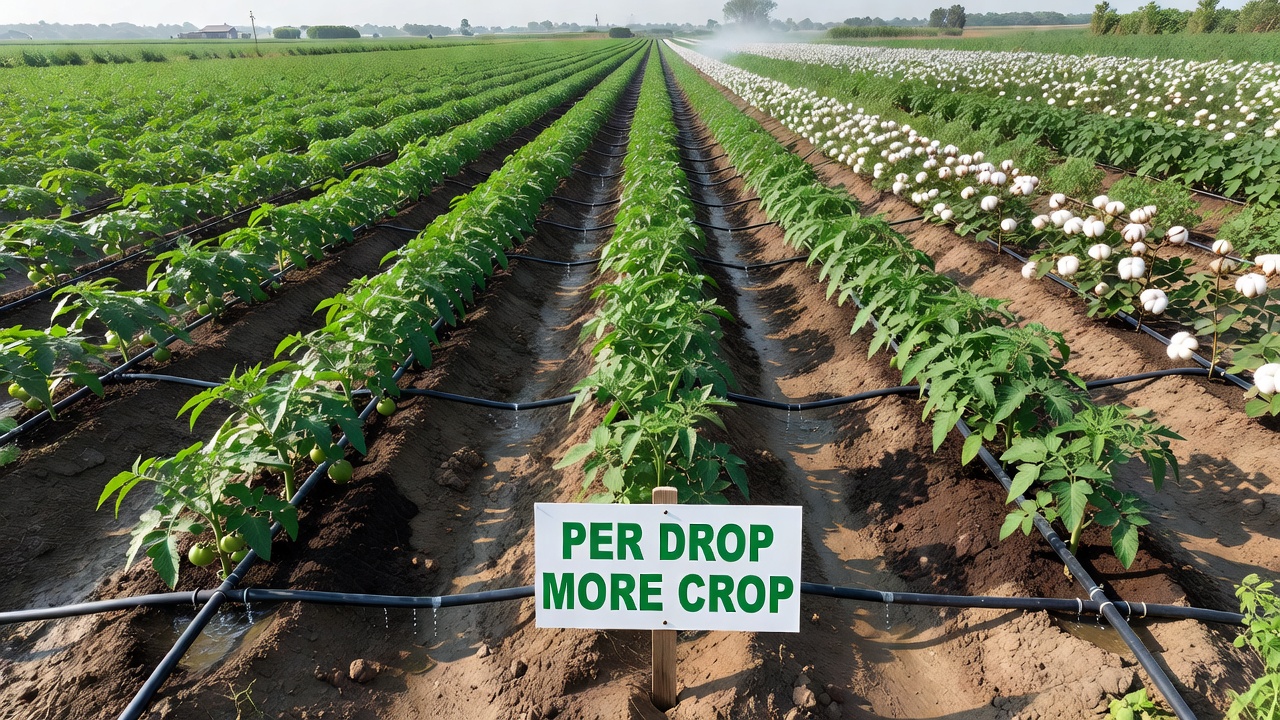
Jaunpur: The state government is continuously working to make the state’s agricultural landscape modern, sustainable and profit-oriented. As part of this effort, the expansion of micro-irrigation technologies has been turned into a mass movement to conserve water resources and realise the national goal of “Per Drop More Crop.” Launched with the aim of tackling the groundwater crisis and bringing about a real rise in farmers’ income, this ambitious plan is today proving to be the cornerstone of the state’s agricultural revolution. In this context, Jaunpur district is emerging as an outstanding model of agricultural development, water conservation and farmer welfare through the adoption of micro-irrigation technologies.
Under the skilled guidance of the district administration, Jaunpur district is witnessing unprecedented, positive change in the fields of agriculture and horticulture. For a long time, traditional and water-intensive irrigation methods led to excessive extraction of precious groundwater on one hand, while the wastage of water kept pushing up farmers’ production costs on the other. As a lasting solution to this serious problem, the installation of micro-irrigation systems under the Pradhan Mantri Krishi Sinchayee Yojana is being promoted on a war footing, under coordinated central and state government policies. The far-reaching impact of this scheme is clearly visible on the ground in development blocks such as Baksha, Badlapur and Besahupur in the district.

Heavy subsidies driving adoption
The state government is providing extensive financial assistance to farmers under this scheme, so that even economically weaker farmers can seamlessly benefit from the latest agricultural technologies. In Jaunpur, small and marginal farmers are being given special priority, with a heavy government subsidy of 45 to 55 percent for installing drip and sprinkler irrigation systems. To ensure a fully transparent process, this subsidy amount is transferred directly into beneficiaries’ bank accounts through Direct Benefit Transfer (DBT). This accessible, corruption-free and farmer-friendly process has encouraged thousands of farmers in the district to give up traditional methods and adopt modern irrigation technology.
Micro-irrigation, particularly drip irrigation, ensures targeted delivery of water straight to the roots of plants. The continuous use of this scientific method has resulted in a direct saving of around 40 to 50 percent in water consumption for irrigation. In Jaunpur district, known for its fertile agricultural land and diverse cropping pattern, this push for water conservation is proving to be life-sustaining, not just for the present generation but for generations to come. By ensuring the maximum use of every drop of water, the district administration is doing important work to maintain ecological balance in the agriculture sector and address the challenges of climate change.
Fertigation adding a new dimension to farm economics
Beyond water conservation, the system is also giving farm economics a new and improved direction through fertigation technology. Using modern venturi systems along with drip and sprinkler equipment, farmers are now delivering essential nutrients, liquid fertilisers and pesticides straight to plant roots along with water. This advanced method has completely curbed the wastage of costly fertilisers in the fields and made balanced use of chemicals possible. At the same time, labour costs involved in traditional irrigation and manual spreading of fertiliser along field bunds have come down sharply, by 30 to 35 percent. This direct reduction in cost has considerably widened farmers’ net profit margins.
Success stories from the ground
Several progressive farmers in Jaunpur district have directly demonstrated the multi-fold benefits of micro-irrigation on their own fields. The success story of beneficiary farmer Pawan Kumar Pandey, a resident of Machhligaon in Badlapur block, stands as a living testament to the effectiveness of this government scheme. He has completely given up traditional flood-irrigation methods for his wheat crop and successfully switched to mini sprinklers. Not only that, he is also using state-of-the-art nano urea through the venturi system, ensuring the crop gets the nutrition it needs in equal measure and at a faster pace. His scientific approach to making optimal use of resources has become a powerful source of inspiration for other farmers in the area.
Similarly, progressive farmer Jang Bahadur Singh of Nari Baksha village, under Baksha development block, has also set new standards in agricultural production by adopting the sprinkler method. He used this advanced sprinkler system to irrigate his wheat crop, and the results have been highly encouraging and beneficial. Compared to traditional flood irrigation, the wheat crop in his field is far healthier, greener and free of disease. The even distribution of water through the sprinkler system is producing a better crop overall, improving both the quality of the produce and the grain.

Benefits extending to commercial crops
The use of this new technology in the district is not limited to traditional foodgrain crops alone — it has also produced encouraging results in commercial farming. In various parts of Jaunpur, micro-irrigation has proved to be a game-changer in the cultivation of brinjal, maize and various seasonal and off-season green vegetables. As a result of this scientific method, a direct increase of 20 to 30 percent has been recorded in the yield of horticultural and cash crops. Thanks to the higher quality and better size of the produce, farmers are also fetching premium prices for their crops in local and outside markets. This dual benefit of higher yield and lower production cost is turning the government’s vision of doubling farmers’ income into reality on the ground in Jaunpur.
Healthier soil, stronger farm ecosystem
Under traditional irrigation methods, flooding the fields with water would wash away soil nutrients, while waterlogging hindered root development. Sprinkler and drip irrigation systems, by contrast, preserve soil structure, maintain proper aeration and prevent soil erosion. Farmers in Jaunpur have found that continuous use of this technology keeps their soil loose and more fertile. This improvement in the agricultural ecosystem is strengthening the district’s food security and agricultural sustainability over the long term.
Administration’s role: monitoring, outreach and support
Behind this remarkable success of government schemes lies the continuous monitoring, transparent functioning and hard work at the ground level by the district administration and concerned departments. Various development blocks of the district are inspected closely and periodically at the departmental level. Administration teams visit farmers directly in their fields, offer them technical advice, and ensure the smooth functioning of their equipment. Through awareness campaigns and farmer meetings, this cooperative approach by the administration is instilling fresh confidence in rural areas, encouraging farmers to try new, scientific methods in farming without any hesitation.
Simple, transparent process for farmers
The state government has made the entire process of installing micro-irrigation systems extremely simple, transparent and farmer-centric. Any interested farmer wishing to install a sprinkler or drip irrigation system on their field and avail the subsidy can visit and get in touch with the relevant district administration offices on any working day. The application process has been made completely hassle-free, requiring only a few essential documents such as a valid identity card, the latest land record (khatauni), a passport-size photograph, and a copy of the bank passbook. Applications are being processed quickly through a single-window online application system, so that farmers can receive the equipment on time and benefit from it within the current crop cycle.
Looking ahead: solar-powered irrigation on the horizon
This comprehensive drive for agricultural modernisation in Jaunpur district is a result of the state government’s long-term vision. Keeping future needs in mind, plans are also being drawn up to integrate micro-irrigation technologies with other ambitious schemes, such as solar-powered irrigation pumps. The main objective is to ensure uninterrupted, cost-free irrigation, without any energy crisis, even in remote agricultural areas of the district where power supply is limited. This technological integration will not only reduce farmers’ dependence on conventional electricity and diesel, but will also make Jaunpur’s agricultural system fully self-reliant, green and environmentally friendly.
The Uttar Pradesh government is firmly resolved to take the benefits of cutting-edge agricultural technology and science to every field and farm in the state. The effective, ground-level implementation of the “Per Drop More Crop” scheme in Jaunpur district — with its time-bound technical support and accessible subsidy disbursement — is a striking example of how the entire picture of the rural economy can be transformed when policies are clear and the administration is responsive and accountable. The state government and the local district administration remain fully committed to raising farmers’ standard of living, safeguarding precious water resources for the future, and making Jaunpur a leading and prosperous district in the country in terms of agricultural productivity.