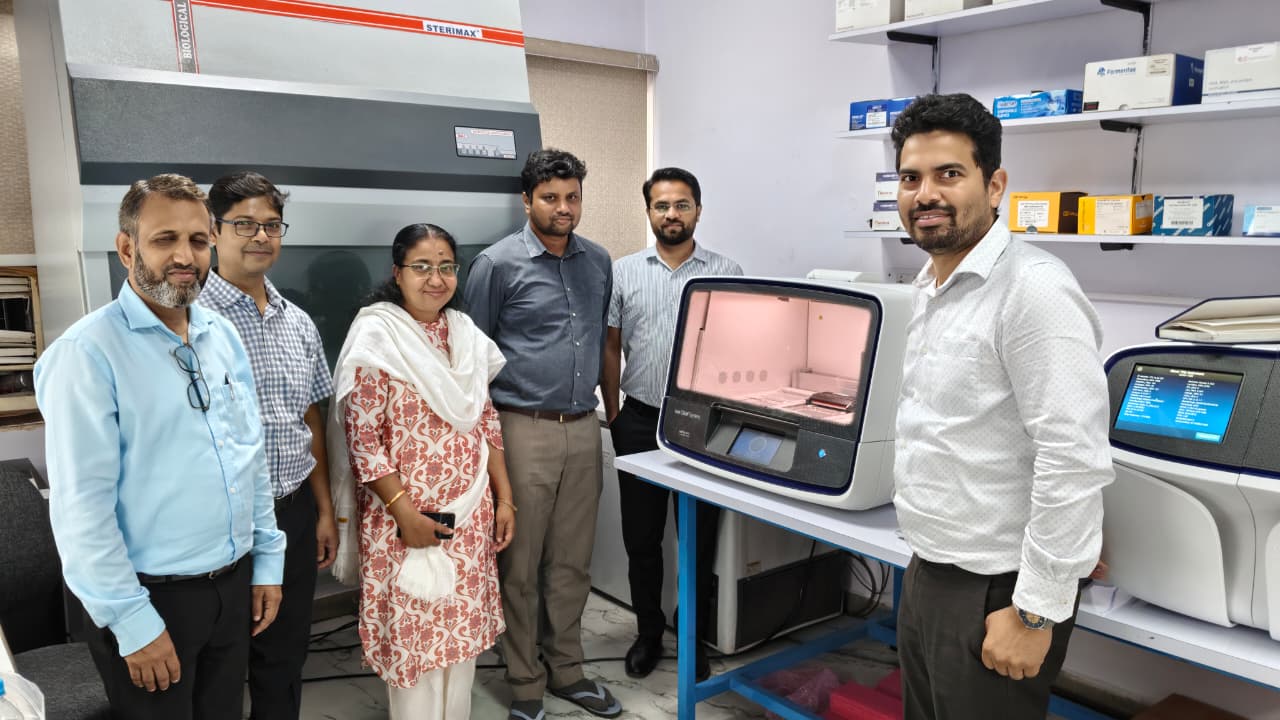
Bareilly: In a significant step towards enhancing animal disease diagnostics and epidemic preparedness, the ICAR–Indian Veterinary Research Institute (IVRI) has installed a state-of-the-art Ion GeneStudio S5 Next-Generation Sequencing (NGS) System at its Centre for Animal Disease Research and Diagnosis (CADRAD) in Bareilly.
The advanced facility has been established under an Epidemic Fund-supported project, being implemented by the Food and Agriculture Organization (FAO) in collaboration with the Department of Animal Husbandry and Dairying, Government of India, with financial support from the Epidemic Fund.

Speaking on the occasion, Dr. Sohini De, Joint Director, CADRAD, said the new sequencing platform would provide a major boost to disease diagnosis and scientific research. She noted that the installation of the NGS system would significantly strengthen the institute’s advanced diagnostic and research capabilities, enabling faster and more precise identification of disease-causing pathogens.
The sophisticated system was successfully installed on June 4 and 5, 2026, by expert engineers from Thermo Fisher Scientific. The installation ceremony was attended by Dr. Mohammad Haseeb, Animal Health Specialist, FAO New Delhi, who was present as a special guest.
According to experts, the cutting-edge sequencing technology will play a crucial role in surveillance and disease diagnostics by enabling scientists to closely monitor evolving strains of viruses and bacteria, rapidly identify emerging and re-emerging pathogens, and conduct in-depth genetic analysis of infectious agents. The system will also support accurate investigation of sudden disease outbreaks in animals and help researchers understand disease transmission patterns at the molecular level.

Additionally, the facility will contribute to extensive research on antimicrobial resistance (AMR), one of the most pressing global public health challenges. Enhanced genomic surveillance and pathogen characterization are expected to strengthen India’s ability to prevent, detect, and respond effectively to future epidemics and zoonotic disease threats.
Officials described the establishment of the NGS facility at CADRAD as a landmark achievement in strengthening the country’s national disease surveillance and epidemic preparedness infrastructure. The technology is expected to significantly improve India’s capabilities in epidemic prevention, early detection, preparedness, and rapid response, particularly in the livestock and animal health sectors.
The development further reinforces IVRI’s position as a leading institution in veterinary research and disease diagnostics, supporting the nation’s efforts to safeguard animal health, food security, and public health through advanced scientific innovation.
Reported by Akhilesh Chandra Saxena from Bareilly.