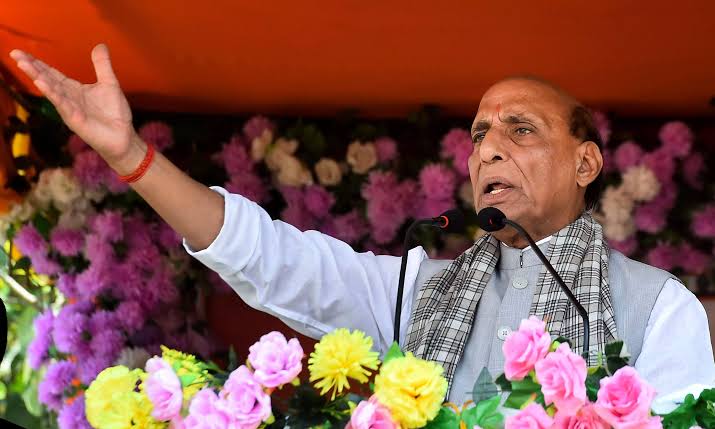
New Delhi: Defence Minister Rajnath Singh said India’s journey over the past 12 years has been marked by a transition from shortages to self-reliance, from self-reliance to self-confidence, and now towards the vision of a developed nation, or Viksit Bharat.
Addressing an event organised by a media organisation in New Delhi, Singh said the government led by Prime Minister Narendra Modi has focused on addressing long-standing challenges, expanding opportunities, and driving transformative reforms. He stated that the first term of the government concentrated on overcoming shortages and improving governance, while the second term translated aspirations into achievements and accelerated the drive towards self-reliance. According to him, the current term is laying a strong foundation for a developed India through the guiding principles of “Reform, Perform, Transform.”

Highlighting India’s changing global profile, the Defence Minister said the country’s voice now carries greater weight on international issues and is being heard with increased attention across the world. He pointed to the success of the Make in India initiative, noting that despite initial scepticism, it has become a key driver of manufacturing growth and industrial development.
Singh also highlighted advances in emerging technologies, including the semiconductor sector. Referring to the India Semiconductor Mission launched in 2021, he said the country has made significant progress through the development of semiconductor parks and supporting infrastructure, enabling domestic chip production.
On the defence front, he stated that India’s annual defence production reached a record ₹1.78 lakh crore in the financial year 2025–26, nearly three times higher than the figure recorded in 2014–15. He added that defence exports have crossed ₹38,000 crore, compared to ₹686 crore in 2013–14, reflecting growing international confidence in India’s indigenous defence manufacturing capabilities.
The Defence Minister also highlighted growth in sectors such as mobile phone manufacturing, automobile exports, railway production, and digital infrastructure. Referring to India’s digital transformation, he said the Unified Payments Interface (UPI) processed over 22 billion transactions in April, with a transaction value exceeding ₹29 lakh crore, while its international adoption continues to expand. He further noted the nationwide rollout of indigenous 5G technology and ongoing efforts toward the development of 6G capabilities.
Speaking about welfare delivery reforms, Singh said initiatives such as Jan Dhan accounts, Aadhaar, mobile connectivity, and Direct Benefit Transfer have significantly reduced leakages and improved the efficiency of government schemes. He stated that these measures have enabled direct transfer of benefits to millions of citizens while enhancing transparency and accountability.

He also cited the implementation of the Goods and Services Tax (GST) as an example of cooperative federalism, saying it has strengthened coordination between the Centre and states while creating a more unified tax framework.
Referring to major policy decisions and internal security initiatives, Singh said the abrogation of Article 370 in Jammu and Kashmir and ongoing efforts to eliminate Naxalism demonstrate the government’s resolve to address long-standing challenges. He further highlighted the growth of India’s start-up ecosystem, noting that the number of start-ups has expanded from around 500 to more than 200,000 over the past decade, while the number of unicorns has increased significantly.
The Defence Minister also underlined the importance of preserving India’s cultural heritage alongside economic development. He pointed to initiatives such as the redevelopment of the Kashi Vishwanath Dham Corridor, Mahakal Lok, Maa Kamakhya Divya Lok Pariyojana, the installation of the Sengol in Parliament, the repatriation of ancient artefacts, and the digitisation of historical manuscripts as efforts aimed at reconnecting the nation with its civilisational roots.
Addressing the role of the media in the digital age, Singh said journalism today faces the challenge of ensuring accuracy and reliability amid an abundance of information. While acknowledging the growing influence of Artificial Intelligence, he emphasised that technology cannot replace human creativity, judgment, and empathy.
He stressed that the future of journalism would depend on balancing technological efficiency with human values, ensuring that reporting remains both credible and humane. He also reiterated that journalism plays a vital role in strengthening democracy by bringing facts to light and guiding public discourse responsibly.
Emphasising the importance of responsible reporting, particularly on issues related to national security and the armed forces, Singh said misinformation can have serious consequences for society and can adversely affect the morale of defence personnel. He urged the media to uphold the principles of accuracy, objectivity, and impartiality, noting that reporting correct information is more important than being the first to report it.