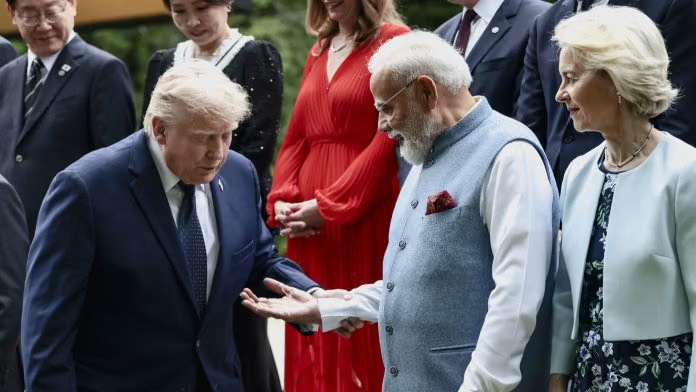
Paris: As leaders of the world’s most advanced economies gather in France for the G7 Summit, the occasion presents an opportunity not only for discussions on trade, technology, climate change, and security, but also for a deeper examination of the forum’s relevance and effectiveness in an increasingly fragmented world. At a time when conflicts continue to rage across regions, economic uncertainty persists, and geopolitical rivalries are intensifying, the question is unavoidable: Is the G7 still capable of providing meaningful global leadership?
The G7 was conceived as a platform for cooperation among leading industrialised democracies. Its stated objectives have always included promoting economic stability, international collaboration, and global peace. Yet the true measure of any international institution lies not in its declarations but in its outcomes. On that score, the record of recent years is far from reassuring.

The prolonged Russia-Ukraine conflict, recurring instability in West Asia, disruptions in global supply chains, climate emergencies, and rising protectionism have exposed the limitations of existing global governance mechanisms. While the G7 has remained vocal on many of these issues, its ability to influence outcomes has often appeared constrained by internal divisions and competing national interests.
A significant challenge facing the grouping is the perception that it remains heavily influenced by the priorities of a few powerful nations, particularly the United States. Differences among member states on trade, climate policy, defence spending, and approaches to international conflicts have increasingly come into public view. Such disagreements weaken the forum’s collective voice and undermine its credibility as a platform capable of forging global consensus.
The summit also unfolds against the backdrop of shifting geopolitical realities. The world is no longer defined solely by the influence of Western economies. Emerging powers such as India, Brazil, Indonesia, and South Africa are playing a growing role in shaping global economic and political agendas. Their perspectives, and those of the broader Global South, can no longer remain peripheral to international decision-making.
India’s participation in the summit is therefore particularly significant. As one of the world’s fastest-growing major economies and an increasingly influential voice among developing nations, India is uniquely positioned to articulate concerns that often receive insufficient attention in global forums. Issues such as food security, equitable development, climate justice, debt sustainability, and access to technology remain critical priorities for large parts of the developing world.

Recent diplomatic efforts aimed at reducing tensions in West Asia have also highlighted an important lesson: dialogue remains more effective than confrontation. Markets, investors, and ordinary citizens across the world benefit when diplomacy prevails over conflict. Sustainable peace cannot be achieved through pressure alone; it requires trust, engagement, and mutual respect.
The G7 must therefore use this summit as a moment of introspection. Rather than focusing exclusively on strategic competition and economic advantage, it should consider how to make global governance more inclusive, representative, and responsive to contemporary realities. A world facing interconnected challenges requires cooperative solutions that transcend political blocs and ideological divides.
Leadership and dominance are not synonymous. Genuine leadership is earned through consensus-building, fairness, and the ability to inspire confidence among nations both large and small. If the G7 wishes to remain relevant in a rapidly changing international order, it must embrace a broader vision—one that prioritises peace, inclusivity, balanced development, and shared prosperity.
The future of global stability will not be determined by the power of a select few nations alone. It will depend on the willingness of countries to work together in pursuit of common goals. The G7 has an opportunity to demonstrate that it understands this reality. Whether it succeeds will determine not only its own relevance but also its contribution to a more peaceful and balanced world.







 ---------------------------------------------------------------------------------------------------