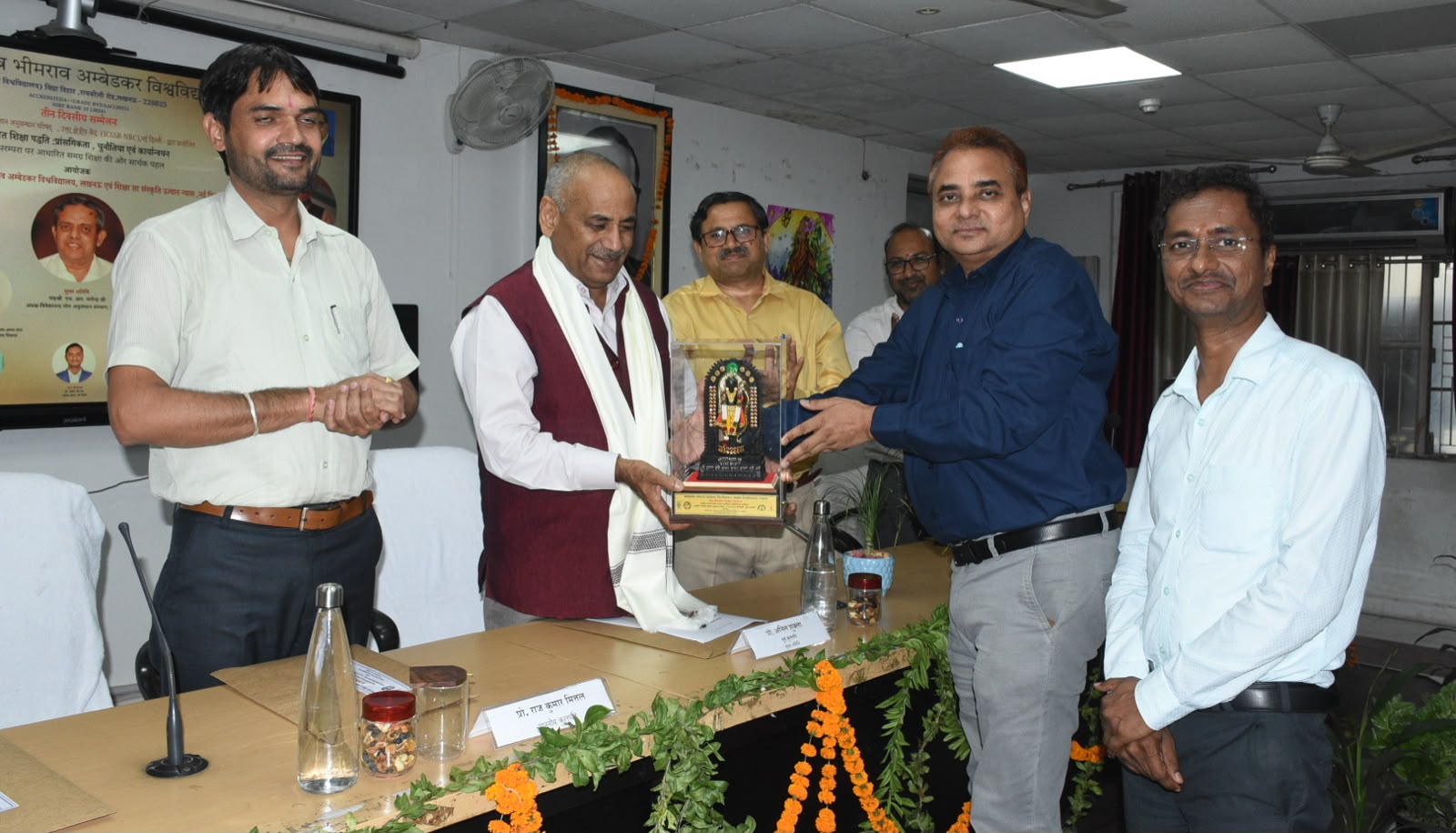
Lucknow: The three-day National Conference on “Panchakosha-Based Education System: Relevance, Challenges and Implementation” concluded on 16 October at Babasaheb Bhimrao Ambedkar University (BBAU), Lucknow. The conference was organised under the guidance and patronage of the University Vice Chancellor, Prof. Raj Kumar Mittal, jointly by the Department of Yoga, BBAU, and Shiksha Sanskriti Utthan Nyas, New Delhi. The conference was sponsored by the Indian Council of Social Science Research (ICSSR), Northern Regional Centre, New Delhi. The valedictory session was attended by Prof. Anil Kumar Shukla, former Vice Chancellor of Mahatma Jyotiba Phule Rohilkhand University, Bareilly; Khwaja Moinuddin Chishti Language University, Lucknow; and Maharshi Dayanand Saraswati University, Ajmer, as the Chief Guest. Apart from this, Prof. B.C. Yadav, Dean, School of Yoga, Naturopathy and Cognitive Studies, Dr. Deepeshwar Singh, Head of the Department of Yoga and Dr. Narendra Singh, Convener of the conference were also present on the dais.The programme commenced with the ceremonial lighting of the lamp and floral tributes to Babasaheb’s portrait. This was followed by the university anthem, after which the organising committee welcomed the dignitaries on the dais by presenting them with saplings. At the beginning , Prof. B.C. Yadav welcomed all the participants, while Dr. Deepeshwar Singh provided an overview of the programme. The session was conducted by Dr. Deep Narayan Pandey.
In his address, Prof. Anil Kumar Shukla discussed the significance of all five koshas within the Panchakosha-based education system. He emphasised the importance of self-control, stating, One loses when the mind gives up, and one wins when the mind is determined. He explained that controlling the mind and maintaining positive thoughts contribute to the holistic development of an individual’s personality. Highlighting the importance of the Guru in Indian philosophy, he stated that a Guru plays a vital role in guiding individuals, fostering self-awareness and helping them understand the true purpose of life. Under a Guru’s guidance, individuals not only acquire knowledge but also bring positive changes to their conduct, thoughts and personality. He stressed the need to incorporate the Panchakosha-based education system into the mainstream education framework, stating that it would help young people become more aware of Indian philosophy and its rich knowledge traditions. He also discussed various aspects of the verses mentioned in the Manusmriti.

Emphasising that an individual’s true character is reflected in their behaviour, he highlighted the importance of developing Pragya Chakshu (the eye of wisdom). He explained that the purpose of education extends beyond the acquisition of knowledge; it should inspire individuals to move from self-awareness towards selfless service and the welfare of society. He concluded that true education is one that leads an individual from self-realisation to paramartha (the pursuit of the greater good), thereby making life meaningful.
Sharing his views on the Panchakosha-based education system, Prof. B.C. Yadav stated that the Indian knowledge tradition offers a comprehensive perspective on understanding human life. The concept of Panchakosha helps in understanding the different dimensions of human existence. Emphasising the need to integrate this approach into education, he said that its effective implementation could foster self-awareness, positive thinking and a balanced outlook towards life among students.
Dr. Deepeshwar Singh, Head of the Department of Yoga, stated that such programmes are essential for research scholars as well as everyone else, as they provide an opportunity for individuals to understand themselves and recognise their abilities. He explained that the Panchakosha-based education system enables individuals to understand various aspects of their physical, mental, intellectual and spiritual development. Such initiatives not only connect participants with Indian philosophy and its knowledge traditions but also encourage introspection and inspire them to lead their lives in a more meaningful direction.
Dolly Arya, a research scholar in the Department of Yoga, delivered a presentation on the Panchakosha-based education system and its various dimensions. She explained the concepts of Annamaya Kosha, Pranamaya Kosha, Manomaya Kosha, Vijnanamaya Kosha and Anandamaya Kosha, highlighting their significance in human life.


She also discussed the concepts of Tridosha and Saptadhatu, water consciousness and the various sources of vital energy (prana), along with their functioning. She explained that the Panchakosha framework plays an important role in understanding the physical, mental, intellectual and spiritual development of an individual.
As part of the conference, special lecture sessions were organised. The first lecture session, chaired by Prof. P.K. Chaurasia, focused on the theme “Vijnanamaya Kosha and Education: Discernment, Reflection, Research and Decision-Making Ability.” The second lecture session, held under the guidance of Prof. B.C. Yadav from the Department of Physics, Chaudhary Charan Singh University (CCSU), focused on “Anandamaya Kosha and Education: Character Building, Self-Awareness and Establishment of Life Values.”
A panel discussion was also organised on the theme “Developing a Curriculum, Teaching Methodology and Assessment Model Based on the Panchakosha Framework.” This was followed by a question-and-answer session, during which participants raised questions related to the subject and received responses from the experts.
At the conclusion of the program, Certificates were presented to the participants who presented research papers at the conference in recognition of their research and academic contributions.
Apart from this the organising committee expressed its gratitude to the dignitaries by presenting them with mementoes and shawls. Dr. Narendra Singh was delivered the vote of thanks.
Faculty deans, heads of departments, faculty members, non-teaching staff, research scholars and students from various departments and schools of the university attended the programme.








 https://www.youtube.com/watch?si=RtToJsBhYBatUrym&v=mOuYNSdhjHA&feature=youtu.be