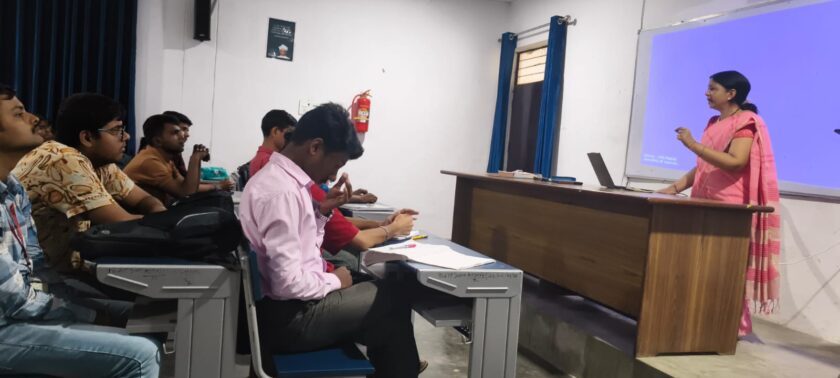
Bareilly: A special programme titled “Book Quest – Beyond the Pages” was organised by the Department of Electronics and Communication Engineering at Mahatma Jyotiba Phule Rohilkhand University as part of the Orientation Programme 2026 at the Faculty of Engineering and Technology. The programme was coordinated by Dr Chhavi Sharma.
The initiative aimed to promote reading habits among engineering students while strengthening their technical concepts, logical thinking, problem-solving abilities, creativity, innovation and understanding of the responsible use of Artificial Intelligence.

During the programme, students were told that in a rapidly evolving technological environment, merely acquiring information is not enough. Future engineers need to understand, analyse and apply knowledge to solve real-world problems. Speakers emphasised that textbooks remain essential for developing a systematic and in-depth understanding of mathematical principles, scientific concepts, design processes and technical subjects.
The programme also highlighted AI as a powerful aid to engineering education, but not a substitute for fundamental knowledge. Students were encouraged to use AI to understand difficult concepts, explore alternative solutions, seek assistance with coding and simulations and develop new ideas.
Through practical examples, students were told that without a sound understanding of the fundamentals of circuits, communication systems, programming, structures or machines, an engineering student may not be able to identify errors in an AI-generated design, calculation or piece of code. The message was clear: “First understand the concept, then explore it with AI, and finally verify the results yourself.”
Prof. Archana Gupta, Dean of the Faculty of Engineering and Technology, said engineering students today need to become problem-solvers, innovators and lifelong learners rather than merely pursue degrees. She encouraged students to develop the habit of reading technical books and quality literature, noting that books promote deep learning, patience and independent thinking, while AI can accelerate learning and expand possibilities.
“A good engineer is not defined merely by the ability to use technology, but by the ability to understand the principles behind it and use technology correctly and responsibly,” she said.
To make the programme engaging and participatory, several competitions and activities based on books, creativity, knowledge, presentation skills and quick thinking were organised. Students participated enthusiastically and demonstrated their creativity, communication skills, teamwork, knowledge of books and innovative abilities.

Krishna Sharma, Raghav Agrawal, Anubhav, Divyanshu, Palak Prajapati and Anuj Verma emerged as winners in various competitions.
Programme coordinator Dr Chhavi Sharma said AI would play an increasingly important role in almost every field of engineering and students should therefore learn to use it appropriately, ethically and intelligently rather than avoid it.
She encouraged students to follow the approach: “Read → Understand → Think → Question → Use AI → Verify → Innovate.”
“AI can give you an answer, but the ability to ask the right question, assess whether the answer is correct and develop a new solution from it comes from your own knowledge,” she said.
The programme concluded with the central message: “Books Build the Engineer, AI Empowers the Engineer.” The organisers emphasised that books provide the knowledge foundation for an engineer, while AI can help transform that knowledge into innovation.
Reported by Akhilesh Chandra Saxena, Bareilly






 ---------------------------------------------------------------------------------------------------