When the Fire Answered the Baton: The Story of Chauri Chaura
By the winter of 1922, something had been building across the villages of the United Provinces for nearly two years. Mahatma Gandhi had called on all of India to resist British rule not with weapons, but with refusal — refusal to buy foreign cloth, refusal to drink at government-licensed liquor shops, refusal to cooperate with the machinery of the empire in any way at all. It was a movement built on discipline, on the belief that restraint itself could be a weapon sharper than any rifle. In the small market town of Chauri Chaura, in the Gorakhpur district, that discipline was about to be tested past its breaking point.
The volunteers here were not students or intellectuals debating politics in drawing rooms. They were peasants, laborers, and a fair number of former soldiers who had once worn the British Indian Army’s uniform and now stood picketing shops instead, trying to force down the price of meat and fish, trying to keep their neighbors from the liquor stalls, trying to push people toward homespun goods instead of foreign imports. It was slow, grinding, unglamorous work — and it was already fraying tempers on both sides.

A few days before the fourth of February, the volunteers had run into real trouble. At Mundera Bazaar, a group led by a retired soldier named Bhagwan Ahir was picketing shops when the local police, under a sub-inspector named Gupteshwar Singh, decided to break it up by force. Ahir and several others were beaten badly. Word of the beating spread through the surrounding villages like a spark through dry grass, and by the time morning came on February 4th, that spark had gathered into something much larger.
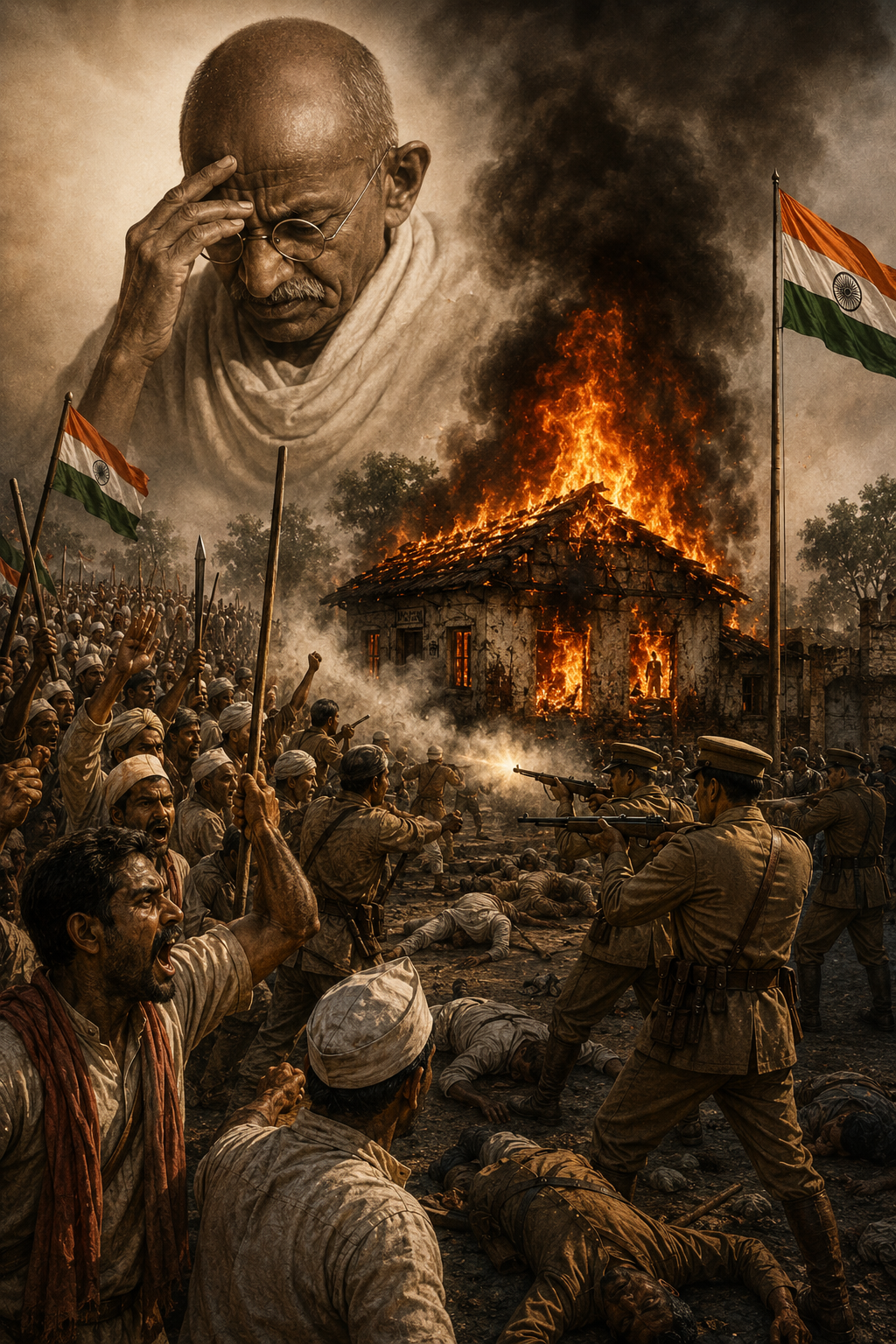
Somewhere between two and three thousand people assembled that day — volunteers dressed in homespun khadi, alongside ordinary farmers who had simply had enough. After a meeting to air their grievances, they formed themselves into a procession and began marching toward the Chauri Chaura police station, chanting slogans in support of Gandhi, intending to protest what had happened at Mundera Bazaar and to carry on with their picketing regardless.
As the crowd neared the station, the police tried to hold them back the only way they knew how — first with warning shots fired into the air. It didn’t work. If anything, it inflamed the crowd further. Stones and brickbats began flying toward the officers, and the police, feeling the ground shift beneath them, opened fire directly into the demonstrators. At least three protesters fell dead, several more wounded, and any hope of an orderly protest evaporated in that instant.
What happened next moved fast, and it moved with a fury that no one — least of all the men who had marched there that morning under Gandhi’s banner of non-violence — could fully control. The police, already low on ammunition and badly outnumbered, retreated into their own station, a modest building with a thatched roof. The crowd did not disperse. Instead, they surrounded it. Someone brought kerosene. The building was set alight.
What followed was chaos and horror in equal measure. Some policemen who tried to flee the flames were driven back inside by the mob; others were killed where they stood and their bodies thrown into the burning wreckage. Twenty-two or twenty-three policemen and chowkidars died that day, most of them consumed by the fire they could not escape. A handful survived only by tearing off their telltale red turbans and vanishing into the crowd, indistinguishable, for a few desperate minutes, from the very people who might have killed them.


By the time the fire burned itself out and the crowd finally dispersed, the police station was gone, along with any illusion that this movement could remain untouched by the violence it was meant to transcend.
The news reached Gandhi within days, and by every account, it struck him like a physical blow. Here were people acting in his name, marching under the banner of a movement he had built specifically to prove that Indians could win their freedom without shedding blood — and they had burned men alive. For Gandhi, this was not a minor setback to be explained away. It was proof, stark and undeniable, that the discipline required for true non-violent resistance had not yet taken root deeply enough across the country. On February 12th, at a Congress Working Committee meeting in Bardoli, he did something that stunned supporters and opponents alike: he called off the entire Non-Cooperation Movement, nationwide, at the very height of its momentum. Then he undertook a five-day fast of penance, publicly grieving the deaths at Chauri Chaura as though the failure were his own.
The British response was swift and merciless. Around 225 people were arrested in the aftermath. A sessions court, in a judgment of almost unbelievable severity, initially sentenced 172 of them to death. On appeal, the Allahabad High Court narrowed that number, confirming death sentences for 19 men identified as ringleaders, while handing down long prison terms — including fourteen life sentences — to the rest. In 1923, the nineteen were hanged.
Chauri Chaura has never settled comfortably into any single version of history. To some, it stands as a moment of raw peasant fury finally answering years of humiliation at the hands of colonial police. To others, it remains a sobering lesson in how quickly discipline can dissolve under real provocation, no matter how carefully a movement has been built. Many younger nationalists at the time were furious with Gandhi for halting the struggle over the actions of one town, feeling that the momentum of two years had been sacrificed in a single decision. But for Gandhi, the principle mattered more than the pace of the campaign — non-violence, to mean anything at all, had to hold even when the crowd’s anger felt justified, even when the police had fired first.
Today, two memorials stand at Chauri Chaura — one honoring the policemen who burned inside that station, and another marking the wider struggle for independence that the incident so dramatically interrupted. Together they mark the spot where a local clash between a few dozen constables and a few thousand villagers ended up reshaping the strategy of an entire national movement.












 https://www.youtube.com/watch?si=RtToJsBhYBatUrym&v=mOuYNSdhjHA&feature=youtu.be