In the heart of Lucknow, where centuries of history coexist with the rhythm of modern life, stories have a way of surviving long after the people who created them are gone. The bustling lanes of Chowk, famous for their vibrant markets, fragrant food stalls, and magnificent remnants of Nawabi architecture, are filled with tales passed down through generations. Most are harmless legends shared over cups of tea and evening conversations. Others are warnings disguised as stories. Among these, none is more feared than the tale of the abandoned Chowk Haveli, a decaying mansion hidden behind crumbling walls and tangled vegetation in one of the oldest quarters of the city.
The haveli had stood abandoned for decades. Time had stripped away its grandeur, leaving behind cracked walls, fading frescoes, and empty corridors where silence seemed to linger unnaturally. Older residents rarely spoke about the building during daylight, and almost never after sunset. Those who did spoke in lowered voices about unexplained disappearances, strange lights visible through broken windows, and distant cries that echoed through the surrounding lanes on winter nights. According to local folklore, the mansion belonged to a nobleman during the final years of the Awadh kingdom, a man who was betrayed by his closest associates and condemned to a horrific death beneath his own home. The story claimed that his restless spirit never left the haveli, remaining trapped within its walls and waiting for those foolish enough to disturb his eternal suffering.

For Arjun Verma, a young investigative journalist known for exposing scams and debunking myths, such stories were irresistible. He had built his reputation on separating fact from fiction, and he regarded supernatural claims with skepticism. His interest in the haveli began during an ordinary evening at a tea stall near Akbari Gate. While working on an unrelated assignment, he overheard a conversation among several elderly men discussing the recent disappearance of a young shop assistant. Their discussion repeatedly returned to the abandoned mansion. One man insisted that the missing youth had been seen near the haveli shortly before vanishing. Another quietly remarked that the building had claimed another victim. The third simply shook his head and muttered that some places should never be disturbed.
What began as casual curiosity soon developed into an obsession. Over the following weeks, Arjun examined police reports, municipal records, and old newspaper archives. Although most of the disappearances lacked evidence connecting them to the haveli, a disturbing pattern emerged. Several individuals who had vanished over the past two decades had reportedly been seen near the property shortly before they disappeared. None were ever found. No bodies were recovered, no suspects identified, and no explanations offered. The absence of answers only deepened the mystery.
Driven by a determination to uncover the truth, Arjun decided to investigate the mansion himself. On a cold December afternoon, he arrived at the property carrying a camera, a flashlight, and a notebook filled with historical references. As he pushed open the rusted iron gate, a strange feeling settled over him. The air seemed unusually still despite the noise of the nearby city. The sounds of traffic, conversation, and commerce faded as though muffled by an invisible barrier surrounding the estate. Standing before the weathered structure, Arjun felt an unease he could not immediately explain.
The interior of the haveli appeared frozen in time. Layers of dust coated every surface, while fragments of broken furniture lay scattered across vast rooms that had once hosted lavish gatherings. Elegant chandeliers hung precariously from cracked ceilings, and portraits of long-forgotten residents stared down from darkened walls. As Arjun explored the corridors, documenting architectural details and signs of neglect, he became increasingly aware of an oppressive atmosphere. The silence felt unnatural, and more than once he had the distinct sensation that someone was observing him from beyond the shadows.
Later that evening, while reviewing the photographs he had taken, he noticed something peculiar. In one image captured at the end of a hallway, a faint human figure appeared standing in the distance. The image was blurred, making it impossible to distinguish specific features, but the silhouette resembled a man dressed in traditional royal attire. Assuming it was an optical illusion caused by lighting conditions, Arjun dismissed it. However, as he continued examining the photographs, he realized the same figure appeared in several others. In each successive image, the mysterious figure seemed slightly closer to the camera.
The discovery unsettled him more than he cared to admit. Nevertheless, his desire for answers outweighed his growing discomfort. Two days later, he returned to the haveli and ventured into sections of the building he had previously avoided. While exploring the upper floor, he discovered a chamber whose walls were covered in faded Urdu inscriptions. Most had deteriorated beyond recognition, but one phrase remained visible beneath layers of grime. Roughly translated, it read: “The betrayed remember what the living choose to forget.”
As he studied the inscription, his flashlight suddenly flickered. A cold gust swept through the room despite the absence of open windows. Moments later, he heard the unmistakable sound of footsteps behind him. The noise was slow and deliberate, as though someone were approaching with careful intent. When he turned around, the room was empty. Yet the footsteps continued, echoing through the darkness from somewhere beyond sight. For the first time since beginning his investigation, genuine fear took hold.
That night, Arjun experienced a vivid dream unlike anything he had ever known. He found himself trapped within a narrow stone chamber beneath the earth. The air was suffocating, and darkness pressed against him from all sides. In the dream, he witnessed a desperate man clawing at stone walls while pleading for mercy. The man’s fingernails were broken and bloodied, his face gaunt from hunger and despair. Before awakening, Arjun saw the stranger turn toward him. Their eyes met, and the terror within the man’s gaze felt so real that Arjun jolted awake, drenched in sweat. The digital clock beside his bed displayed 12:17 a.m.
The nightmares continued night after night. Each dream revealed fragments of a tragic story. Arjun saw meetings conducted in secret, whispered conspiracies fueled by greed, and trusted companions plotting against a nobleman they once served. He watched as the victim was imprisoned beneath his own mansion and abandoned to die in darkness. The recurring visions felt less like dreams and more like memories forcing their way into his consciousness.
Determined to understand what he was experiencing, Arjun immersed himself in historical research. Eventually, he uncovered records describing a wealthy nobleman whose disappearance had never been satisfactorily explained. Contemporary accounts hinted at betrayal involving members of his inner circle, while local rumors spoke of hidden treasures and political intrigue. Although no official document confirmed the legends, enough evidence existed to suggest that a terrible crime had indeed occurred within the walls of the haveli.
As Arjun pieced together the fragmented history, the boundary between research and obsession gradually dissolved. He became consumed by the mystery. Strange occurrences began following him beyond the mansion. Reflections in mirrors occasionally seemed delayed by a fraction of a second. He often sensed someone standing behind him when no one was there. Whispers drifted through empty rooms late at night, disappearing whenever he attempted to locate their source. Despite his rational mind searching for explanations, he could not ignore the growing conviction that something connected to the haveli had attached itself to him.
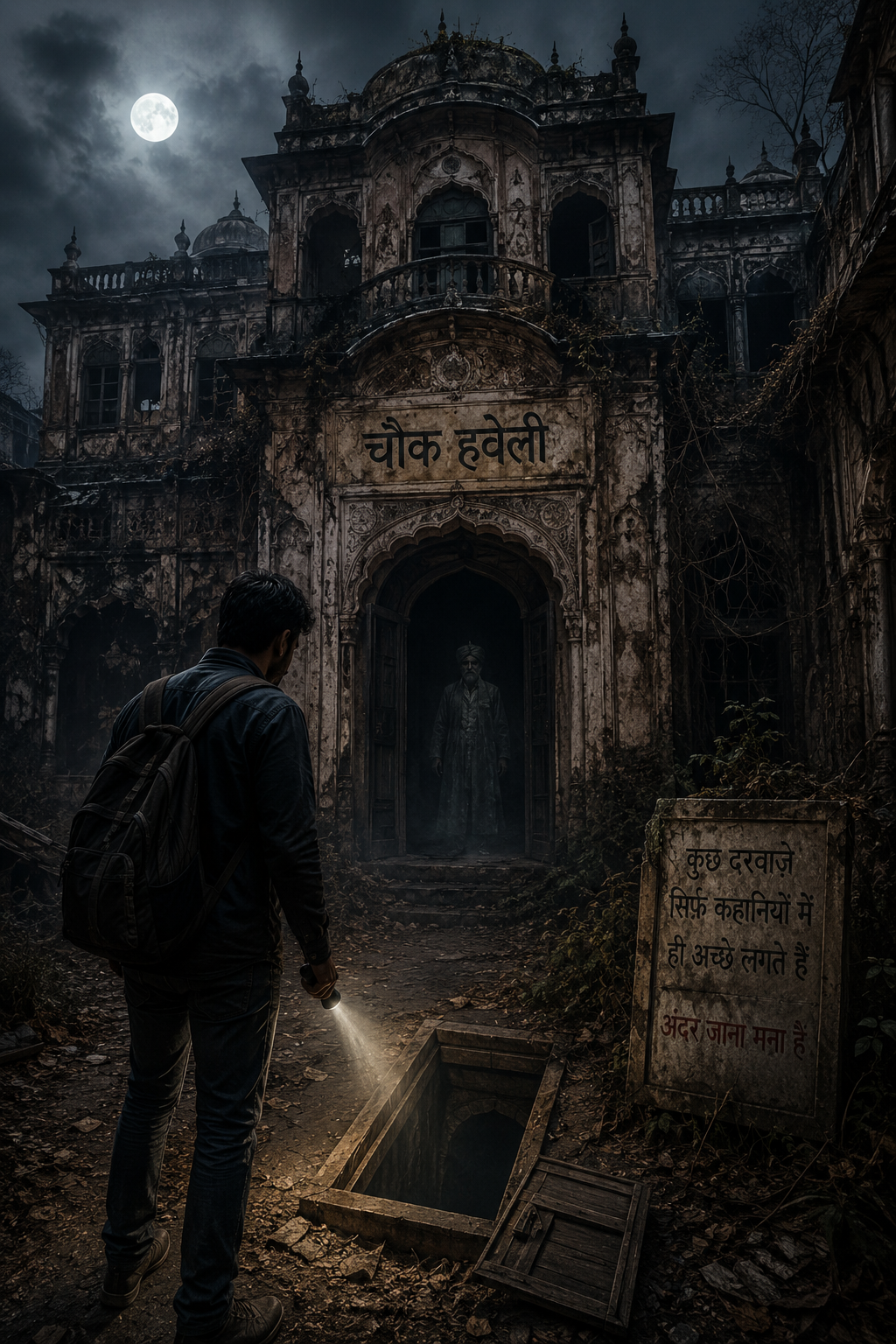
One fog-covered winter morning, compelled by a force he could neither understand nor resist, Arjun returned to the abandoned mansion. The city appeared muted beneath a blanket of mist, and the haveli seemed even more isolated than before. While searching the central courtyard, he discovered a concealed trapdoor hidden beneath accumulated debris. Beneath it lay a narrow staircase descending deep underground.

The tunnel below was ancient and unnaturally cold. Moisture covered the stone walls, and faded symbols lined the passageway. As Arjun moved deeper into the darkness, the temperature continued to drop. Soon he began hearing whispers echoing through the tunnel. At first they sounded like distant wind, but gradually they transformed into recognizable voices. Some seemed to be pleading. Others cried out in despair. Many spoke words he could not understand.
The passage eventually opened into a vast underground chamber dominated by a massive stone altar. Resting upon it was an ornate dagger whose polished blade appeared untouched by age. The moment Arjun approached the relic, the whispers intensified until they filled the chamber like a storm of voices. Against every instinct urging him to retreat, he reached out and touched the weapon.
The effect was immediate.
A violent tremor shook the chamber. Dust cascaded from the ceiling as the ground beneath his feet trembled. The shadows surrounding the altar twisted and gathered into a towering figure. Slowly, the apparition of a nobleman emerged from the darkness. His face bore the marks of unimaginable suffering, while his eyes reflected centuries of loneliness, grief, and betrayal. As the spirit raised its hand, the chamber transformed around Arjun.
Suddenly he was witnessing the past unfold before him. He saw trusted allies imprison the nobleman beneath the mansion. He heard desperate pleas ignored by those who once called themselves friends. He felt the crushing weight of isolation as days turned into weeks and hope slowly died. The horror of the vision lay not in violence but in abandonment. The nobleman had not simply been murdered; he had been forgotten.
When the vision ended, Arjun understood the terrible truth. The spirit was not seeking revenge. It was trapped within an endless cycle of suffering, reliving its final moments again and again. Anyone who ventured too close became entangled in that nightmare, drawn into the same prison of memory from which the nobleman could never escape.
The shadows surged toward him. Panic seized Arjun as he turned and fled through the collapsing tunnels. Behind him echoed countless voices and footsteps. Stone cracked overhead while sections of the passageway crumbled. The earth itself seemed determined to bury him alongside the dead. As he raced toward the staircase, an icy hand briefly grasped his shoulder. The touch carried a depth of sorrow so overwhelming that it nearly brought him to his knees.
Moments later, the tunnel collapsed completely.
The following morning, residents of Chowk discovered that a large section of the abandoned haveli had caved in during the night. Authorities inspected the ruins but found no evidence explaining the collapse. There was no sign of Arjun Verma. Despite extensive searches, he was never found.
Life in Lucknow continued as it always had. The markets remained crowded, the tea stalls remained busy, and the city moved forward. Yet among the older residents of Chowk, whispers persist. On cold winter nights when thick fog blankets the ancient lanes, some claim they can hear voices emerging from beneath the ruins. Others report hearing desperate footsteps echoing beneath the earth. A few insist they have heard someone calling for help from deep below the collapsed haveli.
Those who have listened closely say the voice belongs to a young journalist.
A man who went searching for the truth.
And became part of the legend instead.





 ---------------------------------------------------------------------------------------------------