New Delhi: The Indian Air Force (IAF) has initiated a major navigation and electronic warfare upgrade for its frontline Su-30MKI fighter aircraft, aiming to strengthen operational capability in increasingly contested electronic battle environments.
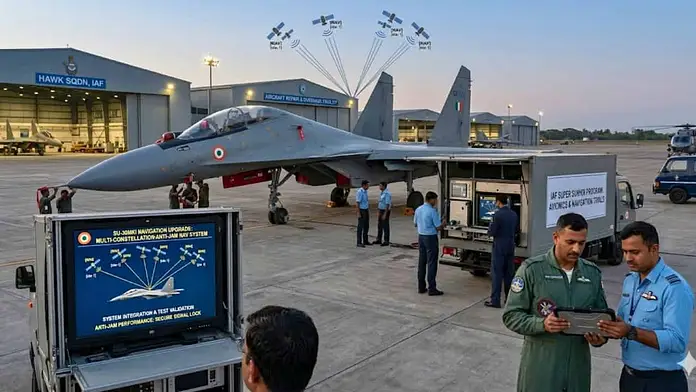
As part of the modernization effort, the IAF has issued a Request for Proposal (RFP) to replace the aircraft’s existing navigation antennas with advanced multi-constellation GNSS (Global Navigation Satellite System) antennas equipped with anti-jamming and anti-spoofing capabilities.

The move comes amid growing concerns over modern electronic warfare tactics such as GPS jamming, signal spoofing, and satellite disruption technologies increasingly being deployed in contemporary conflicts.
Strengthening India’s Frontline Fighter Fleet
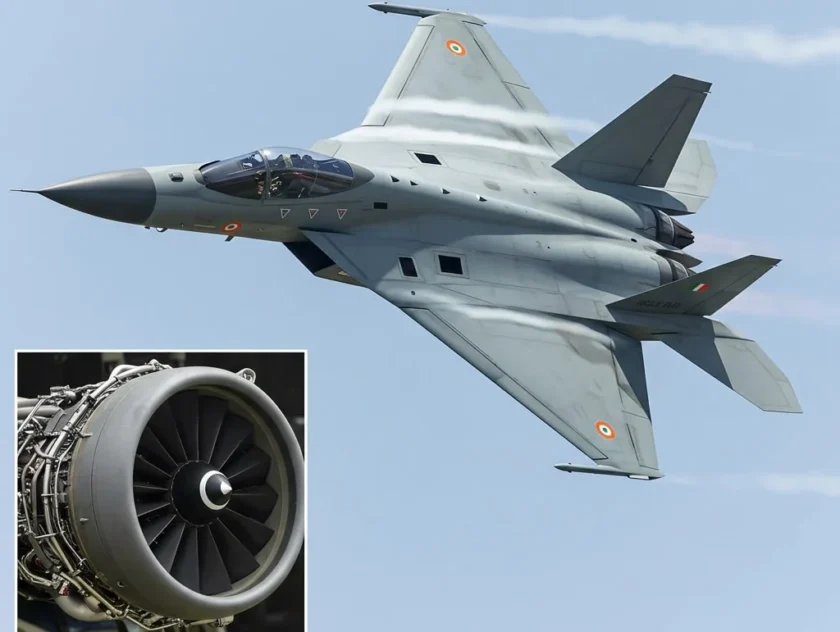
The Su-30MKI remains the backbone of the Indian Air Force, with more than 260 aircraft currently in service. Developed in collaboration with Russia and manufactured in India by Hindustan Aeronautics Limited, the aircraft performs air superiority, precision strike, maritime attack, and long-range combat missions.
The fighter jet also serves as a launch platform for key strategic weapons, including the BrahMos supersonic cruise missile.
While the aircraft’s combat capabilities remain formidable, defence planners believe modern warfare increasingly depends on resilient navigation, secure data links, and electronic survivability in GPS-denied environments.
Why the Upgrade Matters
Currently, the Su-30MKI primarily relies on GPS and Russia’s GLONASS satellite navigation systems. However, military analysts note that adversaries are now capable of disrupting satellite-based navigation using sophisticated electronic attack systems.
During recent regional military operations and exercises, GPS spoofing and jamming incidents were reportedly observed in border regions, highlighting vulnerabilities that can affect navigation accuracy, missile targeting, and precision strike capability.
The new system is expected to significantly improve resilience by allowing the aircraft to simultaneously access multiple global satellite networks, including:
- GPS (United States)
- GLONASS (Russia)
- Galileo (European Union)
- BeiDou (China)
- NavIC (India)
By integrating multiple constellations, the aircraft would gain access to a much larger satellite pool, ensuring uninterrupted positioning even if one network experiences disruption.
Integration of India’s GAGAN System
The upgraded navigation suite will also support India’s GAGAN (GPS Aided GEO Augmented Navigation) system, which enhances navigation precision using satellite-based augmentation technology.

According to defence sources, the new dual-frequency architecture supporting both L1 and L5 bands is especially important for high-speed combat aircraft like the Su-30MKI. Dual-frequency operation helps reduce atmospheric and ionospheric errors, providing significantly more accurate positioning data during aggressive manoeuvres and low-level strike missions.
The upgraded system is expected to deliver navigation accuracy within 1–2 metres, improving the effectiveness of precision-guided munitions and long-range strike weapons.
Designed for Electronic Warfare Conditions
One of the key features of the new antenna system is its anti-jamming and anti-spoofing capability.
Modern electronic warfare systems can attempt to deceive aircraft by transmitting fake navigation signals or blocking genuine satellite transmissions. The proposed system is being designed to continue functioning reliably even under hostile electronic attack conditions.
Defence experts believe such capabilities are becoming essential as regional adversaries rapidly expand electronic warfare and space-based military assets.
Part of the “Super Sukhoi” Modernization Program
The navigation upgrade forms part of the broader “Super Sukhoi” modernization initiative under which the IAF plans to equip the Su-30MKI fleet with next-generation avionics, improved radars, electronic warfare suites, and advanced weapons integration.
The project is also expected to support India’s “Make in India” and “Aatmanirbhar Bharat” initiatives, with Indian defence firms, public sector undertakings, and domestic-private partnerships likely to participate in development and integration.
Companies such as Bharat Electronics Limited and HAL are expected to play key roles in the program.
Officials indicate that prototype development, ground trials, and flight testing will be carried out in phases before large-scale fleet-wide integration begins. Initial upgrades may reportedly cover more than 50 aircraft before expansion across the entire Su-30MKI fleet.
Military analysts view the initiative as a crucial step toward ensuring that India’s frontline fighter aircraft remain fully operational and mission-capable in future high-intensity electronic warfare scenarios.