Bareilly: The Divisional Kharif Productivity Seminar-2026 for the Aligarh, Agra, and Bareilly divisions was organised at the Vivekananda Auditorium of the Indian Veterinary Research Institute in Izzatnagar under the chairmanship of Minister of State for Agriculture, Agricultural Education and Agricultural Research Baldev Singh Aulakh and in the distinguished presence of Animal Husbandry and Dairy Development Minister Dharampal Singh.
During the seminar, officials and farmers from various districts highlighted region-specific agricultural challenges and placed suggestions before ministers and senior officials. Representatives from Pilibhit stressed the need for solar-based fencing to protect crops from stray animals and demanded solutions regarding land disputes under Section 24 and crop damage caused by monkeys.

Farmers from Shahjahanpur demanded an increase in agricultural machinery targets, effective solutions for stray cattle, and adequate availability of fertilizers. Officials from Badaun pointed out that despite being a major maize-producing area, the district has only one maize dryer and requires additional drying infrastructure. They also proposed setting up potato-based industries in the region due to high potato production.
Several farmers raised concerns over delayed installments affecting the functioning of Krishi Vigyan Kendras and demanded subsidy schemes for solar fencing and the establishment of animal shelters. Farmers also insisted that crops should be procured directly from cultivators at Minimum Support Price (MSP), rather than through traders.
Officials from Bareilly informed the gathering that multiple schemes for cattle protection are being implemented and that farmers are receiving cattle under participation schemes. However, they noted the need for larger cattle shelters. Farmers also pointed out that the benefits of the cluster formation scheme are not reaching small farmers due to landholding limitations and requested relaxation in eligibility criteria.
The Project Director of DRDA Mathura highlighted increasing waterlogging problems caused by soil erosion from the Aravalli hills, which is damaging crops. Meanwhile, the Chief Development Officer of Aligarh demanded notification of certain maize varieties and enhancement of millet procurement targets due to high production in the district.
The issue of permitting tranquilizers to capture stray bulls was also discussed, with officials clarifying that permission already exists and veterinary officers receive training from the Forest Department.
Representatives from Agra stated that despite high millet production, the region lacks training centres. They also raised concerns over saline water and demanded that electricity connections for mushroom cultivation and polyhouses be categorized under agricultural use to provide relief to farmers. Problems related to bank loans for dairy farming and the need for a barrage on the Yamuna River were also highlighted.
Farmers from Hathras said that although potato cultivation covered 52,000 hectares, growers were not receiving fair prices for their produce. Demands were also made for the establishment of a District Cooperative Bank and increased millet procurement targets.
Farmers from Kasganj requested linking the Mohanpur Pea Market with the main mandi to reduce inconvenience. They also sought the establishment of a hi-tech nursery, to which officials responded that approval had already been granted.
Farmers from Firozabad requested subsidies on smaller tractors due to shrinking landholdings and urged the government to restore subsidies on vermicompost fertilizers. Farmers from the Bareilly region complained that canal cleaning work during November delays water supply required for wheat sowing, causing hardships.

During the seminar, the Agriculture Director informed farmers about the benefits of green manure crops such as dhaincha and sunhemp. He encouraged farmers to cultivate dhaincha on field boundaries and announced that dhaincha seeds would be procured at Rs 10,000 per quintal.
Officials were instructed to ensure that no tagging practices occur during fertilizer sales and warned that strict action would be taken on complaints. Agriculture officers were also directed to clearly display fertilizer prices and widely publicize seed availability and rates through media and outreach programmes.
The meeting also noted that the budget allocation for Kisan Diwas, which earlier covered only ten months, has now been extended for all twelve months of the year.
Addressing the gathering, Minister Baldev Singh Aulakh assured farmers that their concerns and suggestions would be seriously considered and efforts would be made to resolve shortcomings. He said irrigation-related issues would be discussed with the concerned departments to ensure timely water supply and encouraged farmers to adopt intercropping practices with government-supported seed distribution.
Animal Husbandry Minister Dharampal Singh stated that all issues raised by farmers had been carefully heard and would be addressed systematically. He informed that meetings had been held with fertilizer production units on the directions of Chief Minister Yogi Adityanath to improve fertilizer availability and announced plans to establish cow dung-based fertilizer factories in 18 divisions.
He added that agriculture and animal husbandry together would play a crucial role in doubling farmers’ income and appealed to people not to misuse drinking water supplied under the “Har Ghar Jal” scheme. He also stated that the government is continuously working to provide urban-level facilities in villages and to strengthen cattle shelters and breed improvement programmes. He announced that farmers rearing six cattle would receive Rs 6,000 as maintenance support along with cattle sheds.
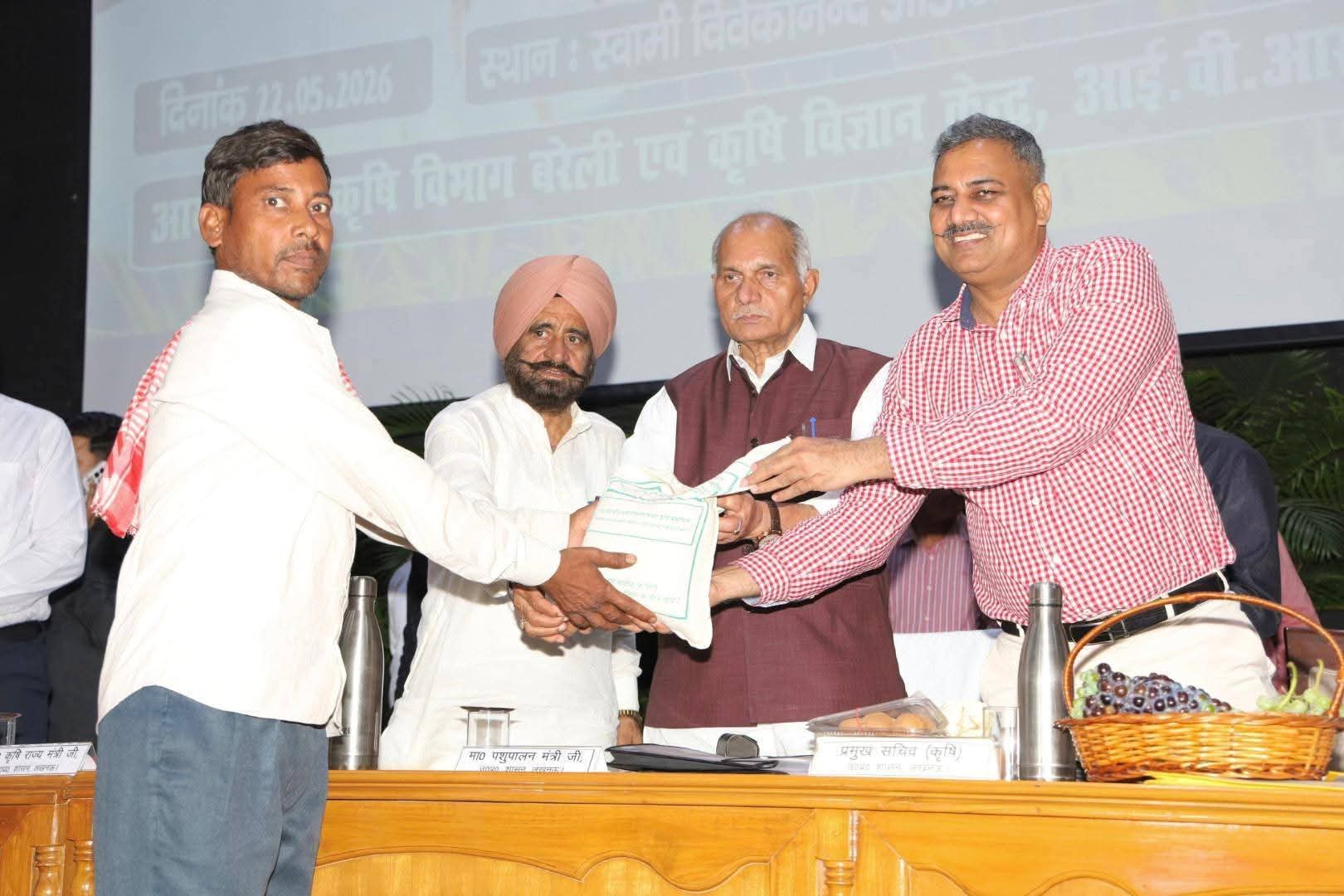
During the programme, seed kits of urad and maize were distributed to farmers by the Agriculture Minister. Two farmers were symbolically handed tractor keys and subsidy cheques worth Rs 24 lakh. Compensation cheques worth Rs 51,000 were also distributed to farmers whose wheat crops had suffered losses.
Senior officials including the Principal Secretary Agriculture, Agriculture Production Commissioner, Director of Agriculture, Bareilly Divisional Commissioner Bhupendra S. Chaudhary, and divisional and district-level officers from Aligarh, Agra, and Bareilly divisions were present at the seminar.
Reported by Akhilesh Chandra Saxena from Bareilly.







 ---------------------------------------------------------------------------------------------------