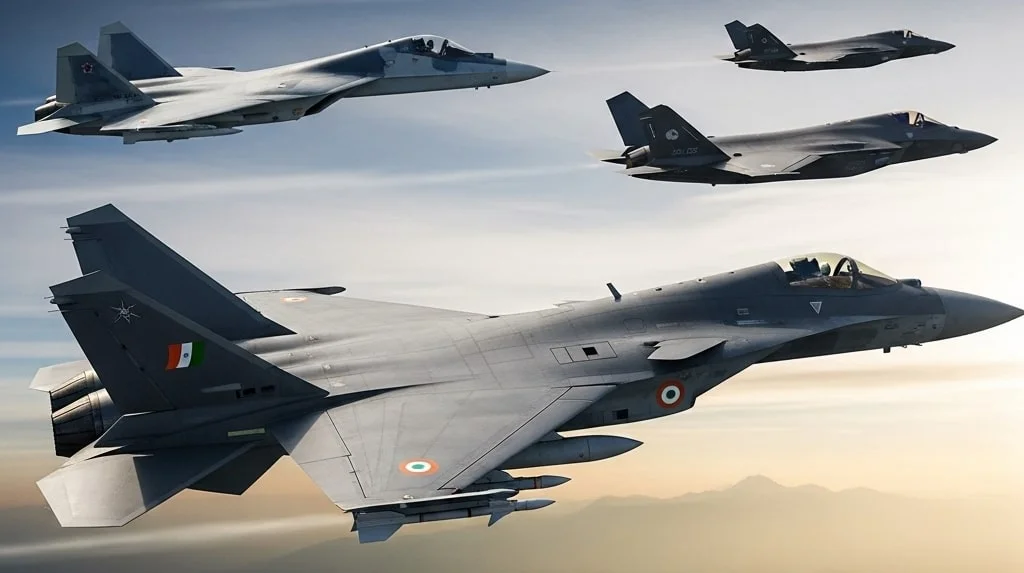
New Delhi: The Indian Air Force is planning a major long-term transformation of its combat fleet, aiming to restore its strength to 42 squadrons by 2040 while ensuring that nearly 60% of its fighter aircraft are indigenously developed. The strategy reflects a broader push toward self-reliance in defence manufacturing under India’s “Aatmanirbhar Bharat” vision.
According to the roadmap, the Air Force is expected to operate around 454 indigenous combat aircraft by 2040, forming the backbone of its future air combat capability.
Tejas at the Core of Light Fighter Fleet
The foundation of this modernization drive will be the HAL Tejas programme, developed by Hindustan Aeronautics Limited. The IAF plans to induct Tejas Mk1A and Mk1B variants in large numbers, alongside a limited fleet of earlier Mk1 aircraft that will remain in service for a transitional period.
These aircraft are intended to replace ageing platforms such as the Jaguar strike fleet and gradually phase out legacy MiG-series fighters. Production capacity is also being expanded, with additional manufacturing lines aimed at accelerating deliveries.
Tejas Mk2 to Strengthen Medium Fighter Segment
In the medium-weight category, the upcoming Tejas Mk2 is expected to play a decisive role, with plans for over 130 aircraft. The Mk2 will be powered by the advanced GE F414 engine, produced under a co-production arrangement in India, marking a significant step in technology transfer and domestic capability building.
The aircraft is expected to replace several mid-generation fleets, including MiG-29UPG and Mirage 2000 fighters, as they reach retirement.
AMCA to Mark India’s Fifth-Generation Leap
At the top tier of future air capability will be the Advanced Medium Combat Aircraft programme, or AMCA. Designed as India’s first stealth fighter platform, AMCA will introduce advanced sensor fusion, stealth characteristics, and network-centric warfare capabilities.

The Cabinet Committee on Security (CCS) approved initial funding of approximately ₹15,000 crore for design and prototype development. Initial variants are expected to enter service in the mid-2030s, with further upgraded versions planned for the late 2040s.
Foreign Aircraft as Capability Bridge
While indigenous development remains the priority, the Indian Air Force is also considering limited foreign acquisitions to bridge immediate capability gaps. This includes the proposed procurement of 114 multi-role fighter aircraft—widely expected to be the Dassault Rafale—and a potential acquisition of fifth-generation fighters such as the Sukhoi Su-57.
These platforms are expected to serve as stopgap solutions until domestic programs reach full operational strength.
Strategic Outlook
By combining indigenous platforms like Tejas and AMCA with selective foreign acquisitions, the Indian Air Force aims to build a balanced and technologically advanced fleet. The long-term goal is a modern, self-reliant air force capable of maintaining strategic superiority while reducing dependency on imports.
If successfully executed, the 2040 force structure would mark one of the most significant transformations in the history of India’s air power.