Prologue: Where the Road Ends and Fear Begins
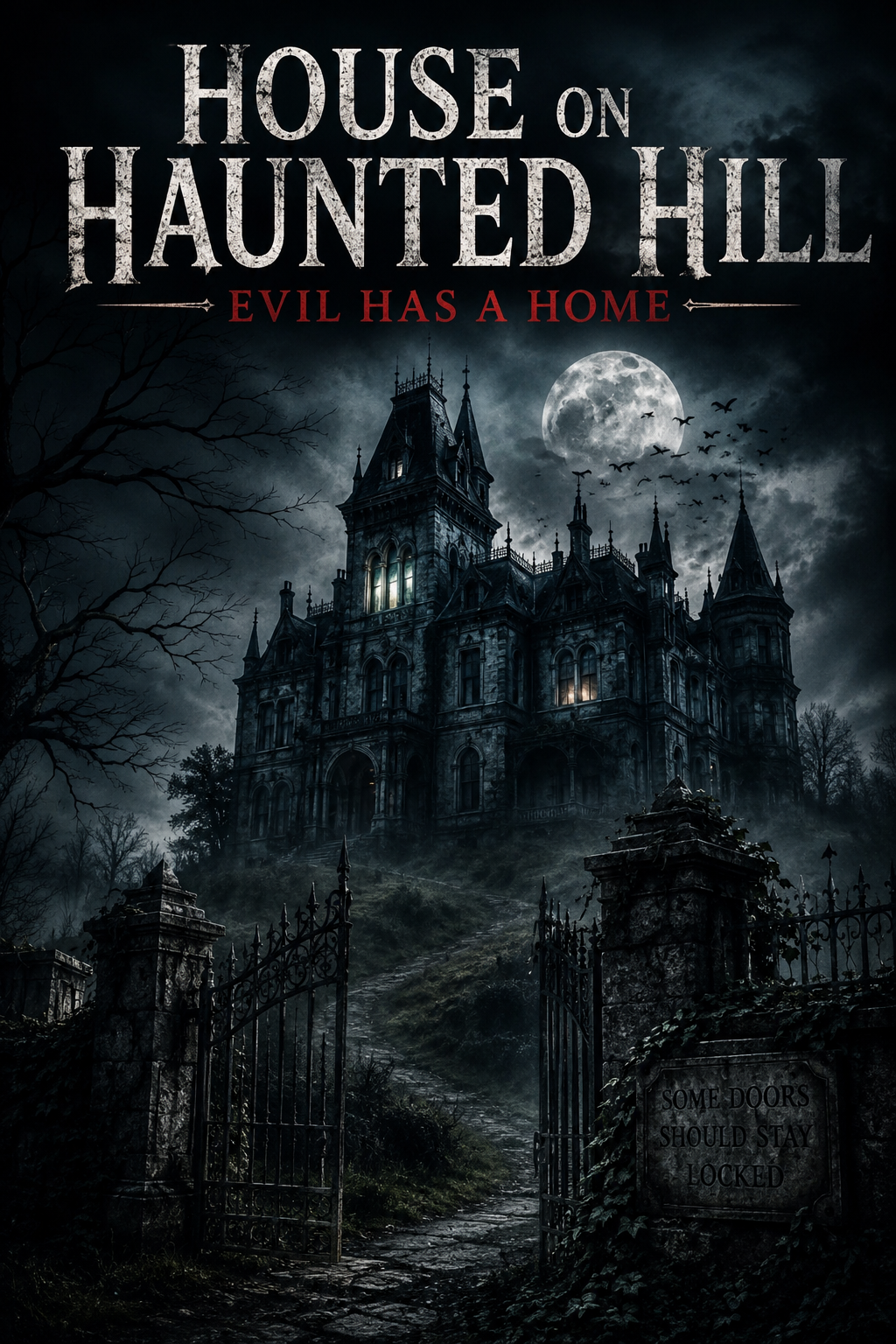
On the outskirts of a forgotten town—so small it seemed to hesitate before appearing on maps—stood a structure that refused to belong to the present.
Locals called it simply: the House on Haunted Hill.

It loomed above the treeline like a watching eye, its silhouette carved against the fading sky. No birds nested on its roof. No vines truly claimed its walls. Even time seemed reluctant to touch it, circling around it instead of passing through.
People did not visit the house.
They avoided remembering it existed.
Yet memory, like fear, has a way of surviving silence.
And in that town, silence was never empty.
Chapter 1: The Blackwood Legacy of Silence
Long before the house became a warning whispered at dusk, it belonged to a man named Edgar Blackwood—an industrialist whose fortune was built on ambition so sharp it cut through morality itself.
He did not inherit wealth. He extracted it.
And when he built his mansion atop the hill, it was not meant to be a home. It was a statement.
Inside those walls, elegance and coldness coexisted. Chandeliers glittered above rooms where laughter once echoed during lavish gatherings. But even at its brightest, the house never felt warm.
Edgar’s wife, Evelyn Blackwood, was often seen wandering its corridors alone. Her beauty was once admired across society circles, but the mansion seemed to slowly erase her—like a painting left in rain.
Then came Edgar’s death.
No will explained the estate. No heir claimed it. No servant stayed.
The house was left behind like a sentence unfinished.
And over time, the town learned a new truth:
The house had not been abandoned.
It had simply stopped letting people leave.
Chapter 2: The Curiosity That Should Not Have Awakened
Years passed.
Legends grew thicker than dust.
Some said the house held spirits. Others believed it was a gateway. A few insisted it was alive in the way storms are alive—unthinking, but unstoppable.
Most people avoided it entirely.
Except for a group of young explorers.
They were not foolish in their minds—only convinced that fear belonged to others. Armed with lanterns, curiosity, and the dangerous confidence of disbelief, they decided the mansion was nothing more than old architecture and exaggerated stories.
They were wrong.
The moment they stepped through the iron gates, the world behind them felt… distant.
As if the house had quietly agreed that it now owned them.
Chapter 3: The Entrance That Watched Back
The front doors opened without resistance.
Inside, the air changed immediately.
Cold. Dense. Expectant.
The entrance hall stretched wide beneath towering ceilings. Portraits lined the walls—faces of the Blackwood family painted with unsettling precision. Their eyes did not simply follow movement.
They recognized it.
Dust floated like suspended time. Every footstep echoed longer than it should have, as though the house repeated sound for its own understanding.
No one spoke at first.
Because speaking felt like permission.
Still, they moved forward.
Chapter 4: Rooms That Remember Too Much
Each room was a fragment of a life that no longer existed.
The parlor held furniture draped in white sheets, resembling covered bodies waiting for identification. A grand piano stood untouched in the corner, its keys yellowed like old teeth.
The dining hall was set for a feast that never ended—plates arranged, cutlery aligned, glasses untouched.
And yet nothing decayed in a natural way.
Everything felt preserved by intention.
As they wandered deeper, the air grew heavier, as though the house was slowly learning their names.
Then came the whispers.
Not words exactly.
More like thoughts that did not belong to them.
The house was speaking.
Chapter 5: The Library of Forgotten Truths
They reached the library as night began to settle outside.
Towering shelves groaned under the weight of forgotten knowledge. Books leaned into each other like exhausted witnesses.
It was here that one of them—Mark, the group’s quiet historian—felt something pull at him.
He selected a leather-bound volume.
The moment it opened, the room changed.
A wind passed through sealed windows.
Lantern flames died instantly.
Darkness swallowed everything.
Chapter 6: The Blackwood Secret Revealed
When light returned, Mark’s face had gone pale.
The book was no ordinary record. It was a confession written across generations.
The Blackwoods had not merely built the house.
They had bound it.
Edgar Blackwood, desperate for power beyond industry or politics, had made a pact with forces that existed beyond human law. Wealth was granted. Influence followed.
But every bargain has a cost.
The house became the container.
And the souls inside… became currency.
Evelyn’s tragedy was not madness—it was awareness. She had realized too late that the house did not belong to them.
They belonged to it.
As the final line was read aloud, the library itself reacted.
A deep rumble rolled through the mansion like a breath held too long.
And then released.
Chapter 7: When the House Decided to Wake
The doors slammed shut.
Not from wind.
From will.
The walls began to shift—not collapsing, but adjusting, as if the architecture itself had muscles.
Shadows detached from corners and formed shapes resembling the Blackwood family. Their expressions were not entirely angry.
They were trapped.
The house was not only a prison.
It was a memory that refused to end.
Fear spread through the group like fire through dry wood.
But fear was not the only thing present.
Something else began to rise.


Resolve.
Chapter 8: The Corridor of No Return
They ran.
Corridors stretched longer than they had before. Doors led to rooms they had not passed. Stairs curved into impossible angles.
The mansion was rearranging itself.
A living maze built to exhaust hope.
Whispers grew louder.
Stay.
Join us.
You cannot leave what already knows you.
But they kept moving.
Because stopping felt worse than fear.
Chapter 9: The Mirror Chamber
At the top of the house, they found a door slightly open.
Inside stood a single object:
A mirror.
Tall. Fractured at the edges. Rippling like liquid thought.
Behind it, portraits of the Blackwoods lined the walls—each expression more tormented than the last.
When they looked into the mirror, their reflections hesitated.
Then disappeared.
And were replaced.
Not by themselves.
But by the Blackwoods.
Edgar’s rage filled the glass.
Evelyn’s sorrow bled through it.
The truth became unbearable:
The house was not haunted.
It was remembering through them.
Chapter 10: The Breaking Point of Fear
The walls tightened.
The house was closing in.
Not to kill.
To keep.
But something changed in that final moment.
The group stopped running.
They stood together.
Shoulder to shoulder.
Breathing in sync.
Fear did not disappear—but it stopped leading.
And in that unity, something inside the house hesitated.
A crack formed in its certainty.
Chapter 11: The Light They Created Together
It began subtly.
A warmth.
A pulse.
A shared defiance that did not belong to any one of them.
The mirror reacted first—flickering, distorting.
Then the shadows recoiled.
The Blackwood silhouettes in the walls trembled, as if hearing something they had forgotten.
The group’s unity became a force the house could not categorize.
Not fear.
Not despair.
Something else.
Hope.
The mirror shattered.
Not violently.
But finally.
Chapter 12: The Collapse of the Mansion’s Memory
The house reacted like a wounded mind.
Walls loosened. Floors shifted. The oppressive weight lifted in uneven waves.
For the first time, the mansion was unsure of itself.
Doors opened without resistance.
The staircase led downward without distortion.
And the exit appeared.
Not as illusion.
But as permission.
Epilogue: The House That Finally Exhaled
They stumbled out into the open air.
The sky was burning orange with sunset.
Behind them, the House on Haunted Hill still stood—but it no longer felt like a predator.
It felt… tired.
Inside its windows, the Blackwoods could be seen once more.
But not in torment.
In stillness.
As if something inside them had finally been understood.
The house remained.
But something had changed.
It no longer called out.
It only remembered.
And in that quiet, the town learned a new version of its oldest fear:
Sometimes a haunting is not about spirits.
Sometimes it is about stories that refuse to end—
Until someone has the courage to listen, and leave them behind.












 https://www.youtube.com/watch?si=RtToJsBhYBatUrym&v=mOuYNSdhjHA&feature=youtu.be