Geneva: The United Nations has launched a refined diplomatic offensive aimed at dismantling the political hurdles that have paralyzed Libya’s transition toward national elections. This fresh initiative, spearheaded by the United Nations Support Mission in Libya, focuses on a targeted approach to resolve specific disagreements that have long stalled the country’s democratic progress. Rather than seeking to overhaul the existing political framework, the UN is prioritizing high-level, limited gatherings of key stakeholders to address the technical and institutional friction points preventing a unified electoral roadmap.
Strategic Shift Toward Targeted Diplomacy
UN Special Representative Hanna Tetteh has emphasized that these new, smaller-scale discussions are intended to act as a catalyst for the broader national dialogue rather than a replacement for it. The strategic shift comes in response to deep-seated divisions that have rendered previous, more expansive formats ineffective. By convening influential actors in a more focused setting, the mission hopes to accelerate decision-making on critical issues, such as the composition of the High National Elections Commission and the finalization of a workable constitutional basis for the vote.

A Roadmap Centered on Institutional Unity
The mission’s current trajectory remains rooted in a structured roadmap introduced last year, which serves as a blueprint for restoring stable governance. This plan hinges on three fundamental pillars: the establishment of a robust electoral legal framework, the formation of a single, unified government, and the engagement of the Libyan public through structured national conversations. Tetteh has noted that the primary goal is to rebuild citizen trust in state institutions, which has been severely eroded by years of fragmentation and competing claims of legitimacy.

Alternative Mechanisms Amid Legislative Delays
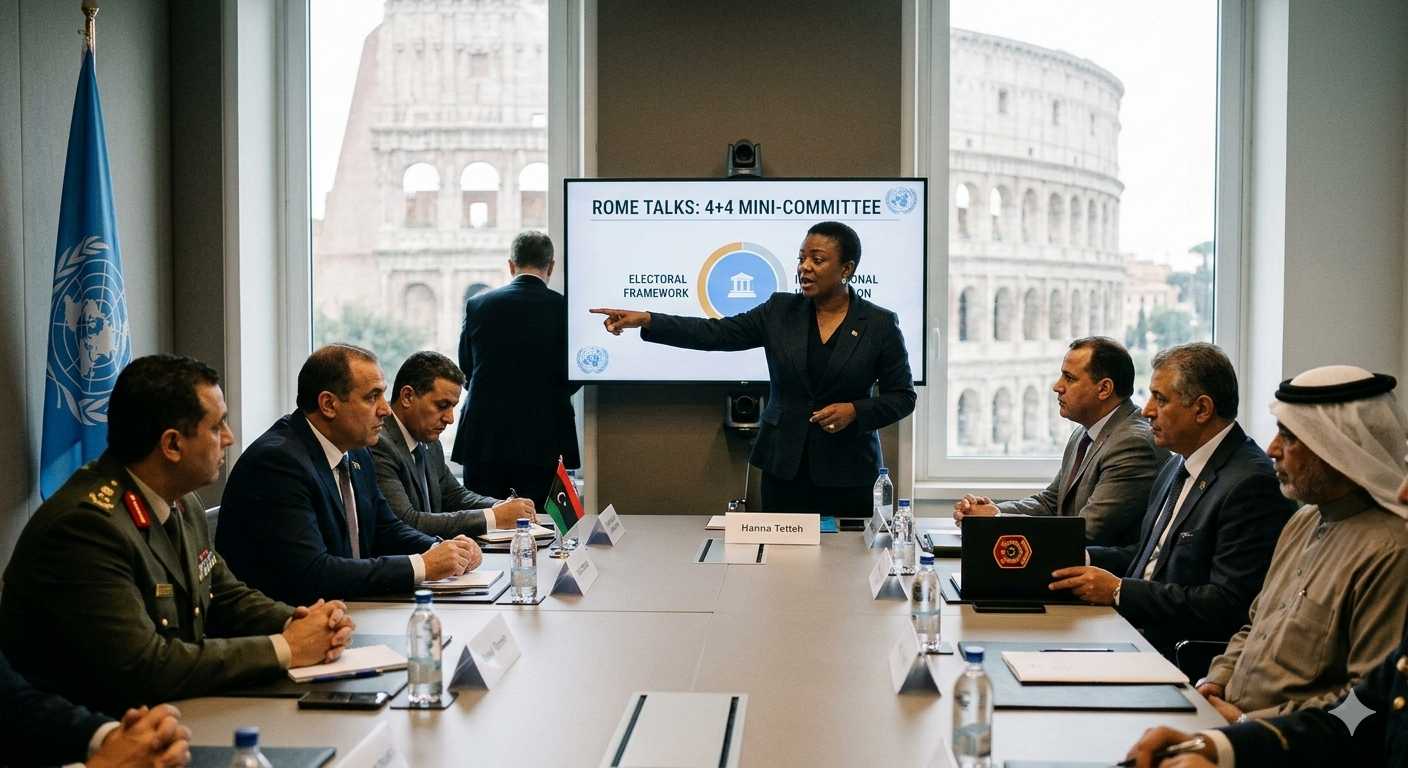
The decision to pivot toward alternative negotiation tracks follows a period of significant stagnation. Over the last eight months, both the House of Representatives and the High Council of State have failed to complete the preliminary phases of the agreed-upon roadmap. This lack of momentum has necessitated a more flexible strategy. The proposed “4+4 mini-committee”—which aims to bring together representatives from the country’s major political and military factions—is viewed as a practical mechanism to bridge the gap between the eastern-based leadership and the Tripoli-based administration.
Supervised Negotiations to Restore Momentum
According to internal mission sources, the first of these specialized sessions is slated to occur in Rome under direct UN supervision. This supervised environment is intended to provide the necessary neutrality and security for rival factions to negotiate without immediate external pressures. While UN officials remain realistic about the complexities involved, there is a prevailing belief that even incremental agreements on electoral laws could provide the necessary spark to restart Libya’s stalled political engine and finally move the nation toward long-awaited elections.