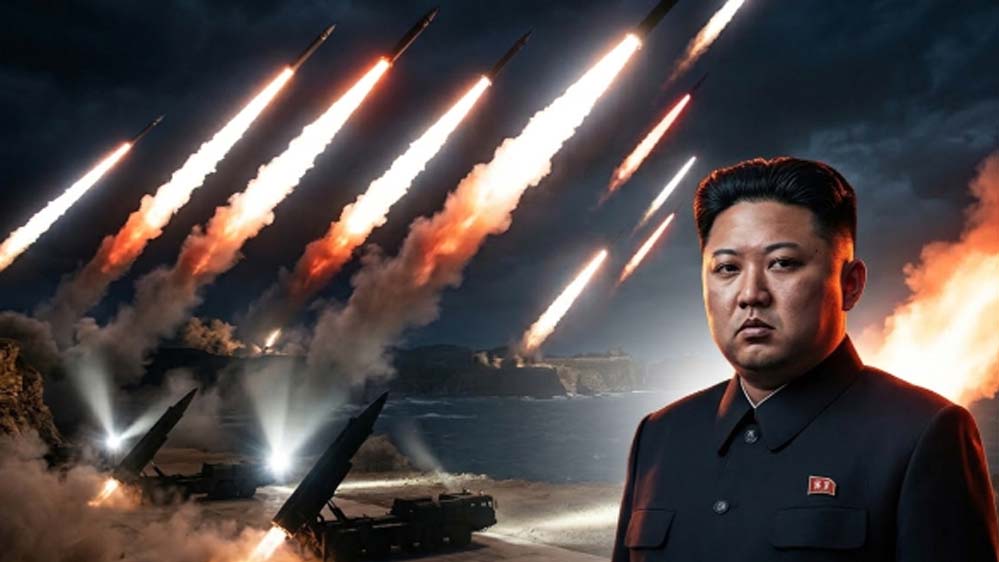
Pyongyang | North Korea has conducted a successful test of a high-capacity solid-fuel missile engine, a development that is likely to heighten global security concerns, particularly in the United States and its allied nations.
According to state media Korean Central News Agency, the test involved a powerful new engine designed to enhance the country’s ballistic missile capabilities. Leader Kim Jong Un personally oversaw the ground-based jet test, underscoring its strategic importance.

Significant Boost in Missile Capability
Reports indicate that the newly tested engine has a thrust capacity of approximately 2,500 kilotons, a marked increase from a previous test conducted in September last year. The upgraded engine reportedly incorporates advanced composite carbon-fiber materials, improving both efficiency and durability.
Defence analysts suggest that the enhanced power could enable North Korea to develop missiles capable of carrying multiple warheads, potentially allowing them to evade existing missile defence systems.
Focus on Solid-Fuel Technology
The test highlights Pyongyang’s continued focus on solid-fuel missile systems, which are considered more advanced and difficult to intercept than liquid-fuel variants. Unlike traditional systems, solid-fuel missiles require minimal pre-launch preparation, significantly reducing detection and response time.
This advancement is believed to be part of North Korea’s broader five-year military modernisation plan, aimed at strengthening its strategic deterrence.

Political Messaging and Rising Tensions
The test follows recent remarks by Kim Jong Un declaring North Korea an “irreversible” nuclear power. In his address, he criticised US foreign policy, accusing Washington of global aggression and referencing ongoing conflicts in the Middle East.
Kim described the engine test as a critical step toward enhancing the country’s military capabilities and ensuring national security.
Global Security Implications
Experts warn that continued advancements in missile technology—particularly the development of intercontinental ballistic missiles (ICBMs) equipped with multiple warheads—could pose a serious challenge to global security frameworks.
The latest test comes at a time of heightened geopolitical tensions worldwide, and is expected to further strain relations between North Korea and the United States, along with its regional allies.
As the situation evolves, international observers are closely monitoring Pyongyang’s next moves amid concerns over a potential escalation in military posturing.