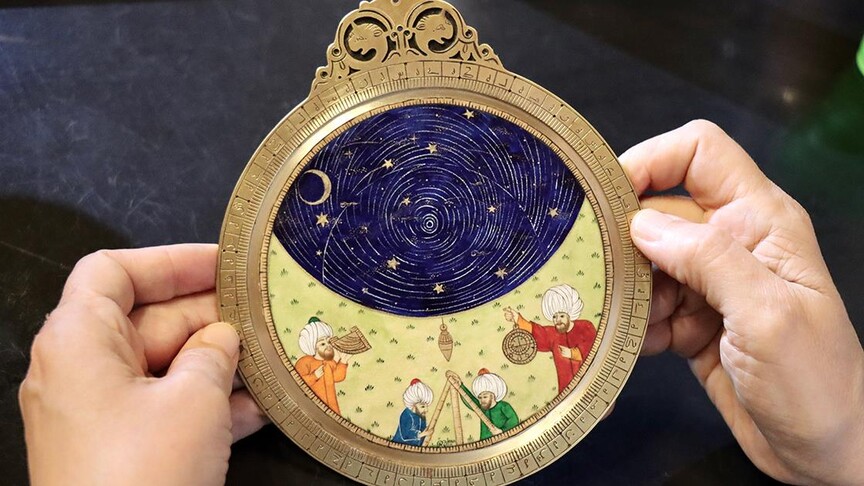
London: One of the most extraordinary scientific treasures from Jaipur’s royal collection—a massive 17th-century brass astrolabe—is set to go under the hammer at Sotheby’s, London, attracting global attention from collectors and museums alike.
Described by experts as both a “supercomputer” and an “ancient smartphone” of its era due to its multifunctional design, the rare astronomical instrument is being hailed as one of the largest and most sophisticated astrolabes ever documented. Benedict Carter, Head of Islamic and Indian Art at Sotheby’s, has called it an unparalleled example of historical scientific craftsmanship and rarity.

The instrument traces its provenance to the private collection of Maharaja Sawai Man Singh II of Jaipur. After his passing, it remained with his wife, the internationally renowned Maharani Gayatri Devi, before eventually entering a private collection. It is now being offered for public auction for the first time in history.
Weighing approximately 8.2 kilograms and standing around 46 centimetres tall—nearly four times larger than a standard astrolabe—the artifact represents the pinnacle of 17th-century scientific innovation. Its estimated value is between £1.5 million and £2.5 million (approximately ₹15–25 crore), and experts believe it could set a new world record for astronomical instruments sold at auction.
According to Oxford historian Dr. Federica Gigante, the astrolabe functioned as a highly advanced all-in-one scientific device. In the 17th century, it enabled scholars to calculate sunrise and sunset times, determine the positions of stars, measure heights of structures, estimate the depth of wells, and even assist in determining the direction of Mecca. It was also used in creating precise astrological charts based on traditional calendars.

Beyond its scientific value, the instrument stands as a powerful symbol of cultural synthesis during the Mughal era. Crafted in the early 17th century by renowned artisans Qaim Muhammad and Muhammad Muqim of the Lahore school, the device reflects a rare fusion of Persian and Sanskrit traditions. Star names are inscribed in Persian, with corresponding Sanskrit equivalents engraved in Devanagari script alongside them.
Originally commissioned for Aqa Afzal, an official in the Mughal administration under emperors Jahangir and Shah Jahan, the astrolabe contains coordinates for 94 cities and pointers for 38 stars—remarkably precise even by modern astronomical standards.
As anticipation builds ahead of the auction, institutions and private collectors worldwide are competing for the chance to acquire this rare scientific and cultural relic, which represents a unique intersection of astronomy, history, and Indo-Islamic heritage.