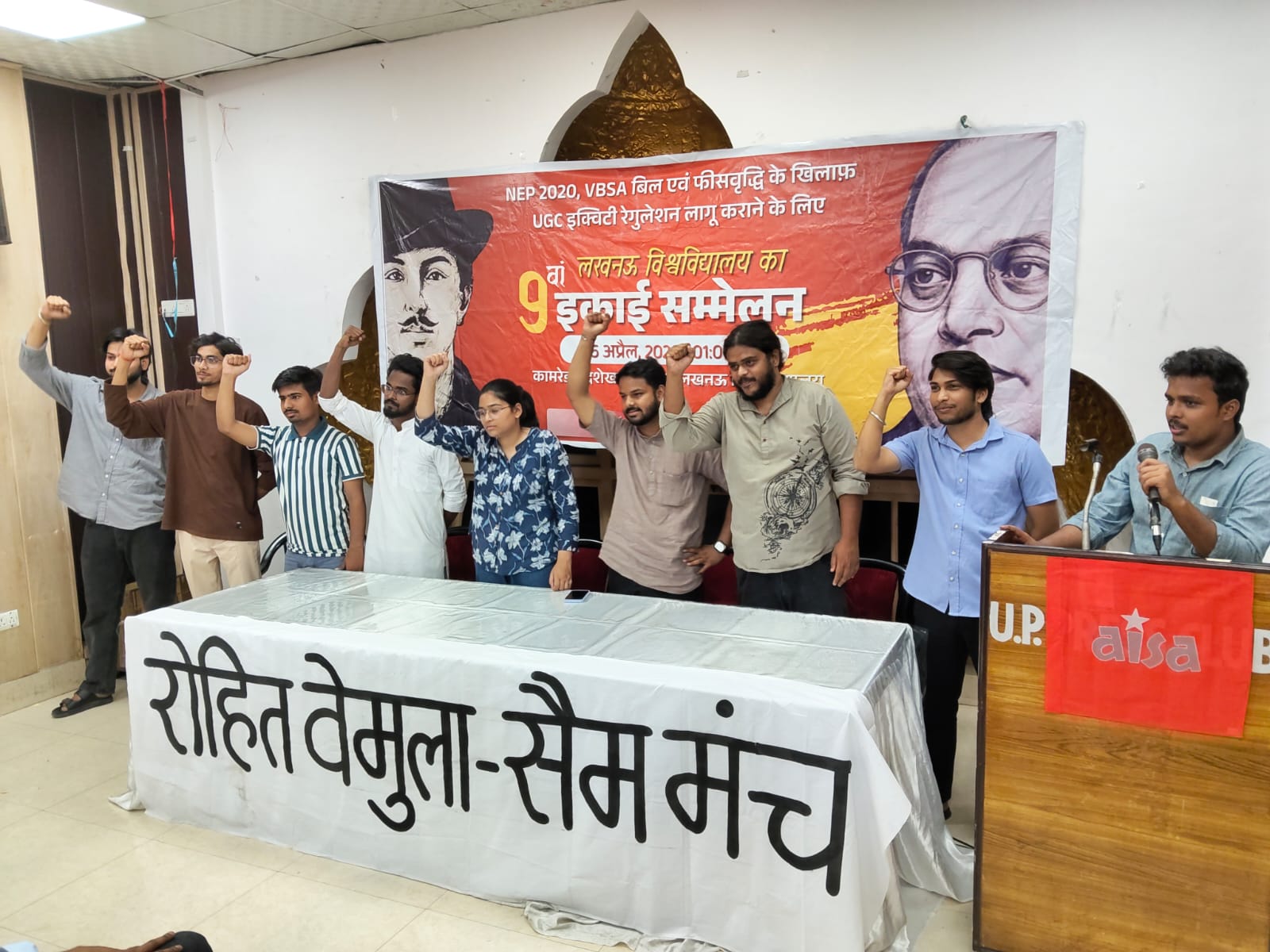
Lucknow: In a strong assertion of student democratic rights, the All India Students’ Association (AISA) successfully conducted its 9th Lucknow University unit conference despite the university administration cancelling the event at the last moment, even after prior written permission had been granted.
Following the cancellation, students organized an open session and protest at Gate No. 1 of Lucknow University, which was addressed by former JNUSU President Comrade Dhananjay and AISA National President Comrade Neha. Subsequently, the organization’s internal session was held successfully at the UP Press Club, where a new leadership team was elected.

Shantam Nidhi was elected President and Harsh was chosen as Secretary. The newly elected team also includes Samer, Sanvidha, and Ahmad as Vice Presidents, while Sukirti, Satyam, Atul, and Ansh were elected as Joint Secretaries. A 39-member council was also constituted during the conference.
Senior AISA leaders including Dhananjay (former JNUSU President), Neha (National President), Shashank (Uttar Pradesh Secretary), Manish Kumar (Uttar Pradesh President), and Shivam Safeer (former Uttar Pradesh Secretary) were present at the organizational session. The proceedings were chaired by Prachi, Seema, and Satyam, while a report on previous activities was presented by outgoing coordinator Samer.
“Democracy in campuses cannot be suppressed”: AISA leadership
Speaking after being elected, President Shantam Nidhi alleged that the cancellation of the conference reflected a broader attempt to control dissent within the university space.
He said that such actions are part of a larger process of restructuring higher education institutions, where dissent is selectively discouraged and conformity is promoted. He also linked these concerns to broader policy frameworks, including the National Education Policy and centralized admission systems, arguing that such measures are shrinking democratic space on campuses.
“Campus democracy is not granted by administration; it is created through collective struggle,” he said, adding that attempts to silence students would only strengthen resistance.

Secretary Harsh highlighted that student issues are interconnected, including fee hikes, expansion of self-financed courses, weakening of social justice mechanisms, and administrative pressure. He said these developments are part of a larger restructuring of public education that risks excluding students from marginalized and economically weaker backgrounds.
Concerns over commercialization and exclusion in education
The conference report presented during the session described a broader structural shift in Indian universities, where higher education is increasingly becoming expensive, exclusionary, and tightly regulated.
It noted the expansion of self-financed courses, repeated fee hikes, punitive late fee structures, and lack of adequate infrastructure as key concerns. The report also pointed to weakening mechanisms against caste-based discrimination and reduced institutional accountability, arguing that administrative reforms are often translating into exclusion rather than inclusion.
It further observed that privatization and caste-based inequality are increasingly reinforcing each other, as access to education becomes more dependent on financial capacity. Student leaders also raised concerns over selective disciplinary actions and the use of administrative measures to limit organized student resistance.
Call for unified student movement
The conference concluded with a call for a broader and unified student movement against fee hikes, privatization, caste discrimination, and administrative authoritarianism. The newly elected AISA unit leadership pledged to intensify struggles on campus and expand democratic student mobilization to defend the idea of public universities.
Despite administrative restrictions, the successful completion of the conference was described by organizers as a political statement reaffirming that attempts to suppress campus dissent only lead to stronger and more organized resistance.











 https://www.youtube.com/watch?si=RtToJsBhYBatUrym&v=mOuYNSdhjHA&feature=youtu.be