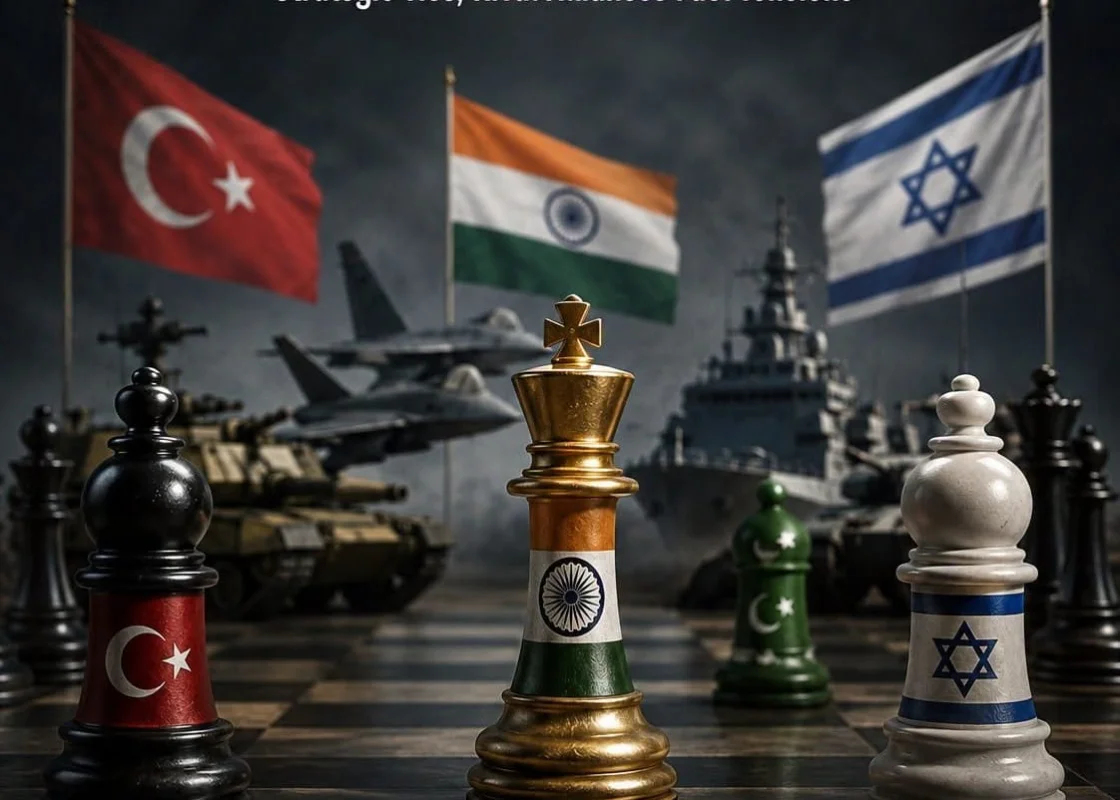
New Delhi: As strategic tensions between Turkey and Israel intensify over developments in Syria and the wider West Asian region, sections of the Turkish media have sought to portray India as part of a broader strategic alignment involving Israel, Greece, Cyprus and the United Arab Emirates. However, such narratives appear to stretch India’s independent foreign-policy choices into a geopolitical equation in which New Delhi has no direct stake.
Recent Turkish media coverage has featured Indian Prime Minister Narendra Modi alongside Turkish President Recep Tayyip Erdogan and Israeli officials, suggesting that India could be linked to an emerging grouping opposed to Ankara. The portrayal comes against the backdrop of deteriorating Turkey-Israel relations and growing competition over influence in Syria and the Eastern Mediterranean.

The latest tensions reportedly followed Israeli strikes on August 18 against the Abu al-Duhur airbase in northwestern Syria. Reports said Israel carried out eight strikes on the facility, located roughly 70 kilometres from the Turkish border, with the objective of preventing the establishment of a Turkish military presence there.
Israel viewed the alleged deployment as a potential security concern, while Turkey denied plans to establish such a forward military position and condemned the strikes. US Ambassador to Turkey Tom Barrack also called for diplomacy and described the Israeli action as an unnecessary escalation.
India Pulled Into a Wider Geopolitical Narrative
Against this backdrop, some Turkish outlets have increasingly highlighted India’s growing defence and diplomatic engagement with Israel and Greece. These reports have also referred to Cyprus and the UAE, presenting the countries as components of a potential strategic grouping that could constrain Turkey’s regional influence.
The narrative has echoes of recent discussions about a proposed “Hexagon of Alliances”, a conceptual framework involving countries across the Indo-Pacific, Gulf and Eastern Mediterranean. A report published in July by Greek-Australian publication Ta Nea similarly pointed to closer strategic links among Greece, Israel, India, the UAE and Cyprus as a potential challenge for Ankara.
Yet describing these expanding partnerships as a formal anti-Turkey alliance risks oversimplifying India’s foreign-policy calculations.
India has steadily expanded defence cooperation with both Israel and Greece, but these relationships are primarily driven by New Delhi’s own security, technology, trade and military-modernisation priorities. Defence agreements, joint exercises and diplomatic engagement do not automatically indicate an intention to participate in a military confrontation involving either country.
Strategic Autonomy Remains Central to India’s Foreign Policy
India has traditionally maintained considerable strategic autonomy and has avoided entering binding military alliances. Its relations with Israel exist alongside important partnerships with Iran and several Arab countries, underscoring the complexity of New Delhi’s approach to West Asian diplomacy.
For India, cooperation with Israel serves several interests, including defence technology, military capabilities, counter-terrorism and innovation. Similarly, stronger ties with Greece reflect India’s expanding engagement with Europe, maritime security interests and economic opportunities.
Neither relationship necessarily translates into an anti-Turkey strategy.
India’s foreign policy is shaped by multiple, often overlapping national interests rather than a single geopolitical bloc. New Delhi has consistently sought room to engage with competing powers without becoming tied to their strategic disputes.
Israel-Turkey Competition Intensifies in Syria
Turkey and Israel, meanwhile, have increasingly found themselves on opposite sides of a complex strategic equation in Syria.

Following the collapse of the Assad government, Turkey emerged as an influential regional actor with close links to Syria’s new leadership. Ankara has sought to protect its security interests and expand its influence in the country.
Israel, for its part, remains focused on preventing hostile military capabilities from taking shape near its borders. Israeli concerns have extended to Turkey’s growing military and political footprint in Syria.
Analysts have noted that the rivalry between Ankara and Jerusalem is becoming an important factor in the evolving balance of power across Syria and the Eastern Mediterranean.
It is against this background that Turkish policymakers may view India’s expanding defence ties with Israel and Greece through a more threatening lens. Ankara’s existing disputes with Athens and its increasingly tense relationship with Jerusalem naturally make India’s engagement with both countries a matter of interest.
India Has Little Incentive to Join a Mediterranean Confrontation
For New Delhi, however, becoming involved in a direct Turkey-Israel confrontation would offer little strategic advantage.
India’s immediate security priorities remain focused on the Indian Ocean, maintaining balanced relations with major global powers, protecting energy supplies and trade routes, and securing access to advanced defence technologies.
A military confrontation in the Eastern Mediterranean would carry substantial diplomatic and strategic costs without offering India a clear national-security benefit.
This makes the portrayal of India as an active participant in an emerging anti-Turkey military coalition difficult to reconcile with New Delhi’s established foreign-policy approach.
Partnerships Do Not Automatically Mean Alliances
The growing interaction between India, Israel, Greece, Cyprus and the UAE is significant, particularly in areas such as maritime security, connectivity, defence, energy and trade. But cooperation among these countries should not automatically be interpreted as evidence of a formal military alliance directed against Turkey.
For India, bilateral and multilateral partnerships are instruments of national interest rather than commitments to participate in another country’s regional confrontation.
The Turkish media narrative therefore appears to say as much about Ankara’s concerns over its changing strategic environment as it does about India’s actual intentions.
As regional alignments evolve, New Delhi is likely to continue pursuing its established policy of strategic autonomy—strengthening partnerships where they serve Indian interests while avoiding commitments that could unnecessarily pull the country into distant geopolitical rivalries.