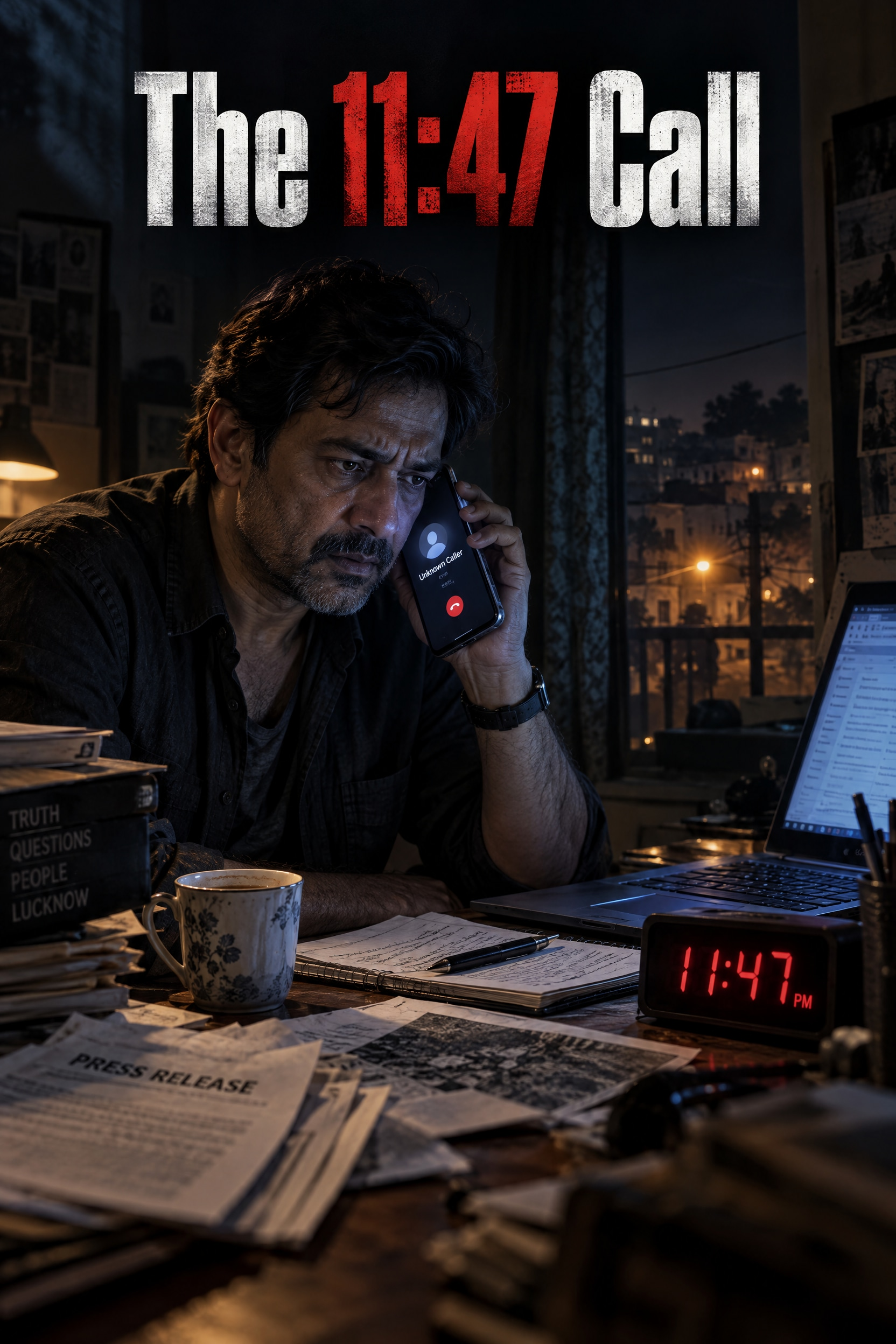
The call came at 11:47 on a Tuesday night, when Lucknow had finally gone quiet. Kabir Sanyal was at his desk in Aliganj with a cold cup of chai, scrolling through an inbox full of press releases and forwards from his aunt. Twenty-two years in journalism had taught him that nothing good arrives after eleven.
His phone buzzed. Unknown number.
“Kabir Sanyal?” The voice was flattened and stretched, as if it had been fed through a machine. “Raghav Bedi will be dead before sunrise. I thought someone should know.”
“Who is this?”
The line clicked off.
Kabir sat for a minute, then laughed at himself. He had received threats, tip-offs and drunk confessions over the years, and this sounded like a prank. He still wrote the name on the back of an envelope, and he did not sleep well.
At 6:10 the next morning, a sirens-and-shouting kind of noise carried up from the street. By 7:00 his editor was on the phone. Raghav Bedi, a retired civil servant, had been found dead in his garden in Gomti Nagar. The police were calling it a heart attack.
Kabir looked at the envelope for a long time.
The second call came four days later, again at 11:47.
“The next one is Surendra Pratap Mishra,” the voice said. “Ask yourself what he and Bedi have in common.”
Mishra was a sitting minister, and he was dead by Thursday. The papers said it was a fall on his own staircase.
Kabir spent the next day in the newspaper’s old archive room, among the smell of damp paper and a ceiling fan that barely turned. It took him three hours to find the thread. Bedi and Mishra had both sat on the oversight committee of something called Project Neelkanth, a government research programme that shut down eighteen years ago after a fire at its facility outside the city. Officially it had studied “behavioural adaptation.” Unofficially, people whispered about memory and manipulation.
He told himself it was a coincidence. Then he remembered that eighteen years ago was also the year his father died, and he stopped telling himself anything.
His father, Anirban Sanyal, had been a chemist. He had died in a road accident when Kabir was twelve, and the family had been told very little. Kabir had spent most of his life with a strange feeling about his childhood, the sense that some memories were too smooth. There was a night at his boarding school he could never quite recall. There were faces he could not place.
He had always put it down to grief. Now he wasn’t sure.
He took what he had to Dr. Meera Vashisht, a forensic psychologist who had consulted on half the difficult cases in the state. Her office was small and tidy, with a single plant on the windowsill that looked like it was being kept alive out of stubbornness.
She listened without interrupting. When he finished, she was quiet for a while.
“Memory isn’t a recording,” she said at last. “It’s a reconstruction. Every time you recall something, you rebuild it, and that makes it editable. If someone wanted to build a method to edit it on purpose…” She shook her head. “I’ve read rumours about Neelkanth. I never thought they were true.”
“The caller isn’t just predicting these deaths,” Kabir said. “He knows too much. He’s either doing it, or he’s close to whoever is.”
“Then you need someone who knows the city,” Meera said. “Someone who was there.”
That someone was Devendra Rathore, a retired inspector with a limp and a habit of answering questions with other questions. He had worked the Neelkanth fire investigation as a young officer and had never forgiven the way it was closed.
“They told us it was an electrical fault,” he said, pouring tea in his kitchen in Chowk. “Forty-one people worked in that building. Eleven bodies were found. You do the arithmetic.”
Over the next two weeks the three of them became an unlikely team. Kabir chased paper trails, Meera built a profile from the pattern of the deaths, and Rathore opened doors that had stayed shut for two decades. They learned that every victim had signed off on Neelkanth’s closure. They learned that the project’s archivist, a woman named Nandita Roy, had vanished a month before the first death.
“She didn’t run,” Meera said, studying the file. “Someone took her. Or she went somewhere very deliberately.”
The next call came on a Sunday, and the voice sounded different. It shook.
“The last one is Harish Vardhan. He signed the order that buried everything. Please. Stop him before I have to.”
Kabir noticed it then: before I have to. He noticed something else too. When he traced the call, it had come from a tower less than a kilometre from his childhood home.


They had Vardhan under quiet protection by Monday evening. It was Rathore who suggested the safehouse, and Rathore who knew the route.
It was Meera who noticed that nothing about the route made sense.
She said it in the car, very softly, while Rathore was out buying cigarettes. “Kabir. Every time we’ve been close to something, it’s gone cold. The warehouse. The records office. Who has known where we were going?”
Kabir didn’t answer. He didn’t have to. When Rathore returned, he saw their faces and stopped, one hand still on the car door.
“I wanted to tell you,” he said finally. His voice was tired rather than angry. “I did. But they have my daughter. They’ve had her for a year. I give them updates, and she stays alive.”
“Who is they?” Kabir asked.
Rathore only shook his head. And then, because he was a man who could not quite bring himself to finish a betrayal, he looked at the floor and said, “The old school. Your school. Go home, Kabir. Whatever you’re looking for is near home.”
The abandoned building stood two streets from the house Kabir had grown up in. The paint had long ago peeled, and the compound wall was draped in creeper. He went in alone at eleven, because he had asked the caller to meet him, and because some part of him already knew.
At 11:47 his phone rang. In the dark, from somewhere ahead, another phone rang too.
“Hello, Kabir.”
The voice came from the room, not the speaker now, and it was no longer distorted. It was an ordinary man’s voice, middle-aged and tired. A figure stepped out of the dark, and Kabir felt the floor drop away beneath him.
It was Anand, a boy from his dormitory. The one who had shared his bread at lunch, the one who had cried the night Kabir’s father died. Kabir had not seen him in thirty years, and he had not thought about him in twenty.
“You don’t remember me properly,” Anand said gently. “That’s all right. They made sure of that. They did it to both of us.”
He told it slowly. Neelkanth had never closed. It had simply moved its subjects into schools, orphanages and hostels, children whose parents asked too many questions or died at convenient times. They had been given new memories, then watched. Anand had broken free eleven years ago, when a fragment of the truth surfaced and refused to stay buried. He had spent a decade piecing himself together and finding the people who had signed the orders.
“I wasn’t trying to kill them at first,” he said. “I just wanted them to say it out loud. But they wouldn’t. And after the first one…” He looked at his hands. “After the first one, I couldn’t stop. I told myself it was justice. Some nights I believe it. Most nights I’m not sure it isn’t just what they trained me to become.”
Kabir stood very still. “My father,” he said.
“He found out what Neelkanth really was. He tried to leave. They stopped him.” Anand’s voice cracked. “You were twelve. They took you in because you were already in the school, and they decided you’d be useful later. A journalist who believed he’d found the story himself.”
“Then why call me?”
Anand almost smiled. “Because I wanted the truth out, and I’m a coward about doing it myself. And because I wanted one person to remember me before it was all over.”
Police sirens were already on the road. Meera had followed, and Rathore, for once, had not stopped her. When the officers came in, Anand did not run. He simply held out his wrists and said, to nobody in particular, “I’d like to make a statement.”
Nandita Roy was found two days later in a locked archive room in a government building, thin and angry and alive. The files she had hidden filled eleven boxes. Vardhan resigned within the week, and the investigations that followed took years.
Kabir wrote the story. It ran across four days and made every front page in the country. It also left him with a quiet, permanent doubt: if some of his memories had been built for him, which of them could he trust? His father’s laugh? The smell of the school corridor? The boy who shared his bread?
He asked Meera that question one evening, on the terrace outside her office, as the lights came on across the city.
“All of them,” she said. “And none of them. That’s true for everyone. You just know it now.”
He stayed there for a long time as night settled over Lucknow, and his phone, for once, stayed silent. He was no longer sure which of his memories were real. But he knew what he had done with the truth once he found it, and for the first time in years, that felt like solid ground.











 https://www.youtube.com/watch?si=RtToJsBhYBatUrym&v=mOuYNSdhjHA&feature=youtu.be