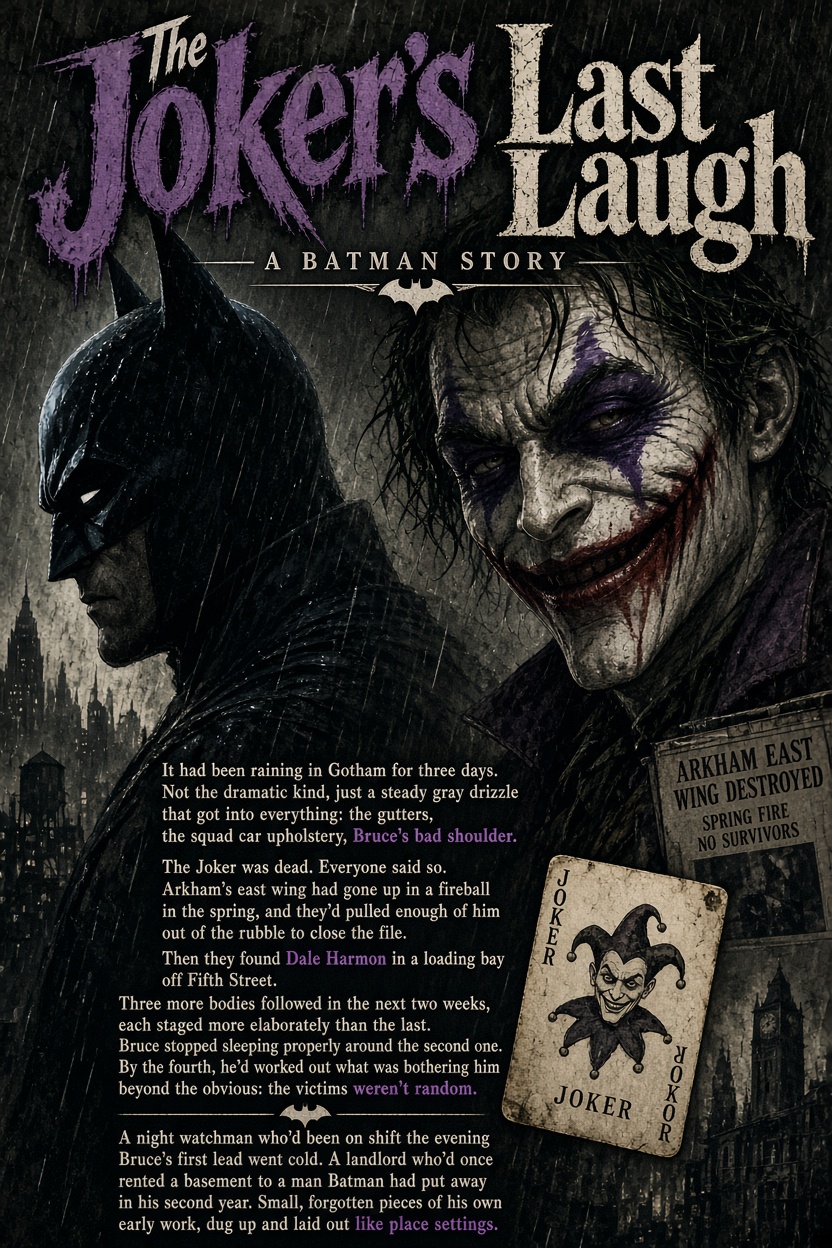
It had been raining in Gotham for three days. Not the dramatic kind, just a steady gray drizzle that got into everything: the gutters, the squad car upholstery, Bruce’s bad shoulder. The Joker was dead. Everyone said so. Arkham’s east wing had gone up in a fireball in the spring, and they’d pulled enough of him out of the rubble to close the file.
Then they found Dale Harmon in a loading bay off Fifth Street.
Somebody had cut a smile into his face, wide and careful, almost neat. A playing card was tucked in his breast pocket, the joker, right side up. Gordon stared at it for a long time and said nothing. He didn’t need to.
Three more bodies followed in the next two weeks, each staged more elaborately than the last. Bruce stopped sleeping properly around the second one. By the fourth, he’d worked out what was bothering him beyond the obvious: the victims weren’t random. A night watchman who’d been on shift the evening Bruce’s first lead went cold.
A landlord who’d once rented a basement to a man Batman had put away in his second year. Small, forgotten pieces of his own early work, dug up and laid out like place settings.
“You haven’t eaten,” Alfred said, setting a tray down beside the keyboard.
“I will.”
“You said that yesterday.” Alfred didn’t push. He just stood there a moment longer than necessary, and Bruce felt it, the thing neither of them was saying. Then Alfred went back upstairs, and the laughter Bruce kept hearing, in the pipes, in the rain, once in his own throat, went on without him.
Gordon was having his own bad month. His detectives had started muttering in the break room, and he’d caught two of them crossing themselves. He told them the Joker was dead and that they were cops, not priests. He believed it, mostly. But every time a new photo landed on his desk, the “mostly” got a little bigger.
The woman showed up on the sixth night, perched on a water tower like she’d been waiting for him. Red and black, face half hidden. The tabloids had been calling her Harlequin for a month, though she’d never said it was her name.
“You’re looking in the wrong places,” she said.
“Am I.”
“He’s not one person anymore, Batman. He never really was.” She shrugged. “I knew him. Before. I can help, or you can keep following the cards until they run out.”
He didn’t trust her. He didn’t trust anyone, and he’d had practice. But she’d named the third victim’s street before he’d told anyone, and that was enough to make him listen.
The clues got stranger. Notes folded into the mouths of the dead. A chalk drawing of Bruce’s old school crest on a warehouse wall. A child’s music box, found at a crime scene, that played a tune he hadn’t heard since he was eight.
Each one was a small cruelty aimed at him alone. Whoever was doing this didn’t want Gotham. They wanted Bruce, and they were taking their time.


It led him, in the end, to Cutter’s Hollow, a carnival on the edge of the city that had gone bankrupt in the nineties and been left to rot. Rust on the ticket booths. A Ferris wheel frozen at an angle. And somewhere in the dark, laughing.
He went in through the funhouse.
Mirrors lined both walls, cracked and filmed with dust, and in every one of them there was a man in a cowl, repeated into the distance. He told himself not to look. He looked anyway. The laughter was louder in here, bouncing, impossible to place. His own breath sounded wrong in his ears.
At the center of the maze was a stage, lit by a single string of flickering bulbs. On it, slumped in a chair, sat the Joker. Purple coat, white face, the whole grin.
Bruce crossed the floor in four strides. Then he stopped.
The thing in the chair was a dummy. Wax and wire and a wig that didn’t quite fit. Strings ran up from its wrists into the rafters, and someone up there let them go slack as he watched. The head rolled forward. The painted smile stayed exactly where it was.
“Do you like it?” a voice said. “I’ve been working on him for months.”
The man who stepped into the light was nobody Bruce recognized. Thin, young, maybe thirty, with the pale, careful look of someone who’d spent a long time indoors. He had studied everything, it turned out. The chemicals, the timing, the jokes, the patience. He’d read every file, watched every tape, and built the whole performance from the outside in. He hadn’t been trying to bring the Joker back. He’d been trying to finish what the Joker started.
“He never got to break you,” the man said, almost sadly. “I’m going to.”
The fight, when it came, was ugly and close. Mirrors went down around them in sheets, and every piece of glass held a different Bruce, a different angle of the same bruised face. The man was good, borrowed-good, all technique and no instinct, and that was the only reason Bruce won. He put him against the stage floor and held him there until the laughing stopped.
It was quiet after that. Just rain on the tin roof and Bruce’s own breathing.
He’d expected to feel something, relief maybe. What he felt was tired. He’d been fighting a mirror, he thought, and the thing in the mirror had looked back at him with a face he almost knew.
Dawn came up gray over Gotham. Bruce stood on the carnival’s broken gate and watched the first police lights come bouncing down the access road. He’d saved the city from one madman. Another would come. That was how this place worked.
He thought about the question that had been circling him for weeks, the one he couldn’t answer. Had the Joker ever really wanted to destroy him? Or had he, in his own twisted way, been getting Gotham ready for a world where Batman wasn’t there to stop the next one?
He didn’t know. The rain kept falling, and somewhere in the city, faintly, he thought he could still hear someone laughing.











 https://www.youtube.com/watch?si=RtToJsBhYBatUrym&v=mOuYNSdhjHA&feature=youtu.be