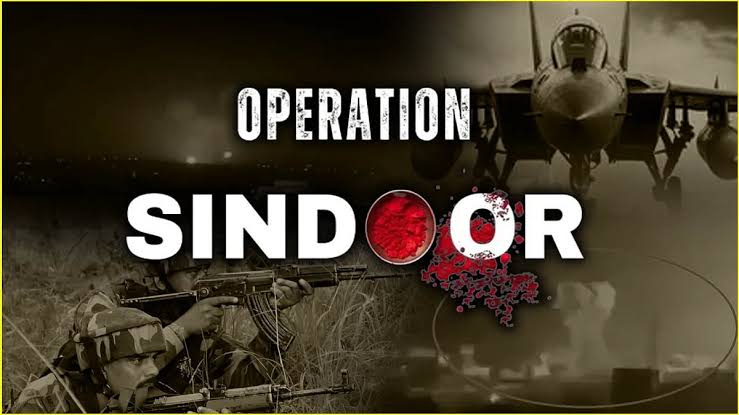
New Delhi: Operation Sindoor, launched by India during the night of May 6-7, 2025, has emerged as a defining moment in the country’s evolving defence strategy, reinforcing a doctrine centred on precision strikes, technological superiority and proactive counter-terror operations.
The military campaign was launched in response to the April 22, 2025 terrorist attack in Pahalgam, Jammu and Kashmir, in which 26 civilians, most of them tourists, were killed. India attributed the attack to Pakistan-based terrorist organisations, including Lashkar-e-Taiba (LeT), Jaish-e-Mohammed (JeM) and The Resistance Front (TRF).
In the opening phase of Operation Sindoor, the Indian Armed Forces carried out coordinated missile, drone and air strikes on nine terrorist infrastructure sites across Pakistan and Pakistan-occupied Kashmir (PoK). According to the Indian government, the initial operation was designed to target terrorist camps, training facilities and logistics hubs while avoiding civilian and military installations.
The strikes escalated into a four-day military confrontation between India and Pakistan from May 7 to May 10, involving long-range stand-off weapons, drones, artillery exchanges and aerial engagements. Hostilities ended following a ceasefire announced on May 10 after diplomatic efforts involving international stakeholders.
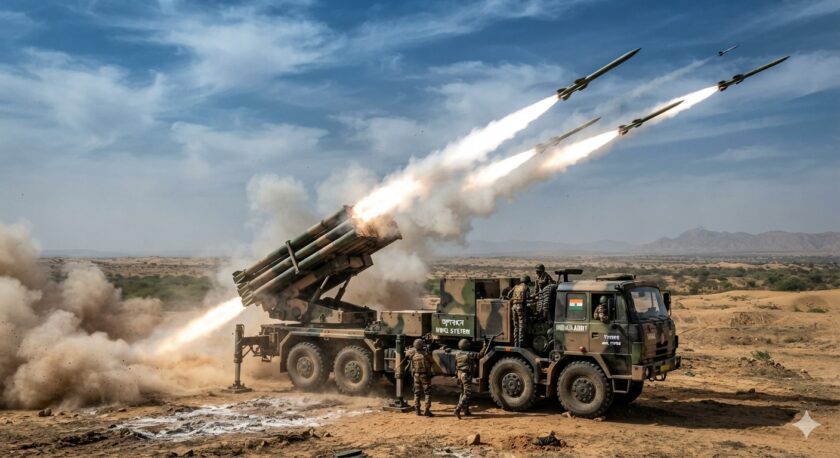
Military analysts have described Operation Sindoor as India’s most sophisticated cross-border counter-terror operation to date. The campaign demonstrated the integrated use of advanced capabilities, including BrahMos cruise missiles, SCALP air-launched cruise missiles fired from Rafale fighter aircraft, loitering munitions, precision artillery, drones and modern air defence systems such as the S-400 and indigenous Akash missile platforms.
The operation also showcased extensive tri-service coordination among the Army, Air Force and Navy, highlighting India’s growing emphasis on joint operational planning and network-centric warfare.
Strategically, Operation Sindoor is widely viewed as an evolution of India’s response doctrine following the 2016 Uri surgical strikes and the 2019 Balakot airstrikes. Defence experts argue that it reflects a lower threshold for calibrated conventional military action against cross-border terrorism while remaining below the level of full-scale war.


Indian leaders have since articulated a policy that makes no distinction between terrorist organisations and those providing them sanctuary or support, signalling a more assertive approach to counter-terrorism. The emphasis has shifted towards deterrence through swift and precise punitive action rather than relying solely on diplomatic or defensive measures.
The campaign has also accelerated India’s defence modernisation agenda under the Atmanirbhar Bharat initiative. Greater investment is being directed towards indigenous weapons systems, artificial intelligence-enabled targeting, unmanned platforms, long-range precision strike capabilities and integrated command structures. Reforms such as specialised combat formations, enhanced border surveillance and proposed theatre commands have gained renewed momentum.
Defence planners believe the operation has demonstrated that carefully calibrated conventional military operations remain possible even between nuclear-armed neighbours, provided escalation is managed through precise targeting and clearly defined objectives.
While India regards Operation Sindoor as a major success that strengthened deterrence and showcased indigenous military capabilities, analysts note that future challenges remain. These include sustaining defence reforms, adapting to rapidly evolving technologies and managing potential crises involving both Pakistan and China.
More than a year after the operation, Operation Sindoor continues to influence India’s strategic thinking, reinforcing a defence posture that prioritises rapid response, technological integration, indigenous capability and credible deterrence in an increasingly complex regional security environment.













 https://www.youtube.com/watch?si=RtToJsBhYBatUrym&v=mOuYNSdhjHA&feature=youtu.be