Dr, Ammar Rizvi, Former Acting CM, Uttar Pradesh
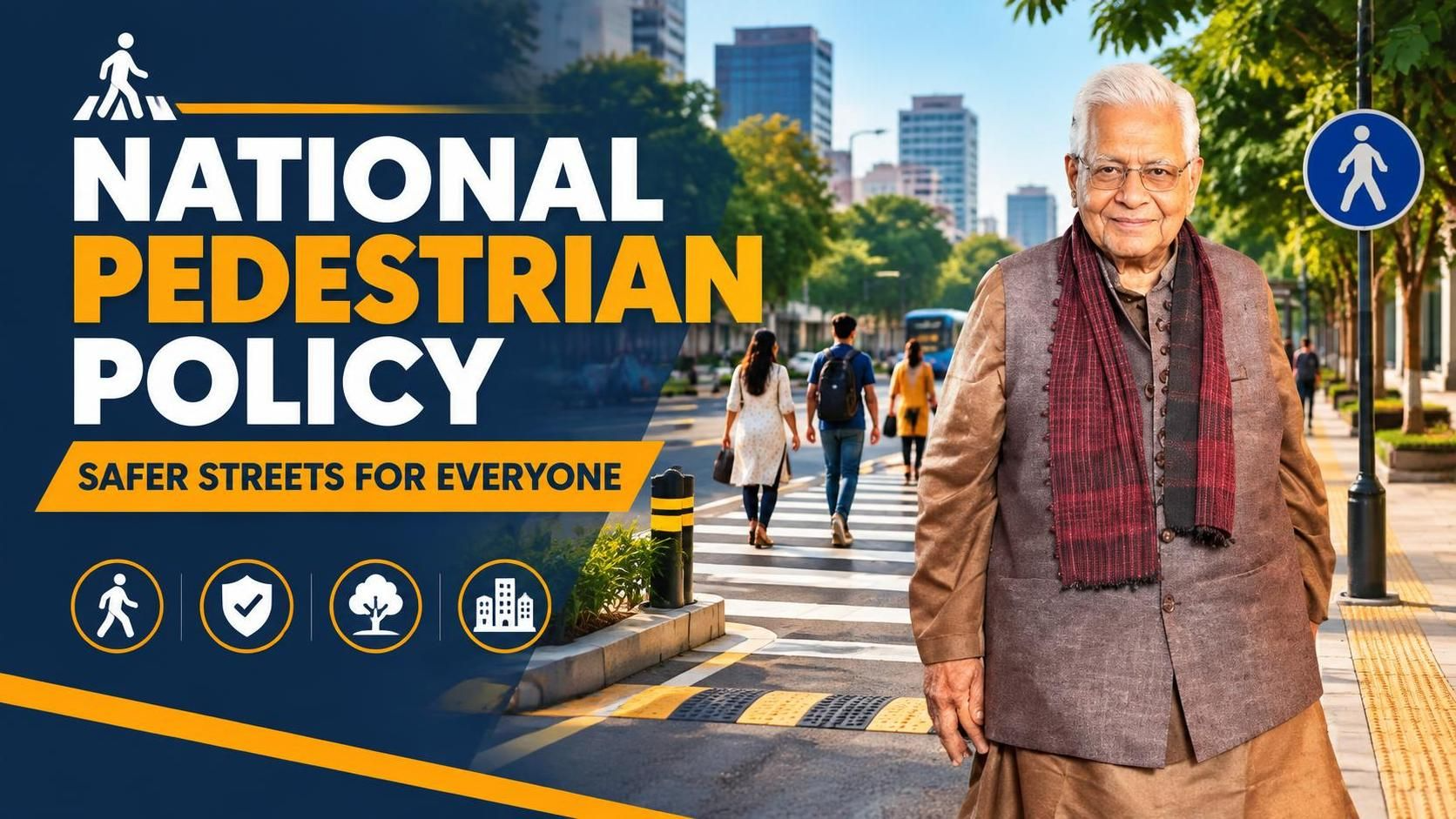
Formulation and effective implementation of a National Pedestrian Policy for a safer, more accessible and people-centric India
The issue concerns every citizen of India, irrespective of age, income, occupation or place of residence—the safety, dignity and right of pedestrians to use our roads and public spaces safely.
Walking is the most basic and universal form of mobility. Every citizen becomes a pedestrian at some point of the day—while going to school, work, a market, railway station, bus stop, hospital, place of worship or public office. Even a person travelling by car, bus, train or metro ultimately becomes a pedestrian at the beginning and end of the journey.
Yet, in many Indian cities and towns, pedestrians remain the most vulnerable users of the road. Footpaths are frequently absent, discontinuous, encroached upon or poorly maintained. Safe crossings are inadequate; pedestrian signals are often insufficient; footpaths may be obstructed by parked vehicles, utility infrastructure, construction material and other encroachments. Elderly persons, children, persons with disabilities and those carrying goods or accompanying small children face still greater difficulties.
The Government of India has already taken several important initiatives relating to urban transport, road safety, accessibility and sustainable mobility. The National Urban Transport Policy and subsequent programmes and guidelines recognise the importance of public transport, non-motorised transport and pedestrian infrastructure. The Ministry of Housing and Urban Affairs has also issued guidelines relating to universal accessibility. However, the present framework would benefit greatly from a dedicated National Pedestrian Policy with clearly defined national objectives, minimum standards, institutional responsibilities, funding mechanisms and measurable outcomes.
Lessons from other countries
Several countries have recognised walking as an important component of their national transport and urban-planning systems and have developed policies, legislation or design frameworks to protect and encourage pedestrians.
- United Kingdom — putting pedestrians at the centre of street design
The United Kingdom provides an important example through its Manual for Streets. The guidance emphasises inclusive street design and calls for pedestrian and cycling networks to be coherent, connected and free from unnecessary obstructions. It also recognises that infrastructure should not merely be technically safe but should be perceived as safe by its users. The UK Government continues to emphasise consideration of people walking in street design and provides guidance to local authorities for pedestrian safety.
- United States of America
The United States of America has a well-established framework of pedestrian safety regulations, although individual states have their own traffic laws. The principal provisions are as follows:-
- Right of way: Motorists are generally required to stop or yield to pedestrians at designated pedestrian crossings.
- Use of footpaths: Pedestrians must use sidewalks wherever available and safe. Where there are no sidewalks, they should generally walk on the left side of the road, facing oncoming traffic.
- Traffic signals: Pedestrians must obey designated WALK and DON’T WALK signals.
- Road crossings: Pedestrians should use marked crossings and intersections. Crossing outside designated areas may require them to give priority to vehicular traffic.
- Motorist responsibility: Drivers must exercise due care, particularly near schools, hospitals, intersections and pedestrian crossings.
- Accessibility: Provision is made for persons with disabilities through accessible crossings, ramps, audible signals and other facilities.
These principles are reflected in guidance from the US National Highway Traffic Safety Administration (NHTSA) and Federal Highway Administration (FHWA).
India could adopt a similar national principle: the design of streets should begin with the needs of people, rather than treating pedestrians as an afterthought after allocating space to motor vehicles.
- Singapore — walking as an integral part of national mobility planning
Singapore provides another valuable example. Its national planning approach explicitly promotes walking, cycling and public transport as sustainable modes of mobility. The Government is expanding walking and cycling infrastructure and has adopted the principle of creating safer, more inclusive and continuous journeys. Singapore’s Active Mobility Act also establishes a legislative framework for public paths and seeks to promote walking and cycling, improve safety and reduce conflicts between motorised and non-motorised users.
Singapore has also required certain major developments to prepare Walking and Cycling Plans, ensuring that pedestrian and cyclist requirements are considered at the planning stage rather than after construction.
- The Netherlands — making vulnerable road users a central element of road safety
The Netherlands is internationally recognised for integrating walking and cycling into its transport and urban environment. Its approach demonstrates the importance of designing the road system around safety, accessibility and the needs of vulnerable road users rather than relying solely upon individual road-user behaviour. The Dutch Government continues to place emphasis on making roads safer for pedestrians, cyclists and motorists through enforcement and behavioural measures.
These international experiences demonstrate that pedestrian safety is not simply a matter of constructing footpaths. It requires an integrated national approach covering street design, land-use planning, road safety, public transport, accessibility, enforcement, traffic management and public awareness.
Suggested elements of a National Pedestrian Policy for India
The Government of India should consider formulating a comprehensive National Pedestrian Policy incorporating, inter alia, the following principles:
- Recognition of pedestrians as priority road users and walking as an essential component of India’s transport system.
- Minimum national standards for footpaths, including minimum effective width, continuity, surface quality, drainage, lighting, accessibility and maintenance.
- Universal accessibility, ensuring that streets and crossings are usable by senior citizens and persons with disabilities, including wheelchair users and persons with visual impairments.
- Safe pedestrian crossings at appropriate intervals, including zebra crossings, pedestrian signals, refuge islands and other appropriate facilities based on traffic and pedestrian volumes.
- Pedestrian-first design at intersections, railway stations, bus stops, schools, hospitals, markets, government offices and other high-footfall locations.
- Removal and prevention of encroachments and obstructions on pedestrian rights-of-way, while ensuring that street-vending and livelihood concerns are addressed through proper planning rather than simply displacing vulnerable groups.
- Integration of pedestrian networks with public transport, so that walking becomes a safe and convenient first- and last-mile connection to buses, metro systems and railway stations.
- Mandatory pedestrian impact assessment for major infrastructure and real-estate projects, particularly large commercial, residential, institutional and transport developments.
- Pedestrian safety audits for major roads and intersections, with time-bound correction of identified deficiencies.
- Protection of school children, including safe school zones, appropriate crossings, traffic calming and safe walking routes to schools.
- Safe walking infrastructure in rural and peri-urban areas, particularly along roads passing through settlements, near schools, markets, bus stops and railway crossings.
- Dedicated funding for pedestrian infrastructure, with appropriate central assistance and incentives for States and Urban Local Bodies that meet national pedestrian standards.
- Performance indicators and public accountability, including regular publication of data on pedestrian infrastructure, pedestrian crashes, fatalities, accessibility and remedial measures.
- Use of technology, including GIS-based pedestrian-network mapping, citizen reporting systems and data-driven identification of dangerous locations.
- Public awareness and enforcement, promoting respect for pedestrian crossings, footpaths and pedestrian right-of-way.
- Providing emergency lanes for Ambulance, Police and Fire Tenders.
A National Mission for Walking

Consideration may kindly be given to establishing a National Mission for Safe and Accessible Walking, under the appropriate Union Ministry, with participation from the Ministry of Housing and Urban Affairs, Ministry of Road Transport and Highways, State Governments, Urban Local Bodies, traffic police, transport authorities, accessibility experts and civil society.
The Mission could establish measurable national targets—for example, the proportion of urban roads having continuous accessible footpaths, the percentage of major intersections with safe pedestrian crossings, reduction in pedestrian fatalities and the percentage of public transport stops having safe pedestrian access.
Such a mission would also complement the Government’s vision of sustainable urban development, improved public transport, healthier communities, cleaner cities and more liveable urban environments.
A question of dignity as well as safety
India is rapidly urbanising and investing heavily in roads, expressways, metro systems, railways and other transport infrastructure. It is equally important that the final few hundred metres of every journey are safe and dignified.
A modern road should not be judged only by the speed at which motor vehicles can travel. It should also be judged by whether a child can safely walk to school, whether an elderly person can cross the road, whether a person using a wheelchair can reach a bus stop, and whether an ordinary citizen can walk to a market, railway station or workplace without being forced into moving traffic.
A National Pedestrian Policy would send a powerful message that the development of India is not merely about building larger roads and faster vehicles, but about creating safer, healthier, more inclusive and people-centred communities.
Following points deserves immediate consideration and implementation:
(a) directing the concerned Ministries to examine the need for a comprehensive National Pedestrian Policy;
(b) constituting an expert committee comprising representatives of the Union Government, States, Urban Local Bodies, road-safety experts, urban planners, accessibility experts and civil society;
(c) preparing uniform national standards for pedestrian infrastructure and pedestrian safety;
(d) establishing a dedicated funding and monitoring mechanism for implementation; and
(e) considering the creation of a time-bound National Mission for Safe and Accessible Walking across India.
(f) Regulation of VIP Movement and Prevention of Unauthorized Road Occupation.
A comprehensive National Pedestrian Policy must also address the difficulties faced by pedestrians during the movement of VIPs, VVIPs and other protected dignitaries. Although security arrangements for constitutional authorities, government representatives and other protected persons are necessary, such arrangements should not result in prolonged or unreasonable restrictions on the movement of ordinary citizens. Excessive road closures, traffic stoppages, diversion of pedestrian routes and the occupation of footpaths by security personnel or accompanying vehicles frequently cause hardship, particularly to senior citizens, women, children, persons with disabilities and patients requiring urgent medical attention.
(g) Prevention of Unauthorized Meetings and Public Gathering on Roads
Another important concern is the unauthorized occupation of public roads, footpaths and pedestrian pathways for political meetings, religious gatherings, social functions, demonstrations and other public events. Such activities, particularly when organized without proper permission or adequate alternative arrangements, obstruct pedestrian movement and compel people, including elderly persons, women and schoolchildren, to walk on busy roads, thereby exposing them to serious safety risks.
Such initiatives would have a profound impact on the everyday lives of millions of Indians and would strengthen India’s commitment to inclusive, sustainable and human-centered development.











 https://www.youtube.com/watch?si=RtToJsBhYBatUrym&v=mOuYNSdhjHA&feature=youtu.be