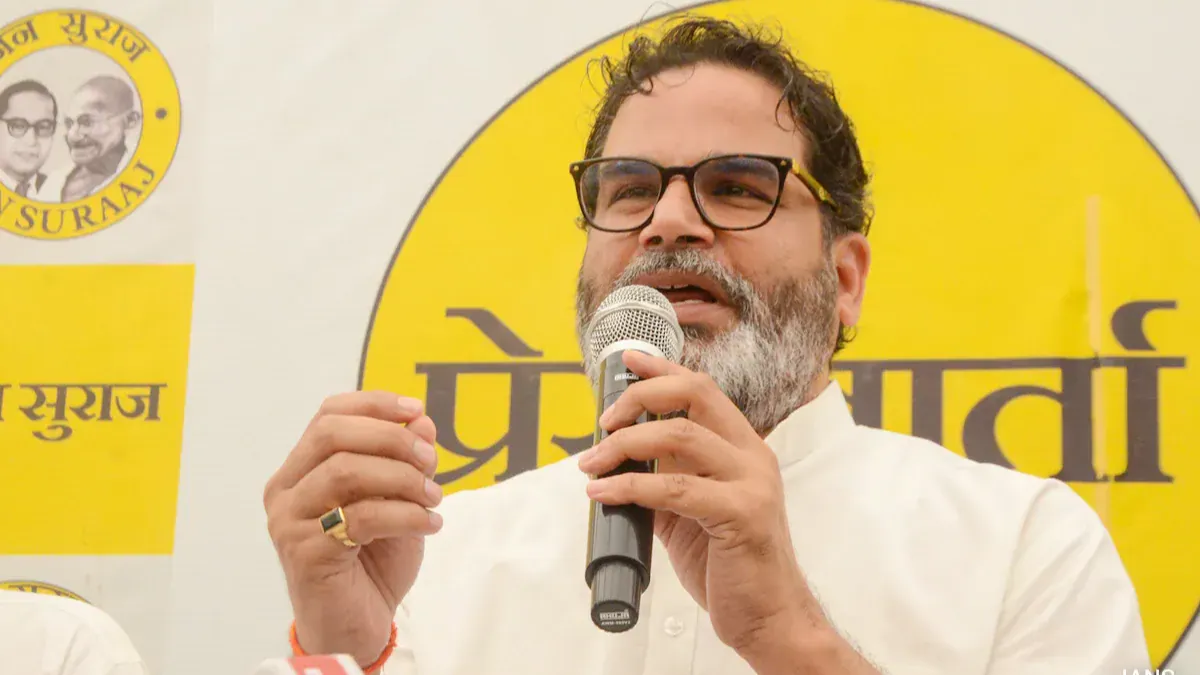
Patna: The Bankipur Assembly by-election in Bihar has evolved into far more than a contest for a single seat. It has become a high-stakes political battle involving the Bharatiya Janata Party (BJP), the Rashtriya Janata Dal (RJD), and Jan Suraaj founder Prashant Kishor, whose political credibility is being tested in his first direct electoral contest.

The election is being closely watched as an indicator of Bihar’s political direction ahead of the next Assembly polls. While the BJP is seeking to retain one of its strongest urban constituencies, the RJD is attempting to consolidate its traditional support base. For Prashant Kishor, however, the by-election represents his biggest challenge yet as he transitions from election strategist to active politician.
The campaign has gathered further momentum following the resignation of senior Jan Suraaj leader Ritesh Ranjan, popularly known as Bittu Singh, who announced his support for the NDA candidate. Singh questioned Kishor’s ability to lead a political party, describing him as an accomplished election strategist but expressing doubts about his political leadership.
Amid these developments, Prashant Kishor has rescheduled his nomination filing to July 13, with Jan Suraaj president Manoj Bharti issuing fresh instructions to party workers to ensure a strong public show of support during the nomination process.
The opposition, meanwhile, is also facing internal challenges. The RJD has fielded Rekha Gupta as its candidate, but her nomination has triggered dissent within the party. Senior RJD leader Surendra Yadav publicly stated that he was unfamiliar with the candidate, while veteran leader Bhai Virendra questioned the selection process. The contest has become more complex with Tej Pratap Yadav’s Janshakti Janata Dal nominating Veena Manvi, a move that could divide opposition votes. Reports of unease within the Congress over the candidate selection process have also fuelled speculation about the strength of opposition unity.
Historically, Bankipur has been one of the BJP’s most secure constituencies. Since the 2010 delimitation, the party has retained the seat continuously. Including the erstwhile Patna West constituency, the BJP has dominated the area since 1995. Veteran BJP leader Navin Kishore Prasad Sinha represented the constituency four times, while his son, Nitin Navin, has won five consecutive Assembly elections.
In the 2025 Bihar Assembly election, BJP candidate Nitin Navin secured 98,299 votes, while RJD’s Rekha Gupta received around 46,000 votes. Jan Suraaj candidate Vandana Kumari managed only 7,717 votes, leaving a gap of nearly 90,000 votes between the BJP and Jan Suraaj. These figures underline the scale of the challenge facing Prashant Kishor.
Rather than opting for a politically safer constituency, Kishor has chosen to contest from one of the BJP’s strongest urban strongholds. He has described the election as an effort to reshape Bihar’s political discourse rather than merely a battle for victory.

His campaign has combined technology-driven outreach with grassroots mobilisation. Volunteers have been engaging residents in parks during the morning, women workers have conducted door-to-door campaigns highlighting issues such as inflation, education and public safety, while evening street meetings and cultural programmes have focused on presenting Jan Suraaj as an alternative to both the BJP and the RJD.
Bankipur’s social composition also makes the contest particularly significant. The constituency has nearly 400,000 voters, with the Kayastha community, estimated to account for around 14 per cent of the electorate, considered a decisive voting bloc. The BJP has nominated Abhishek Kumar, a move widely viewed as an attempt to consolidate this support. The party also enjoys a strong organisational network among traders, upper-caste voters and the urban middle class.
Muslim voters, estimated to comprise 8–10 per cent of the electorate, have traditionally supported non-BJP parties. Political observers believe that any division within the opposition could largely benefit the RJD, which is positioning itself as the BJP’s principal challenger.
Jan Suraaj, meanwhile, is banking heavily on young and educated urban voters by focusing on issues including unemployment, examination paper leaks, migration, traffic congestion, waterlogging, civic infrastructure and education. However, analysts point out that Bihar’s electoral history shows caste-based voting patterns often become more influential than local governance issues during the final stages of campaigning.
The BJP has also intensified its campaign, deploying senior leaders and strengthening its booth-level organisation. Nitin Navin has remained actively involved in constituency-level outreach, reflecting the party’s determination to defend one of its most reliable seats.
For the RJD, the by-election is an opportunity to retain its position as the principal opposition force. For Jan Suraaj, it is a defining political test. In the 2025 Assembly elections, the party fielded candidates in 238 constituencies but secured an overall vote share of only about 2.44 per cent. A significantly improved performance in Bankipur—even without winning the seat—could strengthen Prashant Kishor’s claim of emerging as a viable political alternative. Conversely, a weak showing would raise fresh questions about the party’s organisational strength and electoral appeal.
Regardless of the outcome, the Bankipur by-election has become a symbolic contest with implications extending well beyond one Assembly seat. For the BJP, it is a test of its organisational dominance in an urban stronghold. For the RJD, it is an opportunity to reinforce its opposition credentials. For Prashant Kishor, it is the most significant examination yet of whether a successful political strategist can transform himself into a mass leader capable of challenging Bihar’s established political order.